
 English

UAE food import regulations for fresh produce: Key rules
Federal food-safety requirements set the UAE-wide baseline, but emirate-level approvals and documentation processes differ. In 2026, UAE food import...

Federal food-safety requirements set the UAE-wide baseline, but emirate-level approvals and documentation processes differ. In 2026, UAE food import regulations for fresh produce therefore depend on both the product’s requirements and the emirate receiving it. Release at the first port doesn’t automatically settle the requirements for moving a shipment to another emirate.
For fresh fruits and vegetables, phytosanitary certificates, treatments, and quarantine conditions can depend on the commodity and its country of origin. Product registration, consignment release, certificates, and storage arrangements also affect how an import proceeds.
This guide explains how the federal framework works alongside emirate procedures, what can change requirements for a particular product, and how agricultural standards and Dubai food registration affect imports. It offers a practical overview of the rules that shape shipment preparation and movement through the UAE market.
Key Takeaways
- Plan for a shared federal food-safety framework alongside emirate-specific approval and documentation procedures.
- Identify the destination emirate and receiving port early, especially if the shipment may move between emirates.
- Match phytosanitary and quarantine requirements to the produce type and country of origin.
- For Dubai, treat product registration and consignment release as separate steps; registration alone does not clear a shipment.
- Review pesticide-residue standards, certificates, and shipment records as part of fresh produce import planning.
Dubai food registration and consignment release
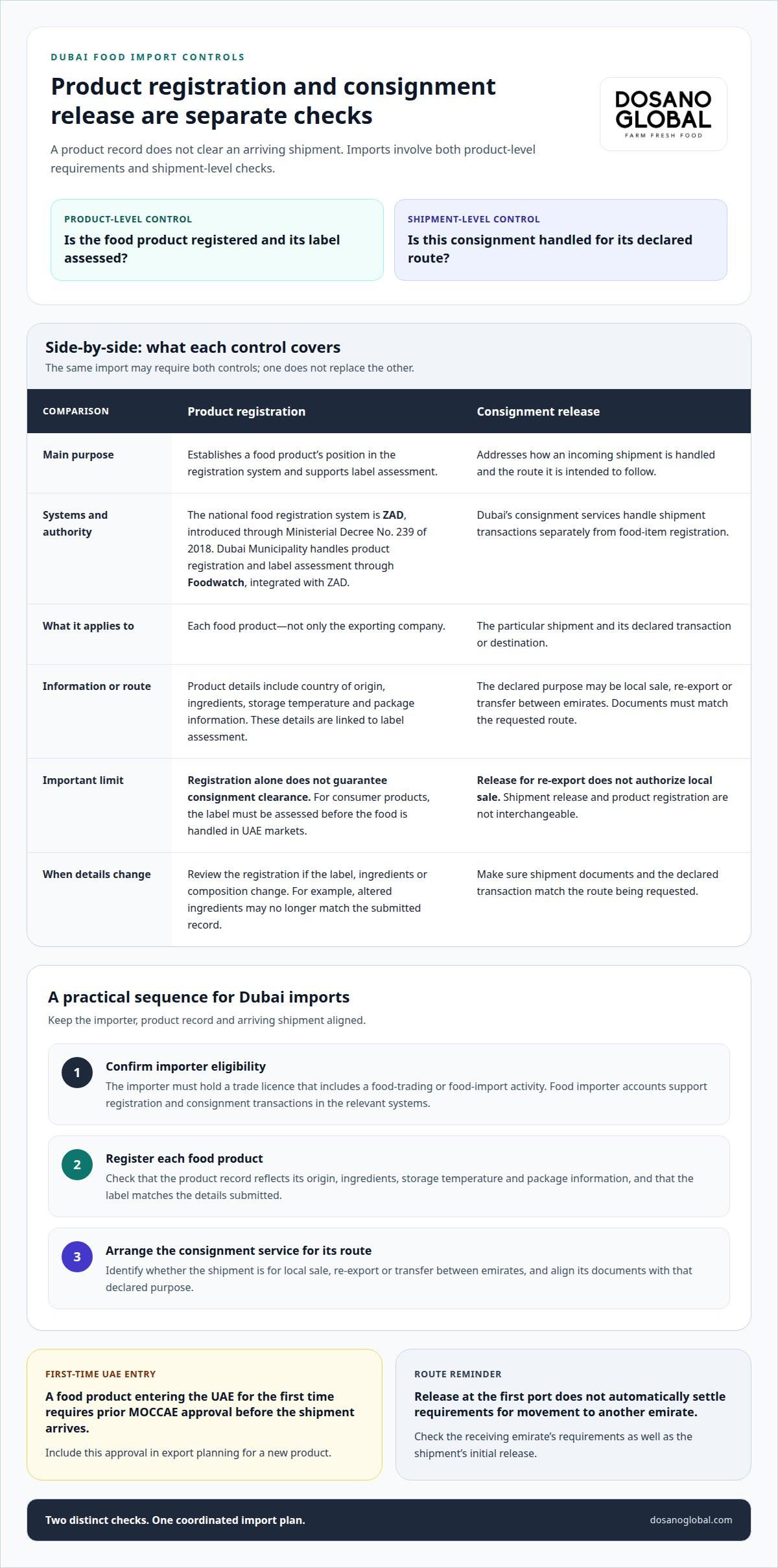
Dubai treats food product registration and consignment release as separate controls. The UAE’s national food registration system is ZAD, introduced through Ministerial Decree No. 239 of 2018. Dubai Municipality handles product registration and label assessment through Foodwatch, which is integrated with ZAD. Registration establishes a product’s position in the system; it does not automatically clear an arriving consignment. The import process therefore involves product-level requirements and shipment-level checks.
Begin by confirming the importer’s eligibility to trade food in Dubai. The importer must hold a trade licence that includes a food-trading or food-import activity. Food importer accounts support registration and consignment transactions in the relevant systems. The licence activity and account used for an import should align with the responsible UAE business. This step comes before export planning: shipment documents cannot replace the importer’s required Dubai food-trading licence.
Product registration applies to each food product, not just to the exporting company. The registration record requires product details such as country of origin, ingredients, storage temperature, and package information. These details are linked to the label assessment. If the label, ingredients, or composition change, review the registration. For example, a product with altered ingredients may no longer match the details previously submitted.
ZAD provides the national registration framework, while Dubai’s Foodwatch process supports local registration and label assessment. For consumer products, the label must be assessed before the food is handled in UAE markets. Dubai product registration and market handling are not interchangeable with approval for a particular consignment. The UAE food import regulations for fresh produce in 2026 therefore require attention to both the product record and the shipment’s intended route.
First-time imports involve an additional approval requirement. A food product entering the UAE for the first time requires prior MOCCAE approval before the shipment arrives. Account for this in export planning, especially when introducing a new product. Registration records should also match the product presented at import, including its origin, package details, and storage temperature.
Consignment services address a separate question: whether a shipment is handled for local sale, re-export, or transfer between emirates. Dubai treats these services separately from food-item registration. A consignment released for re-export is not thereby authorized for local sale. Likewise, product registration does not guarantee consignment clearance. Shipment documents and the declared transaction must match the requested route.
For fresh produce, the registration record covers product origin and storage information, while the consignment process concerns the incoming shipment and its intended destination. Keep these stages distinct when planning an import: establish the importer’s licensed activity, register each product, and arrange the appropriate consignment service. If the product is entering the UAE for the first time, obtain prior MOCCAE approval before arrival.
Q: Are food import regulations the same across all UAE emirates?
The UAE has a shared federal food-safety framework, while emirate authorities manage operational approvals and inspections. Core standards are consistent, but documentation and release procedures can differ by destination.
Federal Food-Safety Rules
Federal Law No. 10 of 2015 requires imported and locally sold food to meet national safety and quality standards, with MOCCAE approval required for food imports. This federal framework gives importers and distributors a common baseline for food safety, regardless of the emirate receiving the goods. It matters because port release alone does not replace federal requirements or establish compliance for every later transaction.
Cabinet Resolution No. (26) of 2017 provides the Executive Regulations for Federal Law No. (10) of 2015 on Food Safety. Together, these measures form the national framework behind controls such as food documentation, labeling, and pesticide-residue requirements. For a shipment originating overseas, the federal rules apply before emirate-specific handling begins.
Emirate-Level Procedures
Emirate-level procedures include the local services, approvals, and inspections used to apply federal food rules. They matter when a shipment enters one emirate but is intended for sale or transfer elsewhere. Authorities may request different documents or use distinct release processes, so the receiving emirate remains relevant after initial customs handling.
For example, Sharjah has a separate food-consignment release service. Ajman’s inter-emirate food-release service lists a federal ZAD no-objection certificate among its documents. Abu Dhabi uses FIEMIS through its Advanced Trade and Logistics Platform for company and product registration, import requests, and shipment controls. These examples show why the destination and route affect the procedure.
Assess a consignment moving between emirates against the receiving emirate’s requirements, not only the first port’s release. For example, produce entering through one emirate for another market may be subject to an additional local process. This can affect the sequence of approvals and the documents accompanying the shipment.
Food Authorities Across Levels
Federal and emirate authorities have connected but distinct roles. MOCCAE operates within the federal approval framework, while emirate bodies handle local processes. In Abu Dhabi, the Abu Dhabi Agriculture and Food Safety Authority oversees food product registration. Dubai Municipality and Sharjah authorities administer their respective local procedures.
This division matters for import planning because the responsible authority depends on the emirate and transaction. Abu Dhabi’s FIEMIS route, for example, includes shipment controls alongside registration and import requests. Local services elsewhere use different processes, even though the national food-safety baseline is shared.
In practical terms, identify the importing emirate, the receiving port, and any onward destination before finalizing shipment documentation. Then align the route with the relevant emirate process while meeting Federal Law No. 10 of 2015. This approach helps avoid treating an initial customs or food release as automatic approval for movement or sale across the UAE.
Product decision tree: what changes the requirements?
Requirements for fresh produce depend on the commodity, its country of origin, and its intended market. The UAE does not apply one universal phytosanitary condition to every product or exporting country. Certificates, treatments, and quarantine conditions vary by commodity and origin.
Phytosanitary and Quarantine Requirements
Phytosanitary requirements are plant-health controls that may involve certificates, treatments, or quarantine measures for imported produce. They matter because a change in origin and associated pest risk can change the conditions for the same commodity.
The UAE plant quarantine decree, identified as 824:2015, lists quarantine pests that are prohibited and non-quarantine pests that may be permitted under specified conditions. This makes the combination of produce type and country of origin central to import planning. A certificate alone does not remove a quarantine restriction if the commodity or origin falls under specific conditions.
For example, fresh fruit from one origin may face different treatment conditions from the same fruit sourced elsewhere. The product and its origin determine the relevant certification and inspection pathway. Abu Dhabi and other emirates operate within this framework, while local import processes may determine how documents are submitted.
Shelf-Life Requirements at Entry
Shelf-life rules specify how much usable life must remain when a covered food product enters the UAE. They matter for retail planning because the expiry date on arrival affects the time available for distribution and sale.
UAE food-import guidance commonly requires 50% to 75% of a product’s total shelf life to remain at import. The applicable share depends on the product category. For a product with a 12-month shelf life, the example requirement is at least 6 to 9 months remaining upon arrival.
UAE.S 150-1:2017 sets mandatory food expiration-date requirements. If remaining shelf life falls short of the requirement for its category, a shipment may be rejected. The product’s total shelf life and the time elapsed before UAE entry therefore affect compliance.
Origin and Product Restrictions
Origin and product restrictions depend on the commodity, its source, and specific plant-health risks. Some products may be prohibited or require permits rather than routine food-import documentation.
Importing paan, or betel leaves, into the UAE is prohibited. Agrochemicals and seeds require specific permits from customs authorities. These restrictions differ from the phytosanitary conditions applied to fresh fruits and vegetables, so classify the product before export.
Food additives create another product-specific decision. UAE.S 192 regulates permitted additives under Cabinet Resolution No. 60 of 2019, and titanium dioxide, E171, has been banned as a food additive in the UAE since 2023. For fresh produce, additive rules become relevant when the product is prepared or contains added ingredients. A municipality’s retail requirements and the product’s expiry date can also depend on its classification.
Agricultural product standards
Imported fresh produce must meet UAE requirements for pesticide residues and food safety. UAE.S MRL 1 specifies maximum limits for pesticide residues in agricultural and food products, while the applicable limit depends on the pesticide and product combination.
There is no single residue threshold for every fruit or vegetable. UAE standards set product-specific limits, so produce safety depends on the residues present and the relevant crop category. The country of origin does not replace these requirements: produce entering the UAE market must meet the applicable national standard.
The UAE Food Safety Law covers procedures for importers, retailers, and suppliers, including pesticide residues and labeling. Cabinet Resolution No. (26) of 2017 provides the Executive Regulations for Federal Law No. (10) of 2015 on Food Safety. These federal rules connect agricultural quality with the controls that apply to food supplied within the UAE.
Commodity standards can add another layer. UAE.S GSO 465 is cited as a standard for citrus fruits entering the UAE market. This gives importers a crop-specific reference alongside the general pesticide-residue framework. Product identity therefore matters: citrus and other produce should not be treated as interchangeable categories when applying standards.
Origin and ingredients also affect how product information is recorded. Where unprocessed agricultural products contain genetically modified organisms, UAE.S GSO 2141:2011 applies when GMO content is greater than 1%. This threshold concerns the ingredients of the product, making accurate composition information relevant to classification and compliance.
Labels provide a separate, visible part of food-safety compliance. UAE.S GSO 9:2019 is the general prepackaged-food labelling regulation and applies to food shipped in bulk and retail packaging. For products sold to consumers, UAE labels must include the product name, ingredients in descending order of weight, allergen declarations, country of origin, manufacturer details, production and expiry dates, storage instructions, and net weight or volume.
Arabic information is central to UAE consumer labels, alongside English. The product label should accurately reflect its ingredients and origin, rather than rely on generic artwork. This matters when an import comes in multiple pack formats or its composition changes. Accurate labeling links the product presented for sale with the standards and information recorded for that food.
For a practical standards review, first identify the produce category, then assess the relevant pesticide-residue requirements and any commodity-specific standard. Next, align the origin, ingredients, and label details with the product being imported. This helps distinguish the federal food-safety baseline from additional requirements for particular crops and packaging formats.
Fresh produce import rules
Fresh produce shipments require documents, suitable handling, and traceable product information. There is no single customs-duty, VAT, or inspection-fee figure for every shipment: applicable charges depend on the product classification and import transaction. Dubai’s food controls include document review, examination, and testing.
Build the shipment file around the product and its export origin. UAE food consignments require a health certificate and certificate of origin issued in the exporting country. Import documentation also includes the commercial invoice, packing list, and product registration documents. Together, these records identify the produce, its source, and the intended import transaction.
Phytosanitary or quarantine conditions for fresh fruits and vegetables depend on the commodity and origin. The required certificate or treatment can therefore differ between shipments of the same produce from different countries. Confirm the applicable requirements before shipping so the consignment’s declared contents match its supporting documents.
Handling is part of compliance for perishable shipments. Temperature-controlled logistics help prevent spoilage and preserve produce quality during transit and storage. Packaging matters too: export-grade packaging helps reduce contamination and bruising, while clear identification supports accurate product and origin information. Differences between the package and shipment records can complicate inspection.
Traceability depends on records from each stage of the supply chain. UAE food producers and importers must document that chain. For shipments passing through several handling points, records should connect the produce’s origin with its movement and destination. UAE authorities conduct inspections at ports, warehouses, and retail outlets, so consistent records matter beyond arrival.
The shipment’s emirate and purpose also determine its release route. Dubai separates consignment services for local sale, re-export, and inter-emirate transfer. Release for re-export does not authorize local sale. The declared transaction, destination, and accompanying documents should therefore describe the same route, rather than treating one emirate’s release as automatic approval elsewhere.
Packaging format changes the information requirements. UAE.S GSO 9:2019 applies to food shipped in bulk and retail packaging, while consumer packs need label details suited to sale. Arabic and English information should match the produce and its sales format. Halal certification concerns applicable meat and animal-derived products, not ordinary fresh fruits and vegetables; keep certificates relevant to the shipment.
For a thorough pre-shipment review, align four elements: produce and origin, certificates, packaging and labels, and the receiving emirate’s release route. This keeps the physical shipment, its paperwork, and its declared purpose consistent from export through inspection and onward distribution.
The total is specific to each shipment: applicable charges vary with the product classification and import transaction. Dubai food checks may include document review, examination, and testing.
Dosano Global
Dosano Global supplies fruits, chillis, and vegetables to businesses in the United Arab Emirates. Once the importing emirate, product requirements, and shipment route are clear, Dosano Global can help source fresh produce for your business. Share your produce requirements and intended destination to discuss a supply plan aligned with your trade needs. The importer remains responsible for the regulatory process, so establish the applicable requirements before arranging the shipment. Contact Dosano Global to discuss your fresh produce sourcing needs.
Turn import planning into a sourcing decision
Use the UAE food import regulations for fresh produce in 2026 as an early commercial filter, not a final paperwork task. Before confirming a buying plan, align the produce category, origin, pack format, intended emirate, and route with your market requirements. This creates a clearer basis for assessing whether a product fits your distribution plans and what information needs to accompany it. Define the intended market first, then shape the product brief and coordinate sourcing around those requirements.
If you are planning a broader food portfolio, define a role and destination for each product category. Dosano Global supplies meat alongside fresh produce, giving buyers the option to consider both in their trade plans. A focused sourcing discussion can turn your market priorities into a practical product brief. Keep the intended sales format and destination in view so sourcing decisions stay connected to your commercial objectives.
When you’re ready to discuss your requirements, contact Dosano Global about your sourcing needs. A clear brief is a confident starting point for your next trade decision.
Frequently Asked Questions
What happens if a product fails to meet UAE import requirements?
A non-compliant food shipment may be detained at port, returned to its country of origin at the importer’s expense, or destroyed. The outcome depends on the issue and the shipment’s status. Missing documents, an applicable plant-health restriction, or failure to meet required product standards can prevent release. Arrival alone does not authorize sale or distribution in the UAE.
What certification do you need to export food to the UAE?
No single certificate applies to every food shipment. Fresh produce may require a phytosanitary certificate or treatment, depending on the commodity and origin. Consignments also require health certificates and certificates of origin issued in the exporting country. Halal evidence applies to relevant products or claims. The required certification documents depend on the product category, exporting origin, local authority, and transaction.
Why do food shipments get rejected in the UAE?
Shipments can be rejected if they fail product requirements or arrive with incomplete or inconsistent documents. For example, conflicting shipment details, unmet quarantine conditions, or shelf life below the category requirement can prevent entry. Product registration does not guarantee consignment clearance. Authorities may also examine or test imported food as part of documentary and physical controls.
What are the UAE import requirements for fresh fruits and vegetables in 2026?
The UAE food import regulations for fresh produce in 2026 depend on the commodity, country of origin, and destination emirate. Importers need applicable health and origin certificates, plus phytosanitary documentation or treatment where required. The shipment must meet UAE food-safety standards and follow the relevant emirate’s release process. Perishable produce also needs handling and storage appropriate to protect it during transit and after arrival.
Which UAE authorities regulate fresh produce imports and what approvals are required?
MOCCAE is part of the federal food-import approval framework, while emirate authorities administer local procedures and inspections. Dubai Municipality handles Dubai food registration and consignment services; Abu Dhabi uses FIEMIS for import requests and shipment controls. Required approvals depend on the product and route. Food entering the UAE for the first time requires prior MOCCAE approval before arrival.
What documents are needed to import fresh produce into the UAE, including phytosanitary and origin certificates?
A typical food-import file includes a commercial invoice, packing list, health certificate, certificate of origin, and product registration documents. The health and origin certificates must be issued in the exporting country. Fresh produce may also require phytosanitary certification, treatment, or quarantine documentation, depending on the commodity and origin. The file should describe the same produce, source, and shipment as the goods presented for inspection.
Which fresh produce imports require permits, pest-risk assessments, or additional treatments in the UAE?
Phytosanitary conditions vary by produce type and origin, so the required certificate, treatment, or quarantine measure is commodity-specific. The UAE plant quarantine decree, 824:2015, lists prohibited quarantine pests and non-quarantine pests that may be permitted under conditions. Seeds and agrochemicals require specific permits from customs authorities. Paan, or betel leaves, is prohibited through normal food-import routes into the UAE.
What are the UAE packaging, labeling, and shelf-life requirements for imported fruits and vegetables?
Food packaging requirements include UAE.S GSO 839:2021, and UAE.S GSO 9:2019 covers food labeling for bulk and retail packaging. Consumer labels must provide required product details in Arabic and English. Shelf-life requirements depend on product category: import guidance commonly requires 50% to 75% of total shelf life to remain at entry. A 12-month product, for example, should arrive with at least 6 to 9 months remaining.