
 English

Raw Meat Receiving Procedures for UAE Restaurants: A Reference
Reliable raw meat receiving procedures for restaurants in the UAE start with checking every delivery, inspecting the product and recording its...

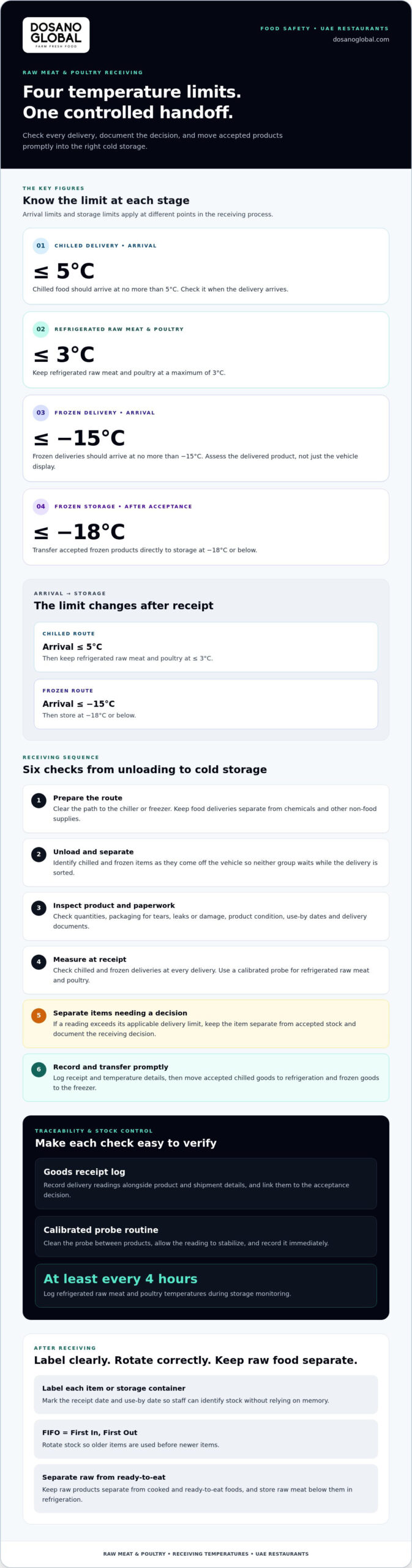
Reliable raw meat receiving procedures for restaurants in the UAE start with checking every delivery, inspecting the product and recording its temperature. Chilled deliveries should arrive at no more than 5°C, while frozen deliveries should arrive at no more than -15°C; refrigerated raw meat and poultry should be kept at a maximum of 3°C. Transfer accepted items to the appropriate cold storage promptly.
Receiving meat and poultry takes more than a quick temperature check. Packaging condition, quantities, use-by dates and delivery records all help staff decide whether to accept a shipment and maintain traceability. This guide explains how to inspect chilled and frozen deliveries, use a calibrated probe, record checks, label receipt and use-by dates, and rotate stock using FIFO. It also shows how to move products efficiently into storage while keeping raw items separate from cooked and ready-to-eat food.
Key Takeaways
- Set up receiving so meat can be inspected and moved promptly into the correct cold storage without crossing food preparation routes.
- Use a calibrated probe and keep a goods receipt log to document delivery temperature checks and support traceability.
- Label stock with its receipt date and use-by date, then rotate it so older items are used first.
- Inspect quantities, packaging, product condition, dates and delivery documents before accepting meat or poultry.
- Keep raw products separate from cooked and ready-to-eat foods, and store raw meat below them in refrigeration.
Chilled and frozen delivery transfer
A chilled delivery is food kept cold but not frozen during transport. For UAE restaurant deliveries, chilled food should arrive at no more than 5°C. Refrigerated food should then remain at 5°C or below. A frozen delivery is food transported in a frozen state. Frozen deliveries should arrive at no more than -15°C, then move into storage at -18°C or below.
Delivery transfer is the controlled movement of food from the vehicle to the correct storage area. Keep the receiving route clear, inspect products promptly and avoid leaving chilled or frozen goods at room temperature while staff handle other tasks. A receiving station near cold storage shortens the transfer and makes it easier to sort deliveries without crossing preparation routes.
Use this sequence for each chilled or frozen delivery:
- Prepare the route. Clear the path from the unloading point to the chiller or freezer. Keep food deliveries separate from chemicals and other non-food supplies.
- Unload and identify. Separate chilled items from frozen items as they come off the vehicle. This prevents a mixed delivery from waiting while staff sort it.
- Inspect each group. Check packaging for tears, leaks, or damage, and compare items with the delivery documentation. Set aside any item requiring a receiving decision rather than placing it directly into storage.
- Check temperatures. Assess chilled and frozen deliveries at receipt, using a suitable temperature-checking method. Compare chilled food with the 5°C maximum and frozen food with the -15°C delivery maximum.
- Sort by storage destination. Move accepted chilled products to a refrigerator or walk-in chiller. Transfer frozen products directly to the freezer, where food should be held at -18°C or below.
- Complete the transfer. Record the receipt and temperature details, then make sure products are stored in their designated areas. Avoid leaving cartons beside the receiving table after the check.
Frozen food storage means keeping products at a consistent frozen temperature after receipt. A freezer set to maintain -18°C or below supports that storage limit; checking the display alone does not replace checking the delivered product. Keep stock organized so staff can identify each item without unnecessary door opening or handling.
For example, if a delivery contains chilled meat and frozen poultry, inspect and separate the two groups as they are unloaded. Check each against the restaurant’s applicable delivery limits, then move the chilled meat to refrigeration and the poultry to the freezer. This creates a clear acceptance point and a direct route into cold storage.
Raw meat and poultry receiving temperatures
Temperature control means keeping raw meat and poultry within safe limits from transport through storage. Chilled food should arrive at no more than 5°C, refrigerated raw meat and poultry should be kept at a maximum of 3°C, and frozen deliveries should arrive at no more than -15°C. Frozen storage should remain at -18°C or below.
The core temperature benchmarks are consistent across the UAE, although local food codes can add operational detail. For chilled and frozen meat, use the arrival limits above, then apply the 3°C maximum to refrigerated raw meat and poultry.
Temperature Control During Transport
Temperature control during transport means maintaining the required product condition from dispatch through restaurant receipt. A documented approach to raw meat receiving procedures for restaurants across the UAE should account for the journey and handover, not just the vehicle’s starting temperature. Minimize unloading delays, prepare the inspection area in advance and move products into storage promptly after assessment.
Keep chilled and frozen goods separate while staff inspect each group. Protect products from direct sun and warm kitchen routes. For example, separate chilled cartons from frozen ones as they are unloaded, so neither group waits while staff sort the rest of the delivery.
Delivery Temperature Checks
A delivery temperature check is a measurement taken when food arrives. Check chilled and frozen deliveries at every delivery, and assess refrigerated raw meat and poultry against its 3°C maximum. Check chilled and frozen deliveries on arrival, then move accepted items promptly to appropriate cold storage.
Arrival and storage limits apply at different stages. A frozen delivery at -15°C is not the ongoing storage target: transfer accepted frozen goods to storage at -18°C or below. If a reading exceeds its applicable delivery limit, keep the item separate from accepted stock and document the receiving decision.
Temperature Logs and Calibrated Probes
A temperature log records readings alongside delivery and product details. Use a calibrated probe to monitor refrigerated raw meat and poultry, and enter delivery readings in the goods receipt log. Raw meat receiving procedures for restaurants across the UAE should make it easy to link each record to the specific shipment, product and acceptance decision.
Use a consistent routine: clean the probe between products, allow the reading to stabilize, and record it immediately. Log refrigerated raw meat and poultry temperatures at least every 4 hours during storage monitoring. Clear entries help staff identify recurring temperature-control issues and review the receiving process.
Date labelling and FIFO rotation
A stock label records when food arrived and when it should be used by. For restaurant meat and poultry, mark the receipt date and use-by date on each item or its storage container. Clear, readable labels help kitchen staff identify stock without relying on memory or opening multiple packages.
FIFO means “First In, First Out”: use older stock before newer stock. Apply it when a delivery adds a product already in inventory. Place newly received items behind older stock, or move older items to the front. This makes the next item to use easy to identify and reduces the chance of newer stock being taken first.
FEFO means “First Expired, First Out”: use the item with the earliest use-by date first. Apply FEFO when dates differ, even if the item with the earlier date arrived later. FIFO and FEFO work together: arrange stock by date, then prioritize the nearest use-by date when selecting items.
Use a consistent sequence when labelling and storing incoming stock:
- Read the package. Identify its product name and use-by information before placing it into storage.
- Mark receipt. Add the date the restaurant received the item. Keep the receipt date distinct from the use-by date.
- Make the label visible. Place it where staff can read it while the item remains stored, without unnecessary handling.
- Position stock for rotation. Move older items forward and place the new delivery behind them. If a newer arrival has an earlier use-by date, place it where FEFO selection makes it clear.
- Check dates during selection. Before preparation, compare the item’s label with the other stock and select the earliest use-by date first.
For example, if a new package arrives while an older package of the same product remains in the chiller, label both with their receipt and use-by dates. Under FIFO, make the older arrival easiest to access. If the newer package has an earlier use-by date, FEFO takes priority, so staff use that package first.
Date labels also support traceability. If staff need to review a delivery, the receipt date helps link stored stock to receiving records. Keep labels legible as products move between storage positions, and replace any detached or unreadable label using the original date information.
Prepared food needs its own date information: label it with production and expiry dates. Keep these labels distinct from raw meat receipt labels, so staff can tell whether a date refers to preparation or delivery. A daily stock review can flag items nearing their use-by date and guide the next FIFO or FEFO selection.
Meat and poultry receiving
Use approved suppliers and maintain receiving records as part of food safety controls. Staff should unload raw products separately, inspect them at a dedicated station and prevent contact with ready-to-eat food.
Food Safety Regulations for Receiving Meat
Food safety rules for receiving meat cover approved sourcing, safe handling, and control of hazards. Restaurants should purchase food only from approved suppliers and keep delivery records that support traceability. The UAE food safety temperature danger zone is 5°C to 63°C, so receiving procedures should limit exposure within that range.
The Ras al Khaimah food code identifies UAE.S GSO 1694: 2005 as the General Principles of Food Hygiene standard. It also lists UAE.S GSO 1909: 2009 for handling ready-to-eat foods. These identifiers help teams distinguish general hygiene principles from controls that protect ready-to-eat items during receiving and storage.
Staff Hygiene, PPE, and Training
Staff hygiene means handling incoming food with clean hands, clothing and equipment. Protective clothing should suit the task and stay clean while staff unload and inspect raw products. Staff should wash their hands before handling deliveries, after touching contaminated packaging and before moving to another food-handling task.
Training means giving staff clear instructions on the receiving sequence and the purpose of each check. Train the receiving team to spot damaged packaging, keep raw products separate, record delivery details and follow the restaurant’s temperature-control process. A supervisor can demonstrate how to isolate a damaged carton and document the decision before products enter storage.
Safe Unloading and Cross-Contamination Prevention
Safe unloading means moving food from delivery to inspection and storage without spreading contamination. Where possible, keep the route away from customer entrances, dining areas, preparation stations, cooking lines and clean dishwashing areas. A dedicated inspection surface gives staff room to check products without placing raw cartons on food-preparation counters.
Follow a controlled sequence:
- Prepare the area. Clear the inspection surface and keep food deliveries separate from chemicals and non-food supplies.
- Unload and sort. Separate meat and poultry from other goods, and identify chilled and frozen items for their storage destinations.
- Inspect before acceptance. Compare delivered quantities with the order, review packaging and product condition, and note missing items or substitutions.
- Protect other foods. Keep raw products apart from cooked and ready-to-eat foods during inspection and transfer.
- Record and transfer. Keep delivery documentation with receiving records, then move accepted products directly to appropriate cold storage.
For example, if a leaking poultry package arrives with intact cartons, isolate it while staff assess it. Keep it away from ready-to-eat food and preparation surfaces. Record the issue and the receiving decision, then clean the inspection area before using it again.
What UAE food safety regulations govern receiving raw meat in restaurants?
UAE food safety rules guide sourcing, receiving, temperature control and protection from contamination. Restaurants should purchase food only from approved suppliers and keep delivery records that support traceability. For raw meat, the receiving process should clearly connect the supplier, product, delivery condition and storage destination.
The temperature danger zone is the range from 5°C to 63°C. Food exposed within this range requires careful control, so receiving teams should limit delays between unloading, inspection, and cold storage. Refrigerated raw meat and poultry should be kept at a maximum of 3°C, while frozen food storage should remain at -18°C or below.
Food hygiene standards provide reference points for safe handling. The Ras al Khaimah food code identifies UAE.S GSO 1694: 2005 as the General Principles of Food Hygiene standard. It also lists UAE.S GSO 1909: 2009 for requirements for handling ready-to-eat foods. These identifiers help distinguish general hygiene principles from controls relevant to ready-to-eat food.
Turn those principles into a receiving routine with specific checks:
- Source control: Buy food only from approved suppliers, and retain the invoice or delivery documentation for traceability.
- Product identification: Match each delivered item to its order and delivery record, including any substitution or missing item.
- Temperature control: Check chilled and frozen deliveries at receipt, and record readings with the relevant goods receipt details.
- Condition assessment: Inspect packaging and product condition before acceptance, and keep damaged products apart from accepted stock.
- Storage transfer: Move accepted chilled or frozen products to the correct storage area without unnecessary delay.
These steps make the rules practical during a busy service. For example, if a delivery includes chilled meat and ready-to-eat ingredients, staff should inspect the goods separately and prevent raw packaging from touching ready-to-eat items. The delivery record should note any issue and the action taken, creating a traceable account of the receiving decision.
Keep the receiving process aligned with the restaurant’s food safety procedures. A documented workflow should specify who checks incoming goods, where staff record readings, how they isolate questionable items and which storage area receives accepted products. This helps staff apply the same controls to every delivery instead of relying on memory or informal handovers.
Receiving documentation also supports internal review. Retain invoices, delivery records, and temperature entries together so staff can connect a stored product with its arrival details. In Ras al Khaimah, food establishment internal-audit records must be maintained and available for at least 6 years. Organized records make that review more practical.
Dosano Global: Meat
Dosano Global supplies fresh meat to UAE businesses sourcing for their restaurants. Once your receiving process is in place, choose products that suit your kitchen’s requirements and assess each delivery using your temperature, packaging and documentation checks.
Alongside fresh meat, Dosano Global supplies fresh fruits, vegetables and chillis. Commercial buyers can source several fresh food categories from the company while keeping receiving standards and storage decisions under the restaurant’s control.
For restaurants planning their next meat order, contact Dosano Global to discuss your requirements, or visit dosanoglobal.com.
Make Receiving a Consistent Part of Every Shift
Effective raw meat receiving procedures for restaurants in the UAE require more than a written checklist. Assign clear responsibilities across shifts, so each team member knows who reviews incoming goods, records decisions and communicates issues before stock is used. Consistent handovers make receiving controls part of routine kitchen operations.
For commercial buyers sourcing several fresh food categories, Dosano Global supplies fresh meat, fruits, vegetables and chillis. Match your sourcing requirements to your kitchen’s established receiving process, so your team can assess deliveries using its usual product, documentation and storage checks.
Take the next step by discussing your meat sourcing requirements with Dosano Global. Contact Dosano Global about meat sourcing, and keep building a receiving routine your team can apply with confidence.
Frequently Asked Questions
What Is a Commercial Kitchen Receiving Area?
A commercial kitchen receiving area is the designated space for unloading, checking and directing incoming goods to storage. For meat deliveries, it needs a suitable inspection surface and a clear path to cold storage. Placing it away from preparation counters helps keep incoming cartons out of food production routes. Staff can also compare delivered items with the order before accepting them.
What temperature ranges and packaging conditions should restaurants check on raw meat deliveries?
Check chilled raw meat and poultry against the 3°C maximum for refrigerated storage, and frozen deliveries against the -15°C arrival limit. Frozen storage should remain at -18°C or below. Inspect packaging for tears, leaks, punctures, or visible damage, and check that products are not showing signs of thawing. For example, a soft or wet frozen package needs separation from accepted stock while staff make a receiving decision.
What documents and traceability records must UAE restaurants verify when receiving meat?
Match each delivery with its order and supplier documentation, then retain the invoice or delivery record with receiving notes. A useful record links the product name, quantity delivered, receipt date, temperature reading and any damage, substitution or missing item to the shipment. This creates a clear trail from arrival to storage. Buy food only from approved suppliers, and organize records so staff can find a specific delivery during a review.
How should restaurant staff inspect meat for freshness, contamination, damaged packaging, and thawing?
Inspect each product on a dedicated receiving surface before it enters storage. Look for damaged or leaking packaging, unusual discoloration, contamination or signs that frozen meat has thawed. Keep suspect packages separate from intact products, and do not place raw cartons on preparation counters. Compare the visible product and packaging with the description and delivery documents. Record the concern and action taken instead of mixing questionable goods with accepted stock.
When should a restaurant reject or return a raw meat delivery in the UAE?
Reject or isolate a delivery item when its condition, packaging, temperature, or documentation fails the restaurant’s receiving criteria. Examples include refrigerated raw meat or poultry above 3°C, frozen deliveries warmer than -15°C, leaking packaging, visible contamination, or an unexplained mismatch with the order. Record the product and reason, keep it apart from accepted food, and document the supplier’s response or return outcome in the delivery record.
What receiving records and temperature logs should restaurants keep, and for how long?
Keep goods receipt details, supplier invoices, delivery documentation, product quantities, temperature readings, and notes about damage or acceptance decisions. These records help connect stored stock to its delivery and support internal review. In Ras al Khaimah, food establishment internal-audit records must be maintained and available for at least 6 years. Keep temperature entries legible and linked to the relevant delivery, rather than relying on unlabelled readings or informal handovers.
Do raw meat receiving rules differ across Dubai, Abu Dhabi, and other UAE emirates?
Temperature limits for chilled and frozen deliveries may vary, so restaurants should verify the applicable requirements before accepting them. Local food codes may add operational details.