
 English

Seasonal Vegetable Procurement for UAE Restaurants
Seasonal vegetable procurement for UAE restaurants works best when buying plans reflect the UAE’s October-to-April winter growing months, when leafy...

Seasonal vegetable procurement for UAE restaurants works best when buying plans reflect the UAE’s October-to-April winter growing months, when leafy herbs typically reach their highest quality. Vegetables and fruits are also at their freshest and most flavourful during their growing season.
Seasonality matters, but restaurants also need produce that suits the menu and kitchen schedule. A reliable plan connects what is in season with practical ordering, careful handling, and clear quality expectations.
This guide explains how to plan seasonal vegetable purchases in the UAE, which leafy, root, and specialty produce to consider, and what to look for in a supply arrangement. It also covers inspection, storage, and practical procurement steps to help restaurant teams maintain freshness and manage day-to-day operations.
Key Takeaways
- Match leafy, root and premium vegetables to seasonal conditions and menu needs to plan a more purposeful produce range.
- Assess how a supplier’s delivery coverage and ordering process fit your restaurant’s location and preparation schedule.
- Build receiving checks and suitable storage practices into your routine to protect produce quality after delivery.
- Understand how sourcing, transport and food-handling responsibilities shape a dependable procurement process in the UAE.
Range of leafy, root, premium, and organic produce
Plan seasonal vegetable procurement for UAE restaurants around growing conditions and menu demand. The UAE’s winter growing months run from October through April, when leafy herbs typically reach their highest quality. Vegetables and fruits are freshest and most flavourful during their growing season. For kitchen planning, consider lettuce, spinach, arugula, kale, and cabbage alongside herbs. Together, these offer varied textures for salads, sides, soups, and garnishes.
Balance leafy vegetables with root produce to give menus more options. Carrots, beetroot, radishes, and potatoes can work in roasted dishes, soups, and composed plates. Compare each item’s usable yield, preparation needs, storage requirements, and role across the menu. Using carrots in both a side dish and stock, for example, makes more use of the same ingredient and helps kitchens get more from each delivered case.
Premium and specialty vegetables can add distinction to hotel dining and seasonal menus. Asparagus, artichokes, and unusual varieties of squash are examples chefs can assess for a specific recipe or event menu. For organic choices, restaurants can prioritize sustainable suppliers and look for organic, non-GMO, and Fair Trade certifications. Treat each certification as a sourcing criterion, then match it to menu requirements and procurement standards. Don’t describe produce as certified unless its certification is documented.
Seasonal prices vary by item, origin, availability, and order requirements. Plan using item-level quotes rather than assuming one price applies to every vegetable or supplier. Suppliers may provide weekly rate sheets for commodity and seasonal produce. Compare listed items with planned recipes, then adjust quantities before confirming the order. Record substitutions and price changes alongside menu costs so chefs and purchasing teams are working from the same information.
Menu flexibility helps protect freshness when a preferred vegetable becomes unavailable. Build a primary ingredient and a suitable alternative into each recipe. For example, a leafy salad might use lettuce or arugula while keeping its dressing and preparation method consistent. Review the supplier’s weekly rate sheet before finalizing specials, then update recipes, staff notes, and purchasing quantities together. This gives the kitchen a clear way to adapt without redesigning the entire menu.
Hotels and cloud kitchens can use the same planning principles across different service formats. A hotel may need leafy vegetables for breakfast, root vegetables for buffet sides, and specialty items for dinner menus. A cloud kitchen can align orders with its active menu and delivery demand. Group orders by recipe and preparation station, then share the final list with purchasing. Specialty varieties are most useful when a named dish, event, or menu cycle supports their use.
Supplier coverage across Dubai and nearby areas
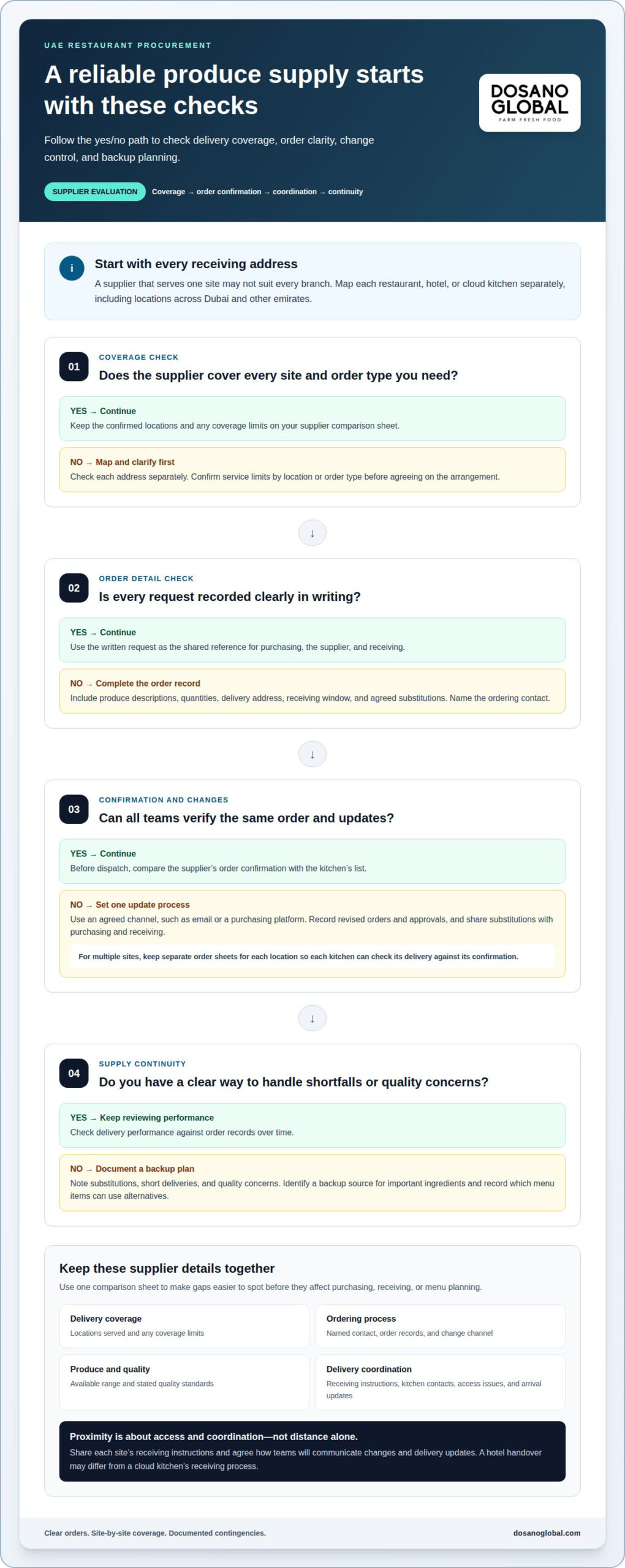
Map the supplier’s stated delivery coverage against each restaurant’s receiving address across the UAE. When mastering seasonal vegetable procurement for UAE restaurants, assess order handling, communication, and contingency planning before agreeing on a wholesale arrangement with partners like Dosano Global.
Supplier Evaluation and Coverage
Create a delivery map listing each restaurant, hotel, or cloud kitchen receiving produce nationwide. Assess every address separately, since access routes and receiving arrangements can differ across emirates. Clarify service coverage, including any limits by location or order type. Compare the produce range, ordering process, quality standards, and ability to coordinate deliveries with kitchen routines. A supplier that serves one site may not suit every branch.
For each potential supplier, confirm the covered locations, ordering contact, and process for communicating substitutions. A restaurant group with multiple sites, for example, needs clear delivery arrangements for each destination. Record the results in a supplier comparison sheet to identify gaps before they affect purchasing, receiving, or menu planning.
Order Confirmation and Supply Coordination
Set a consistent ordering process with a named contact and a written record of each request. Include produce descriptions, quantities, delivery address, receiving window, and agreed substitutions. Before dispatch, compare the order confirmation with the kitchen’s list. This helps prevent mismatched items, incorrect quantities, and deliveries sent to the wrong branch.
Coordinate changes through one agreed channel, such as email or a purchasing platform. If a chef replaces spinach with another leafy vegetable, purchasing and receiving teams need the same update. Record revised orders and approvals. For multi-site operators, use separate order sheets for each location so every kitchen can check its delivery against its confirmation.
Consistent Supply and Backup Suppliers
Consistent ordering means receiving the expected produce and quantities, with clear communication for each scheduled purchase. Review supplier performance against your order records, noting substitutions, short deliveries, and quality concerns. Identify a backup source for important ingredients and document which menu items can use alternatives. A clear substitution plan helps the kitchen respond when a preferred vegetable cannot be supplied as ordered.
Supplier Proximity and Communication
Proximity matters through delivery access and coordination, not distance alone. Share each nationwide address—whether in Dubai or other emirates—along with receiving instructions and kitchen contacts with the supplier. Agree how teams will communicate order changes, access issues, and arrival updates. For example, a hotel receiving team may need a different handover process from a cloud kitchen with a compact receiving point. Clear details help both sides coordinate each delivery.
Food safety, packaging, and temperature-controlled transport
Inspect every produce shipment on arrival and promptly reject items that fail your kitchen’s standards. Protect freshness with suitable packaging, transport conditions, and storage practices.
To reduce spoilage in UAE kitchens, store each vegetable at appropriate temperatures and humidity levels. Separate items according to their storage needs, organize stock by arrival, and use older produce first.
Food Safety and Produce Handling
Receiving checks give kitchen teams a practical control point. Compare each delivery with its order, inspect the produce, and promptly reject items that do not meet your standards. Check leafy vegetables for visible damage and root vegetables for signs of deterioration. Record rejected items and the reason to help purchasing and receiving teams identify recurring issues.
Food safety responsibilities also relate to where produce is grown. Commercial farms operating in the UAE are regulated by the UAE Ministry of Climate Change and Sharjah Municipality for food safety compliance. Restaurants should also define their own receiving and handling procedures, including who inspects deliveries and how concerns reach the purchasing team.
Packaging and Temperature-Controlled Transport
Packaging should protect vegetables from physical damage and keep each delivery organized for inspection. At receiving, check for torn, crushed, or wet packaging, then assess the produce inside rather than relying on the outer pack alone. Separate damaged items from accepted stock to prevent them affecting other vegetables. Note recurring packaging problems in the relevant delivery record.
Transport conditions matter because produce can lose quality before it reaches the kitchen. Coordinate handling so vegetables remain at appropriate temperatures during transit and after arrival. Match pack sizes to the receiving area and available storage; oversized cases can delay inspection and strain kitchen storage. Clear handover instructions help staff move accepted deliveries into suitable storage promptly.
Storage and Shelf-Life Practices
Choose storage conditions to suit each vegetable’s temperature and humidity needs. Keep storage areas clean, organize produce by type, and avoid placing new deliveries in front of older stock. A dated receiving label helps staff use items in the right order. Check stored vegetables routinely and remove deteriorated items before they affect nearby produce.
Order quantities the kitchen can store and use appropriately for menu demand. Divide a large delivery into manageable portions, keeping each protected until preparation. Avoid leaving produce at room temperature longer than necessary during receiving or prep. A simple routine works well: inspect, label, store correctly, and rotate stock by arrival.
Reliable vegetable procurement for restaurants
Reliable procurement connects freshness, order specifications, and delivery timing. In the UAE, compare supply routes and handling steps against the kitchen’s actual preparation schedule. Market-sourced produce is estimated to be 5-7 days old when it reaches a kitchen, compared with 4-6 hours for farm-direct produce. These figures help restaurants assess freshness expectations and choose sourcing arrangements that fit each menu.
Farm-direct supply from a UAE-based farm involves two steps: harvest and delivery. Produce is estimated to reach the kitchen 4-6 hours after harvest. By comparison, market-sourced produce typically passes through 3-5 supply-chain stages before reaching a Dubai kitchen and is estimated to arrive 5-7 days old. A purchasing team can use these differences to decide which items need a shorter route, such as delicate herbs for a service menu.
Delivery timing affects how smoothly the kitchen can receive and prepare vegetables. Coordinate deliveries with hotel and restaurant preparation schedules, including the work required before breakfast and lunch shifts. Share the receiving window, access instructions, and preparation priorities when arranging supply. For a hotel preparing breakfast, an arrival before the shift gives staff time to inspect and organize the order before service.
Clear specifications reduce avoidable substitutions and preparation delays. Define requirements such as ripeness stage, preparation of garlic, count per box, and bulk pack size. A restaurant might specify the ripeness stage for tomatoes used in salads or a count per box that matches its recipe portions. Record requirements by item and use the same wording for repeat orders.
Build each order around four operational details:
- Item and use: Name the vegetable and its menu role, such as herbs for garnish or root vegetables for roasting.
- Preparation specification: State the required ripeness stage or garlic preparation where relevant.
- Pack format: Set count-per-box or bulk pack sizing to match kitchen storage and preparation.
- Delivery timing: Align arrival with the hotel or restaurant’s preparation schedule before breakfast or lunch.
After each order, review the delivery against these specifications. Note differences in freshness, requirements, or arrival timing, then use the record to refine purchasing. If a kitchen’s salad menu depends on tender herbs, for example, choose a supply and delivery plan suited to that need. Reliable procurement matches the supply method to each vegetable’s role rather than applying one standard to every item.
What UAE food import and produce-handling regulations apply to restaurants?
For UAE restaurants, distinguish produce import requirements from the handling steps carried out after delivery. Commercial farms operating in the UAE are regulated by the UAE Ministry of Climate Change and Sharjah Municipality for food safety compliance. Restaurants should focus on receiving, inspecting, and storing vegetables appropriately, while keeping import-related questions separate from kitchen procedures.
Separate Import and Restaurant Handling Responsibilities
First identify whether the transaction concerns imported produce or vegetables grown in the UAE. The import route and the restaurant’s role in purchasing determine which questions concern the importer and which concern kitchen receiving. Do not assume that a restaurant’s handling routine covers every import-related requirement. Keep supplier documents with the relevant order and record the product description and origin shown.
For UAE-grown produce, the stated regulatory context covers commercial farms and food safety compliance. Restaurants can take this into account alongside their own checks, without treating farm oversight as a substitute for kitchen inspection. For imported items, keep purchasing and receiving records together. This gives the team a clear trail from order details to the vegetables accepted for preparation.
Build a Clear Produce-Handling Routine
At delivery, compare the items received with the order and inspect the shipment. Promptly reject produce that does not meet the restaurant’s standards. The receiving team can note damaged packaging, visible deterioration, or an item that differs from the confirmed order. Send the record to purchasing so recurring issues can inform future supply decisions.
After acceptance, move vegetables into storage with suitable temperature and humidity conditions. Organize produce by type and label deliveries with their receiving details. These steps help kitchen staff rotate stock and identify items needing attention before preparation. They also link delivery inspection with the later handling of each batch.
Keep Records Useful to the Kitchen
Keep a consistent record for each delivery, including the date received, listed produce, inspection outcome, and any rejected items. Retain the supplier’s order information with the record. If a discrepancy appears, staff can trace it to the correct order instead of relying on memory. A note about damaged spinach, for example, helps purchasing distinguish a delivery issue from a storage problem.
Review these records with the staff responsible for purchasing and receiving. A repeat pattern in condition or order accuracy can guide clearer specifications and handling instructions. For UAE restaurants sourcing vegetables, a defined process connects import documentation, receiving decisions, and kitchen storage without confusing those separate responsibilities. To discuss vegetable supply for restaurant kitchens, use the supplier’s wholesale channel.
Dosano Global: Meat
Dosano Global supplies fresh vegetables, fruits, and chillis to UAE buyers planning restaurant menus. Its supply offering can support seasonal planning by connecting produce requirements with sourcing from East Africa. Clear item specifications and order details help align requested produce with kitchen needs.
For restaurant teams, the next step is to outline the vegetables and complementary produce needed for upcoming menus, including preferred varieties and pack requirements. This creates a focused basis for discussing supply and planning orders around the kitchen’s needs.
Contact Dosano Global to discuss your produce requirements or visit dosanoglobal.com.
Shape your next procurement cycle with confidence
Prepare a procurement brief for your next menu cycle, connecting planned dishes with purchasing priorities. Before the next order, decide which vegetables anchor signature recipes, which can change with seasonal supply, and who approves substitutions. This makes procurement a planned operating decision rather than a last-minute response.
At each menu review, share the same brief with chefs and purchasing staff. Record which ingredient changes worked, which affected preparation, and what should remain fixed. That feedback can guide the next cycle without requiring the kitchen to rebuild every dish. A disciplined approach to seasonal vegetable procurement for UAE restaurants keeps menu choices aligned with purchasing decisions as seasons shift.
Dosano Global offers meat, fruits, and chillis. Set out the produce your menus require and the role each item plays, so supplier discussions can focus on your kitchen’s needs. Contact Dosano Global about procurement and take the next step toward a well-planned menu cycle.
Frequently Asked Questions
Which vegetables are in season in the UAE each month?
The UAE’s clearest winter growing window is October through April, when leafy herbs typically reach their highest quality. Rather than assigning vegetables to unsupported month-by-month slots, plan around the current harvest and supplier availability. Before each menu cycle, review planned dishes and choose suitable leafy, root, or other vegetables based on what is available.
What UAE-grown seasonal vegetables are available to restaurants?
Leafy herbs are a strong focus during the UAE’s October-to-April winter growing months. For menu planning, consider lettuce, spinach, arugula, kale, and cabbage alongside herbs suited to the dishes being prepared. Ask about produce origin when building a local menu, then distinguish UAE-grown items from other sourced produce in purchasing records. This keeps seasonal claims accurate and helps chefs describe ingredients clearly.
What are current wholesale prices for seasonal vegetables in UAE markets?
There is no single wholesale price for every seasonal vegetable across UAE markets. Prices depend on the item and are provided by quote, with factors including vegetable type, origin, season, order volume, pack size, and delivery requirements. Restaurants can compare weekly rate sheets against recipes and purchasing needs. Check whether a quoted pack format matches the kitchen’s expected usage before comparing totals.
How do seasonal UAE vegetable prices compare with imported produce?
No single price comparison applies to every UAE-grown and imported vegetable. Compare current quotes for the same item, grade, pack format, and delivery arrangement, then consider usable yield and preparation needs. A lower quoted case price may not suit a recipe if the kitchen requires a different size or specification. Review the intended menu use alongside the quote before deciding which source fits best.
Which UAE farms, wholesale markets, and suppliers serve restaurants?
UAE restaurants can source through suppliers serving commercial buyers, including Dosano Global, which supplies fresh vegetables, fruits, and chillis. Match delivery coverage to each restaurant’s address and receiving arrangements. When comparing supply options, assess how orders are specified, substitutions communicated, and produce origin recorded. This helps purchasing teams make informed comparisons without assuming every farm or market serves every location.
How can restaurants assess vegetable freshness, quality, and food safety?
Use a receiving checklist to compare each delivery with its order and record visible condition, packaging, and any rejected items. Inspect leafy vegetables for damage, for example, and confirm that each item matches the requested specification. Move accepted produce into storage with appropriate temperature and humidity conditions. A dated receiving note helps the kitchen trace recurring quality concerns and refine purchasing instructions.
How should restaurants forecast demand and plan seasonal menus around local vegetables?
Start with recipe usage and recent kitchen records, then estimate the vegetables needed for the planned menu period. Separate core dishes from specials that can change with seasonal availability. Keep a signature salad consistent, for example, while allowing its accompanying side dish to feature a suitable available vegetable. Compare planned quantities with leftovers after service, then adjust the next order to match actual kitchen demand more closely.
What are the risks of seasonal produce shortages, price volatility, and supply disruptions in the UAE?
Shifting availability can affect menu consistency, purchasing plans, and ingredient costs. Protect service by identifying which dishes depend on a specific vegetable and which can use an alternative without changing their identity. If a delivery changes, update recipe instructions and purchasing records together. Reviewing order confirmations before preparation also helps teams spot mismatches early and adapt the menu with less disruption.