
 English

International Fresh Produce Sourcing for Buyer Specifications
A reliable produce program is decided before the first shipment. International fresh produce sourcing works best when buyer specifications align with...

A reliable produce program is decided before the first shipment. International fresh produce sourcing works best when buyer specifications align with a supplier’s capacity, packing, certifications, export experience and commercial terms. Assess those capabilities before any introduction to build a program around the produce, volumes and delivery needs your business actually has.
Consistency matters: mismatched quality expectations or packing can disrupt supply just as much as a shortfall in availability. For UAE buyers, destination-market requirements and seasonal supply windows also shape which origins make sense. This guide explains how to assess suppliers against your specifications and how sourcing decisions can affect product availability, costs and food security.
Learn what to include in a produce specification, why certifications and export experience matter, and how to plan for expected arrivals rather than harvest dates alone. We’ll also cover how seasonal supply from different origins can support continuity and what to consider when building a dependable program for the UAE market.
Key Takeaways
- Match supplier capacity, packing, export experience, certifications and commercial terms to your buyer specifications before building a supply program.
- Set calibre, colour, pressure, Brix, defect tolerances and packing requirements in writing before the season to align quality expectations.
- Assess certifications against the destination market’s needs and your business’s sourcing priorities.
- Plan supply around expected arrival windows and channel shelf life; seasonal origins can help support availability throughout the year.
- Wholesale prices and freight costs depend on factors such as origin, season, product specifications, packing and transport needs, so compare the full landed cost rather than the produce price alone.
Matching supplier capabilities to buyer specifications
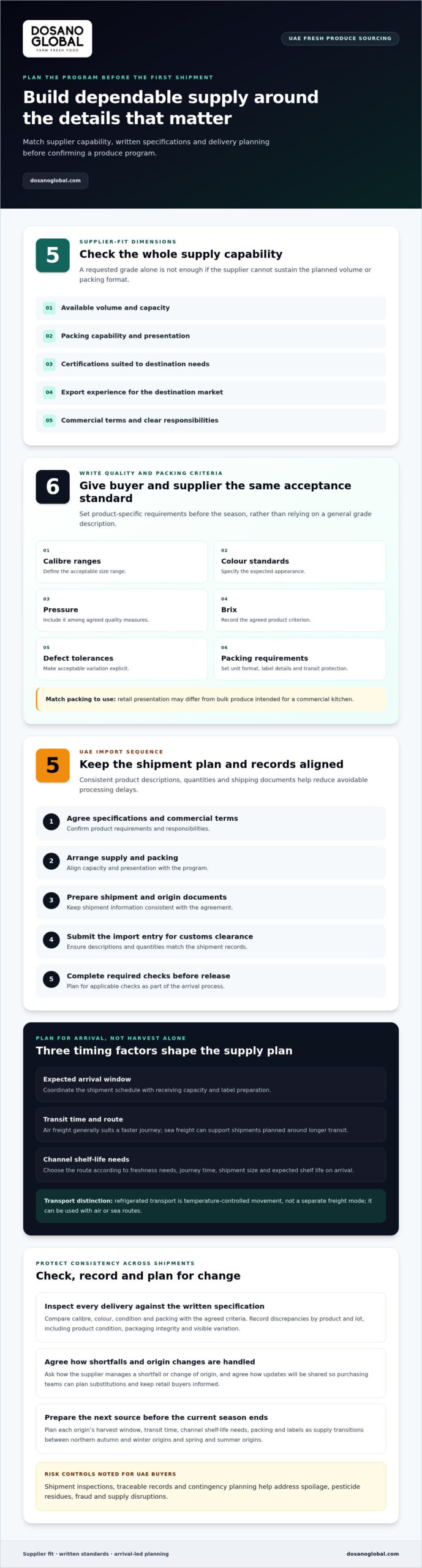
Build a dependable produce program by matching buyer specifications with supplier capacity, packing, certifications, export experience and commercial terms before any introduction. For retail programs, begin sourcing several months before the first arrival to align supply and prepare packing materials and labels.
Maersk’s cold-store video illustrates how handling and logistics support produce quality during transit:
Supplier Capacity and Export Experience
Compare a supplier’s available volume, packing capabilities and export experience with your product, schedule and destination requirements. A supplier that meets the requested grade but cannot sustain the planned volume or packing format may not suit a retail program. Review commercial terms alongside operational capabilities, then record responsibilities and specifications before confirming the arrangement.
Fresh Produce Supply-Chain Management
Fresh produce supply-chain management links origin, packing, transit and receiving plans to the buyer’s expected arrival window. Plan around arrival, not just the harvest date: transit time and the sales channel’s shelf-life needs affect when produce can be sold or used. For example, a retail team can coordinate label preparation and receiving capacity with the planned shipment window.
Air freight generally suits produce that needs a faster journey, while sea freight can support shipments planned around longer transit. Refrigerated transport is temperature-controlled movement, not a separate freight mode, and can be used with either route. Choose according to the product’s freshness needs, journey time, shipment size and expected shelf life on arrival.
For UAE imports, the practical sequence is to agree product specifications and commercial terms, arrange supply and packing, prepare shipment and origin documents, submit the import entry for customs clearance, and complete any required checks before release. Keep product descriptions, quantities and shipping documents consistent across the contract and shipment records to reduce avoidable processing delays.
Assess reliability through consistent availability, freshness, value, communication and suitability of the supply route. Ask how the supplier manages a shortfall or change of origin, then agree how updates will be shared. A clear response process helps purchasing teams plan substitutions and keep retail buyers informed about the product and expected arrival.
Manage transitions between origins by planning the next source before the current season ends. International fresh produce sourcing should account for each origin’s harvest window, transit time and channel shelf-life needs, then align packing and labels with the new supply. This transition plan helps buyers maintain continuity as supply shifts between northern autumn and winter origins and spring and summer origins.
Looking for suppliers you can build a program on?
Reliable sourcing starts by translating product needs into written quality, volume and packing criteria. In the UAE market, key risks include spoilage, pesticide residues, fraud and supply disruptions. Shipment inspections, traceable records and contingency planning help buyers address them.
Grower, Packer, and Exporter Qualification
Assess growers, packers and exporters according to the role each performs. Check whether growers can meet the product and volume requirements, packers can deliver the agreed presentation, and exporters have experience serving the destination market. Consider capacity, export history, communication and commercial terms together. Having the right produce is not enough if the full supply route cannot support the buyer’s program.
Quality and Packing Specifications
Put calibre ranges, colour standards, pressure, Brix, defect tolerances and packing requirements in writing before the season. These measures give both buyer and supplier a shared basis for accepting a shipment. Specify how produce should be presented and packed for its intended retail or food-service use. For example, a buyer can define the acceptable size range and defect tolerance for each product rather than relying on a general grade description.
Describe packaging in practical terms, including unit format, label information and how the product should be protected in transit. Match these instructions to the receiving and sales channel. A retail pack, for example, may need a different presentation from bulk produce intended for a commercial kitchen. Clear, product-specific terms reduce avoidable disagreements at dispatch and receiving.
Freshness and Consistency Checks
Inspect each shipment against the written specification and promptly tell the supplier about any shortfalls. Compare delivered calibre, colour, condition and packing with the agreed criteria, and record discrepancies by product and lot. This provides a clear reference for resolving quality issues and helps purchasing teams spot recurring differences between shipments rather than treating each complaint in isolation.
Freshness also depends on timing: plan around the expected arrival window, transit time and the channel’s shelf-life needs. Use consistent receiving checks for every delivery. A simple inspection record can capture product condition, packaging integrity and visible variation, helping buyers compare incoming lots and give precise feedback.
Sourcing Risk Management
Address spoilage by matching transit plans to the product’s condition and expected arrival, then inspect promptly on receipt. For pesticide-residue concerns, use relevant supplier records and testing processes as part of qualification. Reduce fraud risk by comparing product descriptions, origin details and shipment documents. These are practical controls, not substitutes for applicable destination-market requirements.
Plan for supply disruptions by identifying alternative origins or suppliers before a seasonal change, and define how substitutions must meet the same quality criteria. Keep product, packing and delivery terms consistent in purchasing records. A buyer building a global program can also explore fresh produce sourcing options as a next step.
Certifications and destination market requirements
Compare each supplier’s certification scope, traceability records, quality grades and sustainability practices with your product and buyer requirements. For UAE imports, assess duty treatment using the product’s tariff classification, declared origin, customs value and eligibility under any applicable trade agreement.
Supplier Certifications and Traceability
Compare certification documents by scope, covered site, product category and validity, then match those details to the supplier and produce being purchased. Shipment traceability records should connect the product to its origin, packing operation and lot identification. For example, a vegetable buyer can compare a supplier’s stated certification coverage with the packhouse named in shipment records.
Quality Grades and Sustainability Practices
Compare quality grades with written specifications, not broad labels such as “premium.” Check that grade descriptions align with the calibre, colour, pressure, Brix and defect tolerances agreed before the season. For sustainability priorities, buyers can consider organic, non-GMO or Fair Trade certifications, then compare each certificate’s scope with the specific product and supplier.
Use the same comparison sheet for every candidate supplier. Record certification name and scope, traceability details, grading basis and sustainability evidence in separate fields. This makes gaps visible: one supplier may provide detailed lot records, while another’s grade description may not address defect tolerance. Consistent fields also help purchasing teams compare suppliers across markets without confusing quality claims with certification claims.
For UAE imports, identify the correct tariff classification for each product before costing a shipment. Then assess origin, customs value and whether the goods meet the origin rules and documentation requirements for any applicable trade agreement. These details determine duty treatment; do not assume vegetables with similar names share the same classification or terms.
Keep the document trail aligned from supplier agreement through customs entry. Product descriptions, origin details, quantities and packing records should refer to the same shipment. If claiming a trade-agreement preference, ensure the supporting origin information meets the relevant eligibility conditions. Mismatches between invoice descriptions and shipment records can complicate clearance and cost planning.
- Match certificates to the supplier, site and product being purchased.
- Connect each lot to its origin and packing records.
- Compare quality grades against the buyer’s written tolerances.
- Assess tariff classification, origin and agreement eligibility before final landed-cost planning.
This structured comparison helps buyers distinguish documented evidence from general marketing language. It also gives procurement, quality and import teams a shared record for each supplier and shipment, supporting consistent decisions as sourcing programs expand across products and markets.
Effects on consumer prices and product availability
For UAE buyers, sourcing decisions affect which produce reaches stores and how supply costs move through the chain. A supplier provides produce to a retailer, while the retailer sets the retail price. Sourcing can therefore influence the retailer’s cost base, but the shelf price also reflects the retailer’s pricing decisions and other operating factors.
Availability across seasons often depends on switching between origins. In most produce categories, year-round supply can rely on alternating northern and southern hemisphere sources. Northern origins can support supply during autumn and winter, while southern origins can contribute during spring and summer. Planning these transitions helps UAE buyers prevent seasonal changes from becoming product gaps on shelves or menus.
Origin changes affect more than the harvest calendar. Buyers need to consider the expected arrival window, transit time and the shelf life required by the sales channel. Freshness declines over time, and longer transit leaves less time for retail sale. A shipment that arrives late in its usable window can reduce selling time, even if the product met its specification at dispatch.
Compare sourcing options using the full supply picture, not origin alone. For example, weigh seasonal availability, packing needs, transit arrangements and expected condition on arrival. The lowest-cost source at one stage may not offer the best value if longer transit reduces saleable time. A planned origin transition, meanwhile, can help maintain continuity when another source moves out of season.
Environmental considerations also shape sourcing decisions. Sourcing from nearby suppliers can reduce transportation distances and a restaurant’s carbon footprint. For UAE businesses, compare the supply route with product availability and the channel’s freshness requirements, rather than considering distance alone. A shorter route supports the environmental case only if it meets the product and supply needs.
For retailers and food-service buyers, better availability planning can support steadier purchasing and menu decisions. Restaurants can use seasonal produce to improve flavour and potentially reduce ingredient costs, while retail teams can plan ranges around the origins supplying each season. In either case, align expected arrivals with sales or service schedules, then adjust purchasing as source windows change.
Supply-chain partners can also coordinate around freshness. A freshness cost-sharing contract is one mechanism for coordinating decisions across a produce supply chain. Buyers can focus discussions on freshness requirements, arrival condition and responsibilities. Clear coordination connects sourcing choices with product availability and the time produce remains suitable for its intended market.
What are typical wholesale prices and freight costs for imported fresh produce?
There is no single typical price for imported produce into the UAE. The final wholesale quote and freight component depend on the product, origin, season, specification, shipment size and transport plan. For a useful comparison, separate the produce price from the costs of moving, handling and clearing the shipment.
The price depends on the specific order and is provided after a quote request. Product, origin, season, grade, packing, order volume and delivery terms shape the calculation. Compare quotes using the same specification and delivery basis. A price for one calibre or packing format cannot be fairly compared with a different format or quality grade.
Freight costs vary with route, transport mode, shipment volume, handling needs and the product’s freshness window. Air freight generally supports faster transit, while sea freight can suit shipments planned around longer journeys. Refrigerated transport helps manage temperature during transit, but requirements depend on the produce and route. Assess freight alongside arrival condition and remaining shelf life.
For a UAE landed-cost comparison, organize each quote into consistent components:
- Product: origin, seasonal supply, grade and agreed buyer specification.
- Packing: packaging format, materials, labels and handling requirements.
- Transport: mode, route, transit plan and temperature-control needs.
- Import: applicable duties and clearance-related charges for the shipment.
- Receiving: expected arrival window and the channel’s shelf-life needs.
Then compare the total with the usable quantity expected on arrival. For example, a lower product quote may not offer better value if a longer journey leaves less time for retail sale. A higher freight component may make sense for produce with a shorter freshness window if faster transport protects saleable condition.
Seasonality also changes the comparison. Alternating northern and southern hemisphere origins can support year-round availability in most produce categories, but each transition brings different supply windows and transport routes. Compare quotes for the same seasonal period, then align purchasing with expected arrivals rather than unrelated shipment dates.
Ask for commercial terms that clearly state what the quoted amount covers, the product specification, packing basis, delivery point and any separately handled charges. Use the same assumptions across suppliers and review them when the origin or shipment plan changes. This gives procurement teams a clearer basis for assessing wholesale value beyond the headline price.
For a tailored UAE produce quotation, request a produce sourcing quote with your product, specification, origin preference and delivery requirements.
In a fresh produce supply-chain model, a supplier provides produce to a retailer, while the retailer sets the retail price. Wholesale and retail pricing are separate decisions.
Dosano Global: Meat
Dosano Global sources and supplies fresh agricultural commodities for UAE businesses. Buyers planning produce programs can explore its fruits, chillis and vegetables for wholesale requirements. These categories support procurement teams aligning product needs with seasonal planning, buyer specifications and expected arrival windows.
For a supplier discussion, outline the product category, quality expectations, packing requirements and delivery destination. Clear requirements provide a practical starting point and connect sourcing decisions with your business needs. Produce buyers comparing supply options can contact Dosano Global to discuss its fruits, chillis and vegetables and their procurement priorities.
Contact Dosano Global to discuss your sourcing requirements.
Put Your Next Produce Program in Motion
Start your next sourcing decision with a focused brief: identify the products your UAE business needs, the quality standards your buyers expect and the supply priorities that matter most. This gives procurement teams a practical foundation for international fresh produce sourcing based on real requirements rather than broad assumptions.
Dosano Global supplies fruits and chillis for produce programs, alongside meat for buyers managing wider commodity needs. Use your requirements to guide a focused business discussion and determine how these categories fit your purchasing plans.
Contact Dosano Global about sourcing to discuss your requirements. A clear starting brief can help move your next procurement conversation forward with purpose.
Frequently Asked Questions
What are the main international fresh produce sourcing regions and growing seasons?
Supply commonly shifts between northern and southern hemisphere origins as growing seasons change. For UAE buyers, northern hemisphere sources can support autumn and winter supply, while southern hemisphere origins can contribute during spring and summer. Compare each product’s harvest window with its expected arrival and sales period. This seasonal view helps purchasing teams plan substitutions without assuming every origin produces the same crop year-round.
How do buyers find and vet reliable fresh produce suppliers and exporters?
Start with a product brief that names the intended use, acceptable quality, packing format and delivery destination. Then compare each supplier’s capacity, export record, communication and ability to keep shipment documents consistent with the goods. A practical next step is to review a sample specification and shipment paperwork together before agreeing to a recurring program. For a first order, define how quality concerns and proposed substitutions will be recorded and handled.
What UAE food safety, phytosanitary, labeling, and import documentation rules apply?
UAE import planning needs to account for food safety, phytosanitary controls where applicable, labelling and customs documentation. Requirements depend on the product and its origin. Build an item-specific file with the product description, origin information, packing and label details, and shipment records. Keep these details consistent across commercial documents and the goods. For example, an origin or packaging change can affect the information the import file needs to reflect.
What cold-chain and packaging standards help maintain produce quality during shipping?
Use temperature and humidity conditions suited to the product from dispatch through receiving, because different fruits and vegetables have different storage needs. Packaging should protect produce from crushing while allowing suitable airflow and handling throughout the route. Match packing choices to the transport mode and expected journey, then inspect packaging integrity on arrival. The receiving team can also record visible damage and product condition by lot, giving buyers clear information for supplier follow-up.
What import duties and trade agreements apply to fresh produce in the UAE?
Assess duty treatment using the product’s tariff classification, declared origin, customs value and eligibility under any applicable trade agreement.