 Arabic

Managing Fresh Food Supply Chain Disruptions in the UAE
The most effective way of managing supply chain disruptions for fresh food in the UAE is to prepare for them across sourcing, transport and...

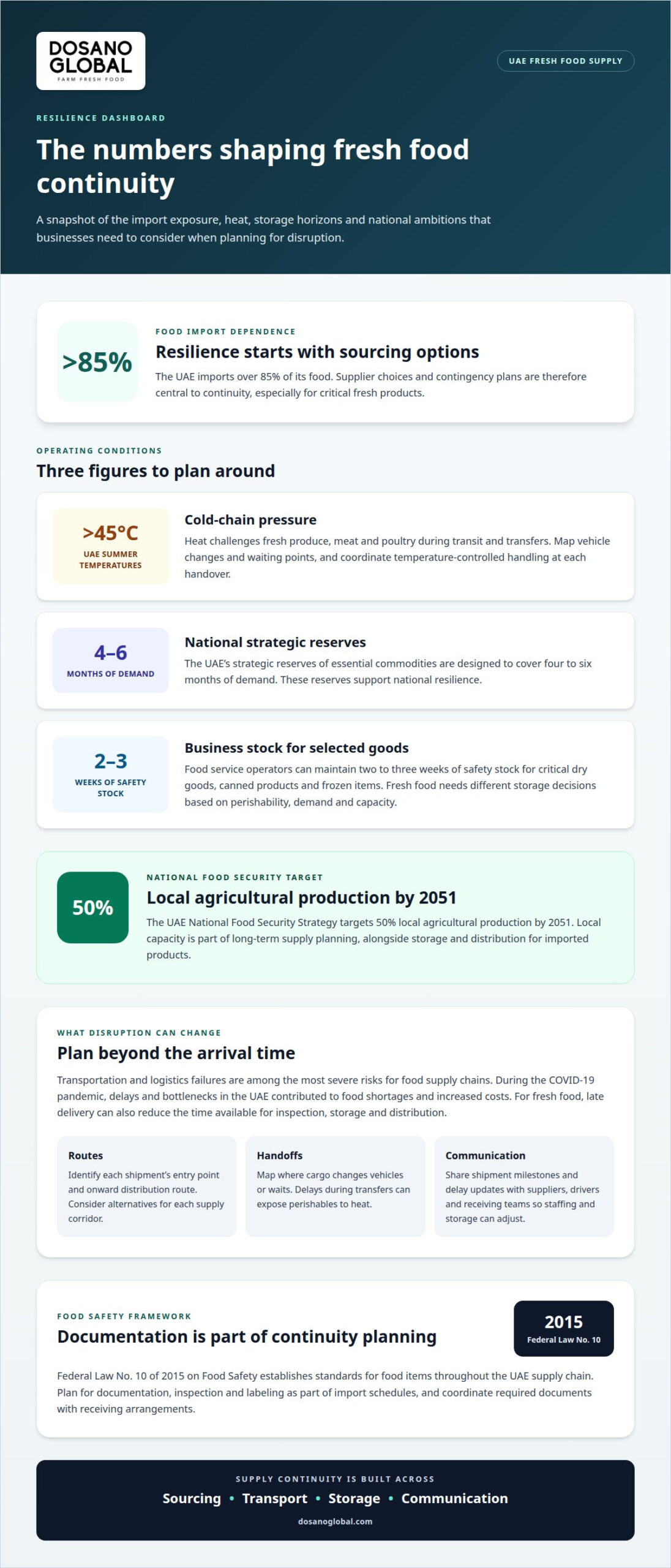
The most effective way of managing supply chain disruptions for fresh food in the UAE is to prepare for them across sourcing, transport and day-to-day operations. Transportation and logistics failures are among the most severe risks for food supply chains, while the UAE imports over 85% of its food, making resilient supplier choices and contingency planning essential.
It’s understandable to focus on whether a shipment will arrive on time. But continuity also depends on how quickly a business can respond when routes, supply or handling are disrupted. A reliable plan identifies risks early, keeps communication open with supply partners and sets out practical alternatives for critical products.
This article explains the disruption pressures affecting fresh food in the UAE and how logistics planning, supplier diversification, contingency measures and clear risk governance can help businesses respond. It also explains how dependable sourcing relationships for fresh fruits, fresh vegetables, halal meat and meat products can support continuity as market conditions change.
Key Takeaways
- Plan for transport delays and cold-chain pressure by identifying where a disruption could affect freshness, timing and delivery continuity.
- Build resilience across sourcing, storage and distribution, and align contingency measures with the products your business depends on most.
- Use regular risk assessments, open communication and traceable supply-chain information to spot problems earlier and coordinate a response.
- Assess how import dependence and changing global routes can affect UAE supply, then develop practical alternatives for essential products.
- Learn how Dosano Global’s fresh fruits, fresh vegetables, halal meat and meat product supply can support business purchasing needs when supply continuity matters.
Transportation and logistics failures
Transportation and logistics failures rank among the most severe disruptions affecting food supply chains. During the COVID-19 pandemic, delays and bottlenecks in the UAE contributed to food shortages and increased costs. For fresh food businesses, a late shipment can also reduce the time available for inspection, storage and distribution. Managing transport risk therefore means planning for interruptions before cargo leaves its origin, not only reacting after a delivery misses its schedule.
Which UAE ports, airports and land routes are most critical for fresh food imports? It depends on the shipment’s origin, transport mode and final destination in the UAE. For each supply corridor, identify the entry point and onward distribution route, then consider alternatives in case of disruption.
Temperature control adds pressure to transport planning. UAE summer temperatures routinely exceed 45°C, creating cold-chain challenges for food operations. Fresh produce, halal meat and meat products need handling plans that account for heat during transit and transfers. Map where cargo changes vehicles or waits for onward movement, then coordinate suitable temperature-controlled handling at those points. A delay during a handover can matter as much as a longer journey, because perishable goods remain exposed while waiting.
Labor and administration can also slow cargo. During the COVID-19 pandemic, cargo drivers and assistants in the UAE took regular tests. Testing and result-processing administration caused delays, showing how a health measure can affect transportation even when roads and cargo remain available. A contingency plan should identify alternative delivery timing and communication steps for drivers, suppliers and receiving teams. Clear updates help receivers adjust staffing and storage arrangements when arrival times shift.
Supplier diversification and logistics flexibility reduce reliance on a single route or delivery arrangement. For each major product category, map the supplier’s origin, transport mode, expected handovers and receiving destination. Then identify a practical alternative, such as another source or route, where available. The goal is not to switch suppliers at the first delay. It is to understand which dependencies could interrupt distribution and prepare a controlled response.
- Track shipment milestones and share delay updates promptly with supply partners and receiving teams.
- Identify route and handling dependencies that could expose fresh goods to heat or extended waiting.
- Document alternative sourcing or transport arrangements for critical product categories.
Human errors, outdated equipment, inconsistent processes and unsafe working environments can all disrupt operations. Standard procedures for handovers, temperature checks and escalation help reduce avoidable mistakes. Digitalization and Industry 4.0 technologies were identified as the most effective mitigation strategies in the study. For UAE food businesses, timely supply-chain information can help teams spot delays earlier, coordinate changes and protect continuity across transportation and distribution.
Food production, storage, transport and marketing support
Food resilience in the UAE depends on more than imports. It also requires coordinated production, storage, transport and marketing support. The UAE National Food Security Strategy targets 50% local agricultural production by 2051. That target makes local capacity part of long-term supply planning, while careful storage and distribution remain essential for products sourced abroad. A practical method is to connect procurement plans with available storage, transport arrangements and changing demand.
What UAE food safety, import, customs and phytosanitary rules apply to fresh food? Federal Law No. 10 of 2015 on Food Safety establishes standards for food items throughout the UAE supply chain. Businesses handling imported food can plan for documentation, inspection and labeling as part of preparing products for market.
These steps make documentation and product readiness part of continuity planning, not paperwork to address after a shipment arrives. Build time for required import processes into purchasing and delivery schedules. For fresh products, coordinate the relevant documents and inspection arrangements with shipment planning, so a delay does not surprise receiving teams. Import procedures should also sit within the wider food-safety framework established by Federal Law No. 10 of 2015.
Storage policies can help businesses absorb short-term supply pressure. The UAE’s strategic reserves of essential commodities are designed to cover four to six months of demand. These reserves support national resilience, while individual businesses still need storage plans suited to their products. Food service operators can maintain two to three weeks of safety stock for critical dry goods, canned products and frozen items. Fresh food requires different storage decisions, which should account for perishability, demand and available capacity.
Public support can strengthen several links in the supply chain. Governments can support continuity through production measures, transport management, food storage, marketing policy and regulations that support farmers and producers. During a pandemic, zero-interest loans can help local farmers continue producing food. Businesses can coordinate purchasing, storage and distribution around expected availability.
Flexible procurement and production help businesses respond when raw materials or deliveries change. The Food and Agriculture Organization (FAO) reports that the COVID-19 pandemic substantially affected both supply and demand in short food supply chains. A business can respond by matching purchasing decisions to demand changes, communicating early with partners and adapting production or logistics plans when shortages emerge. Switching suppliers without accounting for material differences can increase variation in quality and throughput, so alternative sources need practical specifications and clear communication.
- Connect sourcing plans to storage capacity, product life and delivery timing.
- Build import documentation and inspection steps into shipment schedules.
- Use flexible procurement and production plans to respond to demand or supply changes.
For commercial buyers developing fresh-food purchasing plans, fresh food sourcing needs can be considered alongside storage and distribution requirements.
Supplier diversification and contingency planning
A resilient sourcing plan avoids relying on one supplier, origin or transport arrangement. During supplier research, food service operators should identify three to five potential suppliers for each major product category. That shortlist creates options if a supplier faces shortages, production issues or delivery delays. It should also distinguish genuine alternatives from suppliers exposed to the same risks, such as a shared growing region or international route. Diversification works best when each option meets the required product specifications and purchasing needs. For UAE businesses, managing supply chain disruptions for fresh food starts with understanding these dependencies before orders are affected.
Risk assessments turn sourcing options into an operational contingency plan. Review potential disruptions for each category, then record the likely impact, response owner and decision point. A delayed shipment, for example, may call for revised timing, while a sustained shortage may require shifting orders to another source. Regular reviews help businesses update plans as supplier conditions, demand and logistics change. Clear roles also prevent delays while teams decide who communicates with suppliers or approves a change.
Inventory plans should reflect how quickly each product can be used, its storage conditions and how long replenishment takes. Set stock priorities according to business impact rather than applying one rule to every item. A critical ingredient with few alternatives may need closer monitoring than a product with flexible substitutes. Review usage alongside incoming orders, then adjust purchasing as demand changes. This supports continuity without treating fresh and shelf-stable goods as interchangeable. Managing supply chain disruptions for fresh food in the UAE also means aligning inventory choices with purchasing needs.
Technology can connect purchasing decisions to actual supply conditions. Traceable systems collect information about activity along the food supply chain, helping teams identify where delays or quality concerns may arise. Shared updates between suppliers, logistics partners and receiving teams can support a coordinated response. Keep records focused on practical decisions: what is delayed, which order is affected and what alternative action is underway. Information is most useful when operational teams can act on it.
COVID-19 showed how rapidly a disruption can affect supply and demand. A contingency plan should therefore cover both sides: what happens when products cannot arrive, and what happens when customer demand shifts. Food businesses can maintain open communication with supply-chain partners, share expected changes early and coordinate available resources. Sustainable resilience comes from reviewing plans after disruptions, learning which decisions worked, and updating sourcing choices before the next interruption.
- Map supplier, origin and route dependencies for each major product category.
- Assign response owners and decision points to each disruption scenario.
- Use inventory priorities, traceable information and partner updates to guide operational changes.
UAE food supply chain disruption risks
The UAE’s exposure to global food risks comes from connected disruptions, not isolated events. The COVID-19 pandemic and Russo-Ukrainian war affected transportation networks, labour availability and production systems across global supply chains. For UAE businesses, a shock at origin can therefore reach several stages: supply, shipment, receiving and customer demand. Assessing each stage separately can miss how one interruption triggers another.
The Russo-Ukrainian conflict intensified pressure on global food systems, particularly for grains and other essential commodities. Geopolitical conflict can restrict raw-material supply, influence food quality and affect prices. Even businesses that do not buy grain directly may feel indirect effects when suppliers face higher input costs or reduced availability. Risk reviews should map product dependencies, including ingredients, packaging and other inputs needed to keep operations running.
Trade routes create another point of exposure. In the second half of 2024, GCC supply chain leaders ranked global war and trade route disruption as their biggest concerns. A route interruption can affect timing and supply even when farms and suppliers remain operational. UAE businesses can use this signal to identify which products rely on vulnerable international corridors, then set response criteria for delays, rerouting or alternative supply.
Public health measures can disrupt both workers and movement. During the COVID-19 pandemic, restrictions between cities, regions and nations affected distribution of basic goods. Illness, isolation and movement limits also caused labour shortages in downstream food processing and distribution. Outbreaks at food facilities led to temporary closures or reduced operations. A business continuity plan should therefore identify essential roles and communication steps if staffing or facility capacity falls.
Demand can shift alongside supply. The Food and Agriculture Organization (FAO) reported that the pandemic substantially affected both supply and demand in short food supply chains. A supplier may have stock, yet changing orders or reduced distribution capacity can still disrupt availability. Monitor order patterns alongside partner updates so operational decisions reflect actual demand, not assumptions based on earlier purchasing cycles.
Risk governance makes potential threats actionable. Set clear criteria to rank each risk by likelihood, business impact and response time. Assign an owner to monitor geopolitical developments, route changes, supplier disruptions and workforce constraints. Document the trigger for action, such as a missed dispatch or confirmed supply interruption. Review the plan with relevant partners and update it when sourcing or distribution arrangements change.
- Map geopolitical, route, workforce and facility risks across each product’s supply chain.
- Set response criteria and owners before disruptions affect orders or customer demand.
- Review supply and demand signals together to guide continuity decisions.
How dependent is the UAE on imported fresh food, and which countries are the main suppliers?
The UAE imports over 85% of its food, making international sourcing a central part of national food supply. That figure covers food overall, not fresh food alone, so it should not be treated as a fresh-produce import percentage. For buyers, the practical takeaway is clear: a disruption in an overseas origin or route can affect supply reaching UAE businesses.
There is no single supplier-country ranking that applies to fruits, vegetables, halal meat and meat products. Origin depends on the product category and purchasing requirements. A country that supplies one item may not be a relevant source for another. Map origins by product instead of relying on one headline list of countries for all fresh food.
Create a simple origin map for each key product. Record the product, supplier, country of origin, transport route and expected receiving point. This makes concentrated exposure easier to spot. If several products depend on the same origin or route, for example, one disruption could affect multiple purchasing lines. Separate origins can reduce that overlap, provided alternatives meet the business’s quality and delivery needs.
Seasonality also matters. Production periods and availability can change across origins, so procurement teams should connect purchasing forecasts to expected supply periods. When one source is constrained, an alternative origin may not offer the same product at the same time. A realistic contingency plan accounts for these differences rather than assuming every country can replace every supplier immediately.
Import dependence creates operational considerations beyond the point of origin. Imported food in the UAE undergoes documentation, inspection and approval processes before reaching local markets. Buyers should include those steps in shipment planning and maintain clear communication with supply partners about product and delivery information. A change in supplier or origin may require coordination across purchasing, transport and receiving teams.
Supplier diversification is most useful when it reduces shared risk. Compare potential origins using practical criteria: product suitability, route exposure, seasonal availability and response time during a disruption. Keep the assessment specific to each category. A backup source for one type of fruit may not protect halal meat or vegetables, while a second supplier using the same route may offer little additional resilience.
For UAE businesses, the next step is to turn import exposure into a product-level sourcing plan. Identify critical products, map their origins and routes, and define what would trigger an alternative purchase. This gives teams a clear basis for decisions when supply conditions shift, without assuming one global event affects every product equally.
For commercial buyers reviewing their fresh-food sourcing needs, explore fresh food supply options.
Dosano Global
Dosano Global supports UAE businesses seeking fresh agricultural commodities through international sourcing and supply partnerships. When imported supply is central to your purchasing plan, sourcing relationships for fresh fruits, vegetables and chillis can form part of a broader continuity strategy. Aligning product requirements and purchasing needs with a supply partner helps keep decisions connected to your business priorities. Dosano Global serves commercial buyers in the UAE, linking agricultural supply with business demand. If you are reviewing your sourcing arrangements, discuss your fresh-food supply requirements with Dosano Global.
Make your next sourcing decision more resilient
Build continuity into your next purchasing cycle by connecting product priorities with clear sourcing decisions. Identify which categories matter most to your operation, where flexibility is possible and what information your team needs before changing an order. A practical approach to managing supply chain disruptions for fresh food in the UAE turns those decisions into an ongoing process, not a plan reserved for a crisis. Keep supplier communication active as demand and sourcing needs evolve.
For commercial buyers, Dosano Global can support sourcing discussions across fruits, vegetables, chillis and meat. Use that conversation to outline the products your business needs and how they fit your purchasing plans. Contact Dosano Global to discuss supply resilience and take a considered next step toward more dependable sourcing.
Frequently Asked Questions
How to manage to avoid them?
Businesses can’t prevent every disruption, but they can reduce its impact by preparing decisions in advance. Assign an owner to monitor each critical product category, define when an alternative source can be used and set a process for communicating revised orders. If a shipment misses a key milestone, for example, the team can promptly review available stock, pending orders and customer commitments before adjusting allocation.
What are the next steps?
Start by identifying the products whose absence would interrupt your operation. For each, record current sources, customer commitments, acceptable alternatives and the person responsible for decisions. Then run a brief disruption scenario, such as a delayed shipment arriving after a planned service period. Use the exercise to clarify who updates purchasing, receiving and sales teams, and revise the plan when business needs or sourcing arrangements change.
What are the main causes of fresh food supply chain disruptions in the UAE?
Disruptions can begin at different points, including production, labour availability, international trade routes, transport operations and changing demand. Their effects can be connected: a production shortfall may prompt urgent sourcing changes, while a transport interruption can delay several orders. For a UAE business, checking only the arrival date misses upstream dependencies. Map how a problem at origin could affect order confirmation, receiving schedules and customer commitments.
How do UAE businesses maintain cold-chain temperature and traceability for perishable food?
Use a documented handover process for each shipment, recording product identification, condition and temperature readings at receiving and at any later transfer. Assign responsibility for reviewing records and define what happens when a reading falls outside the product’s handling requirements. Linking shipment records to purchase orders and receiving documents helps teams trace affected stock quickly, separate it from unaffected inventory and make clear operational decisions.
What are the costs of cold storage, refrigerated transport, and air freight in the UAE?
Costs depend on the shipment and are provided after a quote request. Key factors include storage duration, shipment volume, route, transport mode, urgency and handling requirements. Air freight, refrigerated transport and cold storage are separate cost components, so assess them against the product’s shelf life and delivery plan. For a useful comparison, define the shipment details and service scope consistently before reviewing a quotation.
How do UAE retailers and food distributors manage shortages and demand fluctuations?
Businesses can adjust purchasing and allocation as sales patterns change instead of relying only on historical order quantities. A retailer facing a temporary shortage, for example, can prioritize committed customer orders and communicate substitutions or revised fulfilment plans early. Distributors can coordinate order updates with buyers, helping partners distinguish a short-lived demand spike from a persistent supply constraint before changing future purchasing plans.
What alternative suppliers and sourcing strategies can reduce fresh food supply risk in the UAE?
Reduce concentration by considering alternative origins and suppliers for each product category, while accounting for seasonality and route exposure. A substitute should meet the required product standard and intended use, not simply appear available. Keep sourcing decisions category-specific: a backup for one fruit may not address a shortage in vegetables or meat. Regular communication helps identify changing supply conditions before they affect planned orders.
How can UAE businesses use local farming, hydroponics, and vertical farms to improve food resilience?
Assess local farming, hydroponics and vertical farming as potential sources for suitable product categories, rather than assuming they can replace every imported item. Compare crop needs with the facility’s capacity, production consistency and buyer requirements. Then decide how local supply could complement imports during seasonal or route-related interruptions. A mixed sourcing plan can connect domestic production options with international supply while keeping product suitability at the centre.