
 English
Choosing a Produce Supplier in the UAE: A Commercial Buyer’s Guide
One flawless crate doesn’t prove a supplier can support your next month of demand. Choosing a produce supplier UAE businesses can rely on means...

One flawless crate doesn’t prove a supplier can support your next month of demand. Choosing a produce supplier UAE businesses can rely on means looking beyond product descriptions and a single inspection. Assess repeatable quality, supply consistency, and how well the offer fits your ordering and receiving needs. For commercial buyers, the real test is whether produce meets defined requirements as demand changes.
A clear evaluation framework makes that decision more practical. This guide explains how to set quality expectations, assess consistency, compare trade readiness, and judge supplier fit for your UAE operations. Dosano Global supplies fresh fruits, vegetables, and chillis to commercial clients across the UAE, with stringent quality controls and tailored commercial supply. Use the criteria below to compare suppliers against your own business requirements.
Key Takeaways
- Start with a written brief covering produce categories, quality requirements, expected volumes, and ordering rhythm.
- When choosing a produce supplier UAE businesses can depend on, compare quality against consistent measures rather than broad claims or a single inspection.
- Use a supplier scorecard to weigh product fit, quality controls, supply continuity, communication, and trade readiness against your requirements.
- Align specifications, order communication, and receiving expectations before the first order, then review performance over time.
- Consider how Dosano Global’s cross-border sourcing and commercial supply of fresh fruits, vegetables, and chillis can fit your UAE business needs.
Choosing a Produce Supplier in the UAE Starts with Your Business Requirements
A one-off produce purchase can be judged against an immediate need. An ongoing commercial relationship must support your product mix, repeat order patterns, and the way your business receives and uses fresh stock. Before choosing a produce supplier, UAE businesses should turn these operating needs into clear requirements instead of comparing product descriptions alone.
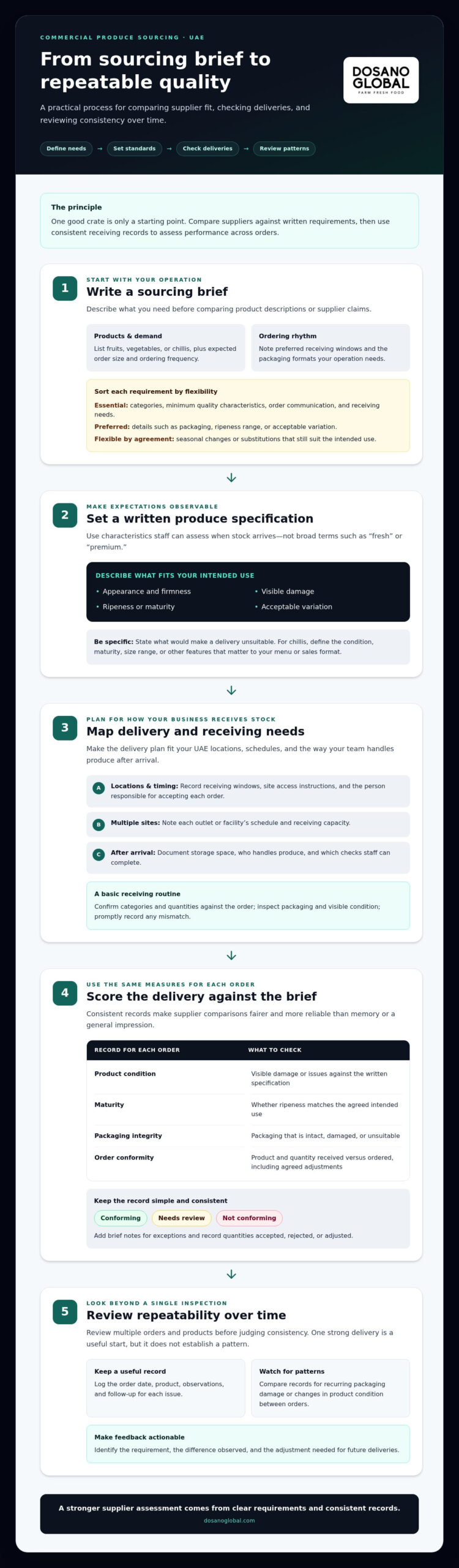
Start with a concise sourcing brief. List the categories you need, such as fruits, vegetables, or chillis, then separate firm requirements from preferences. For example, a kitchen may need chillis within a defined size range and condition, while allowing flexibility on shade or pack format. A shared brief gives your team a consistent basis for comparison and makes your requirements easier to communicate.
Turn demand into a clear produce specification
Describe produce using characteristics staff can assess on arrival: appearance, firmness, visible damage, ripeness, and acceptable variation. Avoid relying on broad terms such as “premium quality.” State what suits your operation and what would make a delivery unsuitable. For chillis, define the features that matter to your menu or sales format. Apply equally practical criteria to other produce, based on how it will be used.
Record the commercial rhythm too: expected order size, ordering frequency, preferred receiving window, and packaging format. Mark each item as essential or flexible. You might require a particular pack type but allow a range of fruit sizes, or allow seasonal flexibility where the intended use remains suitable. Treat substitutions as an option to agree on, not an automatic entitlement or guaranteed arrangement.
- Essential: Categories, minimum quality characteristics, order communication, and receiving requirements.
- Preferred: Packaging details, ripeness range, or variation your operation can accommodate.
- Flexible by agreement: Seasonal changes or substitutions that still meet the intended use.
This structured approach reflects Supply Chain Management principles: connect sourcing decisions to operational needs, not just the product itself.
Map receiving and supply needs across the UAE
Specify where your business can receive commercial deliveries across the UAE and which receiving windows suit its operations. Include site access instructions and identify the person responsible for accepting an order. If several outlets or facilities have different schedules, record each location’s receiving capacity so the delivery plan fits the way your business works.
Document available storage space, who handles produce after receipt, and which checks staff can complete. A basic receiving routine can confirm categories and quantities against the order, inspect packaging and visible condition, and promptly record any mismatch. Clear expectations make order reviews more useful and give your team a consistent reference point.
For businesses sourcing fruit alongside other produce, the fresh fruit supplier UAE buyer’s guide covers fruit-specific considerations that can help refine a sourcing brief. Documenting requirements first helps commercial buyers compare supply fit and plan around their UAE operations.
Assess Produce Quality, Handling, and Supply Consistency
Quality claims help buyers only when they connect to clear, observable requirements. “Fresh” or “premium” can mean different things to different businesses. Written specifications give both sides a shared standard, especially for fresh chillis, where condition, maturity, and order conformity affect whether the product suits its intended use.
Apply the same criteria to every supplier and delivery. Assess appearance and condition against your specification, inspect packaging integrity, and compare the product and quantities received with the order. Include arrival condition in your assessment: produce needs to arrive in a state your business can receive and use.
Create a practical produce quality scorecard
A useful supplier scorecard records specification conformity, product condition, maturity, packaging integrity, and quantities accepted, rejected, or adjusted for each order. Apply the same measures across suppliers, products, and receiving teams. Consistent records make comparisons fairer and more reliable than memory or a general impression.
- Product condition: Record visible damage or other issues against the written specification.
- Maturity: Note whether ripeness or maturity matches the agreed requirement for the intended use.
- Packaging: Log damaged, unsuitable, or intact packaging consistently.
- Order conformity: Compare the product and quantity received with what was ordered, including agreed adjustments.
Choose a simple internal rating, such as conforming, needs review, or not conforming, and add brief notes for exceptions. Record accepted, rejected, or adjusted quantities consistently. This creates a practical account of what arrived, rather than relying on whether a delivery felt satisfactory.
Assess handling and repeatability over time
Receiving checks can reveal patterns, such as recurring packaging damage or changes in product condition between orders. Record the order date, product, observations, and follow-up so the issue can be discussed with specific examples. Useful feedback identifies the requirement, the difference observed, and the adjustment needed for future deliveries.
Review multiple orders and products before judging performance. One strong delivery is a useful start, but it does not establish consistency. Repeated records show whether specifications continue to be met. Compare similar items using equivalent measures, and distinguish a one-time discrepancy from a recurring issue. This gives your team a stronger basis for choosing a produce supplier UAE businesses can rely on over time.
Scorecards also support productive supply relationships. Share precise observations promptly, then use later receiving records to assess whether the clarified specification is being met. For commercial supply focused on fresh fruits, vegetables, and chillis, include Dosano Global’s commercial produce supply in your sourcing review.
Compare Produce Suppliers by Commercial Fit, Not One Selling Point
A strong product description or an attractive offer alone cannot show whether a supplier fits your operation. Compare candidates against the same written specifications, order patterns, and receiving requirements. When choosing a produce supplier, UAE businesses should assess the full working relationship, including quality practices, continuity, communication, and trade readiness.
Rate each candidate against your requirements using a simple scale, such as “meets,” “partly meets,” or “does not meet,” and record the evidence beside each rating. Avoid relying on a generic ranking: a criterion that matters greatly to a high-volume kitchen may be less important to a business with different ordering needs. Consistent criteria make the comparison useful to purchasing and receiving teams.
Compare suppliers against the same criteria
Keep comparisons fair by applying each candidate’s information to an identical brief. Distinguish documented operating practices from broad claims or one-off examples. Record how quality controls are described, how buyer feedback is handled, and how proposed changes to specifications or order details are communicated. Clear updates give your team time to make informed procurement decisions.
Criterion
What to compare
Your assessment
Product fit
Match to required fruits, vegetables, or chillis and written specifications.
Record evidence against your brief.
Quality controls
How quality requirements are applied and explained.
Note documented practices, not broad claims.
Continuity
Fit with expected order patterns and changing demand.
Record strengths, gaps, and conditions.
Communication
Clarity and timeliness around changes, feedback, and order details.
Assess against your operating needs.
Trade readiness
Ability to align relevant product and route documentation with procurement needs.
Verify requirements for the specific route.
Use the same rating scale for each row, then give greater weight to requirements your operation cannot compromise on. This prevents a strong result in one area from obscuring a critical gap elsewhere.
Evaluate trade readiness for UAE procurement
Documentation depends on the product and trade route. For relevant food imports, buyers may need to review shipment documents such as a commercial invoice, packing list, certificate of origin, and health or phytosanitary certificate from the exporting country. Food registration processes can also depend on the point of entry. Verify current requirements with the relevant UAE authority or a qualified trade specialist before procurement. Do not assume a supplier holds a certification unless it is independently substantiated.
With your comparison framework in place, explore Dosano Global’s fresh produce supply for commercial sourcing of fruits, vegetables, and chillis across the UAE.
Reduce Sourcing Risk with a Structured Supplier Onboarding Process
A structured onboarding process turns an agreed supply relationship into steps your purchasing and receiving teams can follow. It aligns product specifications, order communication, documentation, and arrival checks before routine orders begin. For businesses choosing a produce supplier across the UAE, this preparation makes discrepancies easier to identify and discuss without assuming every delivery will be perfect.
Set expectations before the first commercial order
Before ordering, put the agreed produce requirements and operating arrangements in one accessible brief. Include product specifications, order details, packaging expectations, receiving procedures, and communication responsibilities. A shared reference reduces guesswork: the supplier can work to defined requirements, and your team knows what to order, inspect, and report.
- Confirm the requirements brief. Capture produce categories, applicable quality specifications, packaging expectations, order quantities, and planned delivery rhythm. Identify who can approve a change to the brief.
- Set order communication responsibilities. Agree how order details and updates will be shared, who should receive them, and how changes to requirements or delivery plans will be communicated. This gives staff a clear way to raise questions before an order arrives.
- Define the receiving and discrepancy process. Establish how staff will compare arriving produce with the order, record condition or quantity differences, and report them. Use consistent descriptions and retain relevant order records so feedback is clear and actionable.
- Review route-specific documentation. Identify documents relevant to the product and trade route. Food import and safety requirements can depend on the goods and route, so verify current UAE requirements with the relevant authorities or a qualified trade specialist before supply begins.
Review the first orders and refine the working arrangement
Use the first orders to test whether the written arrangement works in daily operations. Compare received produce with the agreed specification, check order conformity, and record material differences alongside communication and receiving observations. Consistent records help separate one-off issues from patterns and provide a factual basis for refinement.
- Review the evidence. Compare order records and receiving notes, including accepted, rejected, or adjusted quantities and any reported condition or packaging discrepancies.
- Discuss and clarify. Share specific observations promptly, then clarify whether the requirement, order details, or receiving process needs adjustment. Record agreed changes so both teams can follow the same updated instructions.
- Refine before expanding. Review supply and communication against your business needs before increasing order scope. Use what you learn to update specifications, staff procedures, and future order planning.
Onboarding is an ongoing working discipline, not a one-time formality. Keep the brief and feedback records current as demand or operating requirements change, and use them to support practical conversations. To align your requirements with commercial supply of fresh fruits, vegetables, and chillis across the UAE, discuss your produce supply requirements with Dosano Global.
How Dosano Global Supports Commercial Produce Buyers in the UAE
A supplier relationship should reflect how your business buys and receives produce, not just what appears on a product list. Dosano Global supplies fresh fruits, vegetables, and chillis to commercial clients across the UAE, combining cross-border sourcing with tailored commercial supply. Its stringent quality controls give buyers a practical basis for aligning product expectations with their supply requirements.
For businesses choosing a produce supplier across the UAE, turn your evaluation criteria into a clear brief. List the produce categories you need and describe the characteristics that matter to your operation. For chillis, for example, document the condition, maturity, packaging, and acceptable variation that suit your intended use. Include expected order patterns and receiving requirements so the supply discussion reflects how your business operates.
These details make the discussion specific and commercially useful. Instead of relying on general descriptions, buyers can distinguish essential requirements from areas where flexibility may be possible, and explain how their teams assess produce on receipt. Dosano Global’s cross-border sourcing and commercial supply can be considered against that defined business need, with quality expectations and supply requirements at the centre of the conversation.
Match produce supply to commercial needs
Prepare a brief that brings together your product categories, written specifications, order pattern, and receiving requirements. Include packaging expectations and how your team handles produce after receipt. If requirements differ by product or receiving site, separate them clearly so each part of the sourcing discussion has a practical reference point.
Dosano Global supplies fresh fruits, vegetables, and chillis to businesses across the UAE. The company applies stringent quality controls and tailors commercial supply to buyer requirements. This gives procurement teams a basis for discussing how product needs, quality expectations, and business operations fit together, without treating broad claims as a substitute for defined specifications.
Move from evaluation to a supply conversation
Bring your sourcing brief and evaluation notes into the conversation. Include the products you need, what quality means for your business, how orders should fit your demand, and what your receiving teams can accommodate. This keeps the discussion grounded in your actual requirements and helps align the details before supply begins.
For UAE commercial buyers, Dosano Global’s cross-border sourcing and produce supply provide a direct option for fresh fruits, vegetables, and chillis. Share your product specifications and supply requirements to start a focused business discussion.
Discuss your produce supply requirements
Build Your Next Supply Relationship with Confidence
A dependable supply relationship starts with a clear commercial conversation about what your business needs now and how those needs may evolve. Use your sourcing brief to guide that discussion, keeping priorities specific and expectations practical. Choosing a produce supplier UAE businesses can rely on is an ongoing decision shaped by clear communication and performance over time.
Dosano Global works with commercial buyers across the UAE, bringing cross-border sourcing and trade partnerships to the supply of fresh fruits, vegetables, and chillis. Its stringent quality controls support a focused conversation about produce requirements and supplier fit. Share the specifications, order patterns, and receiving needs that matter to your operation to take the next step with clarity.
Discuss your produce supply requirements with Dosano Global, and start a supply conversation built around your business.
Frequently Asked Questions
How do I choose a produce supplier in the UAE?
Choose a supplier by matching its commercial offer to your purchasing and receiving needs, then assess performance through real orders. When choosing a produce supplier UAE businesses can depend on, start with the products you use, how your team uses them, and the delivery pattern your operation can manage. For example, a food business preparing chilli-based dishes may value produce that consistently suits its recipes more than a broad catalogue.
What should I check when comparing fresh produce suppliers?
Compare suppliers using the same purchasing scenario and requirements. Consider whether their product range fits your menu or sales mix, whether ordering and receiving arrangements suit your workflow, and how clearly changes are communicated. Your procurement team can also record practical differences, such as the time staff spend sorting a delivery before it can be stored or used.
How can I assess the quality of a produce supplier?
Assess quality by reviewing how quality controls are described and whether delivered produce consistently suits its intended use. During receiving, have staff record specific observations, such as wilted leaves on vegetables or damaged chillis, rather than relying on an overall impression. Keep order records with those notes so your team can discuss recurring concerns and distinguish a product issue from a handling or storage issue at your own premises.
Can one supplier provide different types of fresh produce?
Yes, a commercial supplier may provide multiple produce categories, which can simplify purchasing when the offer fits your needs. Dosano Global supplies fresh fruits, vegetables, and chillis to commercial clients across the UAE. Set requirements for each category, since quality characteristics, packaging expectations, and intended uses can differ between fruit, vegetables, and chillis.
What documents should I review when sourcing produce for the UAE?
Review documents relevant to the specific product and trade route. Depending on the shipment, these may include a commercial invoice, packing list, certificate of origin, and health or phytosanitary certificate from the exporting country. Import registration and food-safety documentation may also apply. Requirements can vary, so verify current requirements with the relevant UAE authority or a qualified trade specialist before placing or receiving an order.
How can a business improve consistency when buying fresh produce?
Make consistency a shared practice between procurement and receiving teams. Use one current specification when ordering, make sure staff know where to record discrepancies, and route feedback to the person responsible for supplier communication. Reviewing an unusual delivery can help identify whether the cause was an unclear instruction, a changed requirement, or a receiving issue, then inform the next order plan.
Is the lowest-priced produce supplier always the best choice?
No. A lower purchase price may not be the best overall fit if staff spend more time sorting produce, usable quantities fall short, or ordering arrangements disrupt operations. Compare suppliers against the product’s intended use and your receiving process, not price alone. A practical review considers the quality received, quantities your business can use, and the effort required to manage each order.