
 English
Commercial Vegetable Sourcing in the UAE: A 2026 Buyer’s Guide
What if commercial vegetable sourcing UAE businesses can depend on began with a clearer brief, not a longer supplier list? A broad product range...

What if commercial vegetable sourcing UAE businesses can depend on began with a clearer brief, not a longer supplier list? A broad product range alone does not ensure that the assortment, order requirements and quality expectations will hold steady from one delivery to the next. Reliable procurement starts by defining what your operation needs and how suppliers should meet those requirements.
If you’re comparing supply options, consistency matters as much as choice. You need an arrangement that fits your commercial requirements, not just persuasive product claims. This guide explains how to prepare a practical sourcing brief, compare supply approaches and assess the factors that support dependable vegetable procurement across the UAE.
It also covers how seasonal sourcing, cross-border procurement and quality controls fit into commercial supply. Dosano Global sources and supplies fresh farm vegetables for commercial clients across the UAE, aligning procurement with buyer-defined requirements. Use the guidance below to clarify your priorities and assess how a sourcing partner can support your operation.
Key Takeaways
- Shape your commercial vegetable sourcing UAE brief around your operation’s produce needs, order patterns and specifications.
- Turn demand into a practical supply plan by defining use, estimating requirements and setting clear quality expectations.
- Compare sourcing options by assortment fit, quality alignment, sourcing model and communication, not product range alone.
- Separate fixed specifications from flexible preferences so suppliers can respond to your requirements more effectively.
- Understand how Dosano Global’s cross-border procurement, seasonal sourcing and quality controls support commercial vegetable supply across the UAE.
Why commercial vegetable sourcing in the UAE starts with business requirements
Commercial vegetable sourcing UAE buyers can rely on begins with defining what the business needs and how supply should meet it. Sourcing connects produce selection with procurement planning and the supply arrangements required by a particular operation. It is more than choosing items from a list. A useful sourcing discussion covers intended use, product specifications, expected demand, quality expectations and delivery coordination.
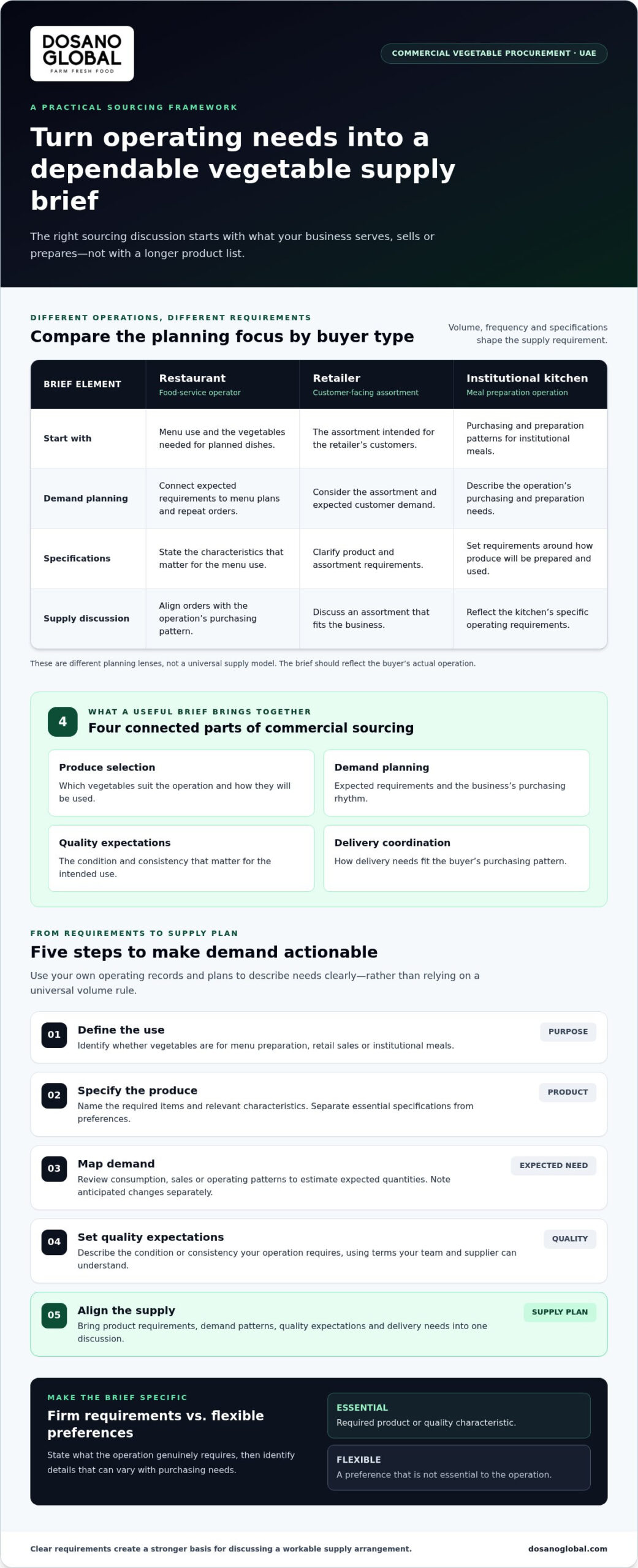
Commercial purchasing differs from retail shopping. A restaurant, retailer and institutional kitchen may all buy vegetables, but their requirements are not interchangeable. A food-service operator may plan around menu use and repeat orders; a retailer may need an assortment suited to its customers; an institutional kitchen may have specific purchasing and preparation patterns. Volume, frequency and specifications shape each requirement, so one supply model will not suit every buyer.
Commercial procurement is also one part of the movement from production to buyer. For a broad overview of understanding the food supply chain, consider how sourcing decisions connect product requirements with the stages and arrangements that bring food to market.
What commercial vegetable sourcing covers for UAE businesses
Sourcing turns a business requirement into a practical path to commercial supply. It brings together four related decisions: which vegetables suit the operation, how procurement should reflect demand, what quality expectations apply, and how delivery coordination fits the buyer’s purchasing pattern. These decisions are connected but distinct. A detailed product request, for example, still needs to be considered alongside the expected order pattern.
Requirements depend on how produce will be used and purchased. A buyer serving a set menu may prioritise consistency with planned dishes, while a retailer may focus on assortment. The goal is not to apply a universal rule, but to make the supply discussion specific to the business.
Why a precise supply brief matters
A request such as “fresh vegetables for regular supply” leaves important points open: which products are needed, what quality standards apply, how often orders are expected, and how demand may change. If buyer and supplier interpret those gaps differently, it becomes harder to align the assortment and expectations between orders. A precise brief gives both sides a stronger basis for discussing a workable arrangement.
State the intended use, preferred specifications and demand patterns, then separate firm requirements from flexible preferences. For example, identify a required product or quality characteristic separately from items that could vary with purchasing needs. Buyers planning across produce categories can also use this fresh fruit sourcing guide to consider how similar requirement-setting applies to fruit procurement.
How commercial vegetable sourcing turns demand into a supply plan
A useful supply plan translates what your business serves, sells or prepares into clear procurement instructions. For commercial vegetable sourcing UAE buyers should consider both regular requirements and changes in demand. This helps suppliers understand the purpose behind each request instead of relying on broad assumptions.
- Define the use. Note whether vegetables are for menu preparation, retail sales or institutional meals. Intended use helps clarify what matters in product selection.
- Specify the produce. Describe the required items and relevant characteristics in plain language. Separate essential specifications from preferences.
- Map demand. Review consumption, sales or operating patterns to estimate the quantities your business expects to need. Use your own records and plans rather than a universal volume rule.
- Set quality expectations. State the characteristics that matter for your use, such as the condition or consistency your operation requires. Use terms your procurement team and supplier can understand.
- Align supply. Bring product requirements, demand patterns, quality expectations and delivery needs together in a discussion that reflects how your business operates.
A buyer brief turns operating needs into practical guidance for commercial procurement.
Translate menu, sales, or operating needs into produce specifications
Make each request specific enough to guide sourcing. A food-service buyer can connect a product to its menu use; a retailer can describe the assortment it intends to offer; an institutional kitchen can outline its purchasing and preparation needs. Add the characteristics that matter for that use, and keep required specifications separate from flexible preferences. This distinction helps a supplier respond to the actual requirement without treating every initial preference as fixed.
Let documented needs guide any variety or origin preference. If those details are not essential to the operation, avoid presenting assumptions as mandatory instructions. Clear descriptions make it easier to discuss suitable procurement options and keep the brief focused on what the buyer genuinely needs.
Plan around demand patterns and seasonal supply
Recurring orders can be planned around the business’s normal purchasing rhythm. Identify anticipated changes in menus, sales or operations separately so procurement has a clearer view of expected demand and where flexibility may be needed. The aim is to describe your pattern, not to impose an unsupported minimum or fixed volume on every buyer.
Seasonal availability is another planning consideration. Allow for possible adjustments to timing or specifications as supply conditions change, rather than assuming every item will be available in the same way throughout the year. Dosano Global includes seasonal produce sourcing in its commercial supply approach, connecting buyer-defined requirements with procurement planning.
Once your priorities and demand patterns are clear, review Dosano Global’s commercial produce supply as you shape your sourcing requirements.
How to assess commercial vegetable sourcing options for your business
A long catalogue can look impressive, but range alone does not show whether a supply arrangement fits your operation. Assess how the requested categories and specifications, procurement approach, quality expectations and communication work together. For commercial vegetable sourcing UAE buyers need an evaluation grounded in their own requirements, not product count or promotional claims.
Assortment fit
Compare the vegetable categories and specifications your business needs with the partner’s stated supply scope. A broad range is useful only when it connects to your purchasing requirements.
Quality alignment
Consider how quality expectations are described and how controls fit into the supply approach. Clear, shared expectations make it easier to discuss consistency.
Sourcing model
Review whether the procurement approach can account for cross-border sourcing, seasonal supply or changing requirements relevant to your business.
Communication
Look for a clear exchange about requirements, procurement and supply coordination. Good communication keeps the commercial discussion focused on practical needs.
Compare supply fit, not just catalogue size
Start with the categories and specifications in your purchasing brief, then assess how directly a partner’s stated scope relates to them. A product list may show breadth, but it does not explain how procurement is organized or whether the approach fits the way your business buys. Consider whether your requirements are steady, seasonal or subject to change, then weigh the sourcing approach against that pattern.
Dosano Global sources and supplies fresh farm vegetables for commercial clients across the UAE. Its stated approach includes cross-border procurement and seasonal produce sourcing, connecting buyer-defined requirements with commercial supply. Assess this fit against your own brief rather than assuming a particular variety, origin or year-round availability.
Assess quality communication and procurement coordination
Quality expectations are more useful when described in terms that can guide a supply discussion. Set out the characteristics that matter to your operation and distinguish essential requirements from preferences. Then consider whether those expectations connect clearly with procurement and supply coordination, rather than appearing as separate claims.
Dosano Global includes quality controls for fresh produce in its sourcing and supply approach. These controls are part of the commercial relationship, not a guarantee of a particular outcome or a substitute for defining the buyer’s expectations. For teams comparing procurement needs across food categories, the commercial meat supply guide offers a related perspective on evaluating supply requirements.
A practical comparison should leave you with a clearer view of fit: whether the assortment serves your needs, quality expectations are aligned, the sourcing model suits your purchasing pattern, and communication supports the commercial arrangement. These criteria help distinguish a workable supply relationship from a catalogue that simply looks extensive.
Build a commercial vegetable sourcing brief that suppliers can act on
A well-prepared brief turns purchasing needs into clear instructions for a sourcing discussion. It helps a commercial partner understand what your operation requires, what can change and how supply should fit your purchasing pattern. A complete brief makes sourcing conversations more productive by separating firm requirements from estimates and preferences.
The information to include in a vegetable procurement brief
Keep the brief practical and specific to your business. Record the details below using your operating information rather than assumptions about what every buyer needs.
- Products and use: List the vegetable categories required and explain how the business uses them, such as for menu preparation, retail sales or institutional meals.
- Specifications: Describe the quality characteristics that matter to your operation. Identify acceptable substitutions and distinguish them from products that must meet a fixed requirement.
- Estimated demand: Provide an estimate based on purchasing records, sales patterns or planned operations. Mark it as an estimate if it may change.
- Frequency and changes: Describe the expected ordering pattern and how your team communicates changes in demand, including planned increases or reductions.
- Delivery and receiving: State the delivery expectations and receiving arrangements relevant to your business. Avoid assuming a schedule or lead time that has not been agreed.
Clarity matters more than length. Separate a required product characteristic from a preference that could be flexible, and indicate when an estimate is provisional. This helps avoid treating an early planning assumption as a final specification.
Align the brief with commercial supply discussions
Before sharing the brief, label each point as confirmed, estimated or flexible. That distinction gives a supplier a useful picture of your priorities and the areas where procurement may need to adapt. It also keeps the discussion focused on how requested products, quality expectations and supply arrangements fit together.
Dosano Global tailors commercial procurement to buyer-defined requirements. Cross-border procurement, seasonal produce sourcing and quality controls for fresh produce are part of its supply approach. A clear brief gives this discussion a practical starting point, whether your needs are steady or change with business operations.
For import-related orders, documentation and regulatory details can depend on current UAE requirements and the circumstances of the product. Verify applicable UAE import and food-safety requirements before finalizing documents or treating a particular document set as sufficient. Keep compliance details distinct from your commercial specifications, while recording relevant requirements in the brief.
Once your product needs, estimates, flexibility and receiving arrangements are organized, use the brief to guide a focused supply conversation. See how Dosano Global’s commercial procurement approach can fit your requirements.
Work with Dosano Global for commercial vegetable sourcing across the UAE
Commercial vegetable sourcing UAE buyers can shape around their own requirements calls for a partner that connects procurement with practical commercial supply. Dosano Global sources and supplies fresh farm vegetables for commercial clients across the UAE, with an approach that includes cross-border procurement, seasonal produce sourcing and quality controls for fresh produce.
Dosano Global’s role in commercial vegetable supply
Dosano Global works as a sourcing and supply partner, bringing buyer-defined needs into the procurement discussion. Your product categories, specifications and purchasing patterns help frame the requirement, while cross-border procurement and seasonal sourcing form part of the wider supply approach. This makes the discussion more relevant to your operation than a general product catalogue alone.
Quality controls are also part of Dosano Global’s approach to fresh produce. They sit alongside procurement and supply, supporting a clear conversation about the quality expectations that matter to your business. The aim is to align sourcing with your commercial requirements, not to promise a particular product, origin, schedule or outcome before those needs are understood.
This UAE-wide commercial focus serves businesses with different purchasing patterns. A buyer with recurring needs can outline expected demand, while an operation with changing requirements can identify where estimates or specifications may need flexibility. In either case, a well-defined brief gives procurement a practical starting point.
Prepare for a focused sourcing conversation
Before discussing supply, bring together the information that best describes your operation. A concise brief can include:
- The vegetable categories your business requires and their intended use.
- Specifications and quality expectations that are essential to your operation.
- Estimated demand, expected purchasing frequency and any likely changes.
- Delivery expectations and receiving arrangements relevant to your business.
- Preferences that can remain flexible as sourcing is discussed.
Separating firm requirements from estimates helps keep the conversation grounded. For example, identify an expected purchasing pattern as a working estimate, while marking a required specification as essential. This gives Dosano Global a useful basis for tailoring commercial procurement to your requirements and discussing how seasonal sourcing and quality controls fit the supply approach.
Share the priorities that matter most to your business, along with the details that may change. Dosano Global supplies fresh farm vegetables to commercial clients across the UAE, connecting buyer requirements with its sourcing and supply approach. Review Dosano Global’s sourcing and supply approach.
Turn your sourcing brief into the next business decision
Put your priorities to work by using the brief to clarify which requirements are fixed, where your business can adapt, and what a practical supply arrangement needs to support. That gives your team a stronger basis for procurement planning and responding to changing operational needs.
For commercial vegetable sourcing UAE businesses benefit from a discussion grounded in their own requirements. Dosano Global works with commercial buyers across the UAE, bringing cross-border procurement, seasonal produce sourcing and quality controls for fresh produce into its supply approach. Your product needs and demand patterns can guide a focused discussion about tailored procurement without relying on assumptions about what every business requires.
Bring your key categories, specifications and expected purchasing patterns to the conversation. Discuss your commercial vegetable sourcing requirements with Dosano Global and take a clear next step toward a supply arrangement shaped around your operation.
Frequently Asked Questions
Can a small business use commercial vegetable sourcing in the UAE?
Yes. A small business can use commercial vegetable sourcing UAE if it is procuring for business operations rather than personal shopping. The right arrangement depends on what it buys, how regularly demand recurs and how precise its requirements are, not on a universal company-size threshold. For example, a small café can outline its menu-related needs and typical ordering pattern, then discuss a supply approach suited to that profile.
How far in advance should a business plan vegetable orders?
There is no single lead-time rule that suits every vegetable order. Plan using your own stock use, expected sales or menus, and the sourcing route involved, then allow time for procurement and receiving coordination. If an event or menu change will increase demand, include that date in the plan early. Seasonal supply can also affect planning, so discuss timing before the requirement becomes urgent.
What happens if a business’s vegetable requirements change?
Tell your sourcing partner as soon as a change becomes likely, and identify the affected item, revised estimate, timing and whether the change is temporary or ongoing. For example, distinguish a one-off increase for an event from a lasting change to your regular menu. This gives procurement a clear basis to revisit the requirement and supply discussion. Treat changes as proposals until revised arrangements are agreed.
Is seasonal vegetable sourcing suitable for UAE businesses?
Yes. Seasonal vegetable sourcing can suit UAE businesses that plan around changing availability instead of assuming every item will be equally available throughout the year. Use seasonal planning to review flexible specifications, acceptable alternatives and forecast changes in your operation. Seasonal conditions can affect availability, so frame requirements realistically without presuming a particular vegetable is always available.
What documents are needed to import vegetables into the UAE?
Vegetable imports generally require a commercial invoice, packing list, bill of lading or airway bill, certificate of origin and phytosanitary certificate issued by the exporting country’s agricultural authority. Importer and product registration through relevant UAE systems may also apply. Exact documentation depends on the product and current requirements at the relevant entry point, so verify applicable UAE food-import and food-safety rules before preparing a shipment.
How should buyers describe vegetable quality requirements?
Describe quality in observable terms tied to intended use, rather than relying on words such as “premium” or “fresh” alone. A food-service buyer might specify the condition needed for preparation, while a retailer may describe appearance and acceptable variation for display. State must-meet characteristics, acceptable tolerances and defects that would make a lot unsuitable. Clear criteria give both sides a shared reference for discussing produce quality.