
 English

Food Supplier Evaluation for Quality and Compliance
A supplier’s company-wide approval alone is not enough. Approval should cover the specific food supplied and the checks made when it arrives. A...

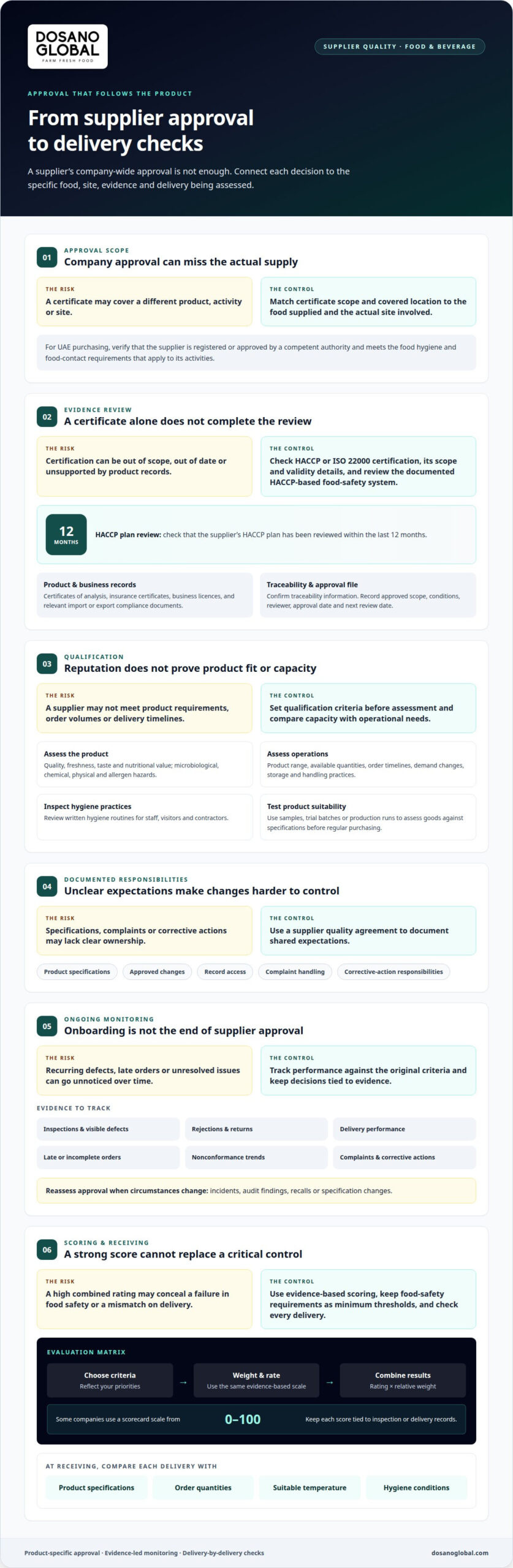
A supplier’s company-wide approval alone is not enough. Approval should cover the specific food supplied and the checks made when it arrives. A supplier evaluation checklist for food and beverage sets out how to assess food safety and traceability, review relevant documents, and confirm that certificates cover the product and site involved. It also guides receiving checks, so each delivery is assessed against agreed requirements.
Quality and compliance matter, and a clear approval process turns those priorities into practical decisions. A useful checklist covers food-safety systems such as HACCP, certificate scope, traceability records, supplier communication, and product condition on receipt.
This article explains how to assess suppliers, document approval decisions, and monitor performance over time. You’ll also learn how to check incoming goods, handle exceptions, and keep approval tied to the specific materials you purchase.
Key Takeaways
- Set clear approval criteria for each food product, and match certification scope to the supplied product and actual site.
- Build supplier qualification around food-safety records, traceability, product suitability and documented approval decisions.
- Monitor performance after onboarding, and reassess approval when incidents, audit findings, recalls or specification changes arise.
- Use complaint records and corrective actions to identify recurring issues and track whether they are resolved.
- At receiving, compare each delivery with its specifications, order quantities and suitable temperature and hygiene conditions.
What is a food supplier approval checklist?
A food supplier approval checklist is a documented process for assessing suppliers before purchase and during ongoing procurement. In the UAE, approval should establish whether a supplier is registered or approved by a competent authority and meets the food hygiene and food-contact requirements that apply to its activities. Document your criteria and apply them to each supplied material, not just to the supplier’s company profile.
A practical supplier evaluation checklist for food and beverage links every requirement to evidence, a reviewer, and an approval decision. It helps buyers distinguish a valid certificate from one whose scope, site, or covered activity does not match the food being supplied.
- Match each certificate to the supplied product and site. A certificate’s scope and covered location should correspond to the product or activity and the actual site involved.
- Review food-safety certification. Check whether the supplier holds HACCP certification or ISO 22000 certification, then confirm the certificate’s scope and validity details.
- Examine the HACCP plan. Review the supplier’s documented HACCP-based food-safety system, and check that its HACCP plan has been reviewed within the last 12 months.
- Collect product and business records. Approval files may include certificates of analysis, insurance certificates, business licences, and import or export compliance documents relevant to the supply.
- Confirm traceability information.
- Record the approval outcome. Document the approved scope, any conditions, the reviewer, the approval date and the next review date.
These checks make certification meaningful. A food-safety certificate for one site, for example, does not establish that another site or product is covered. A certificate of analysis can support a product-specific review, while business and compliance documents help establish who supplies the goods and which requirements apply. Store each record against the relevant supplier and product in a controlled procurement file or platform. This makes renewal dates, scope changes, and supporting evidence easier to track.
Traceability requirements can differ by destination market. The U.S. Food and Drug Administration proposed a 30-month extension of the FSMA 204 traceability compliance date to 20 July 2028, but the proposal was not finalised. For UAE purchasing, keep approval focused on the applicable local requirements and the exact product, site and documents involved. Certification supports the review, but a buyer still needs evidence that it applies to the supply being approved.
For purchasing in the UAE, verify that the supplier is registered or approved by a competent authority and meets the food hygiene and food-contact requirements that apply to its activities.
How Does the Supplier Quality Management Process Work?
Supplier quality management starts with clear qualification criteria and continues through onboarding and ongoing monitoring. Define product requirements, expected supply capacity, food-safety controls, and delivery needs before assessing suppliers. This keeps procurement decisions tied to operational requirements rather than reputation alone.
Assess capacity by reviewing the supplier’s product range, available quantities, order timelines, and ability to handle changes in demand. Check delivery performance against records of late, incomplete, or rejected orders, and compare those records with your receiving logs.
- Set qualification criteria. Assess product quality, freshness, taste and nutritional value, alongside microbiological, chemical, physical and allergen hazards.
- Inspect hygiene practices. Review written hygiene routines for staff, visitors and contractors, plus the supplier’s storage and handling practices.
- Verify product suitability. Use samples, trial batches or production runs to assess whether the goods meet specifications before regular purchasing begins.
- Agree quality responsibilities. A supplier quality agreement can document product specifications, approved changes, record access, complaint handling and corrective-action responsibilities.
- Monitor results after onboarding. Track inspections, visible defects, rejections, returns, delivery performance and nonconformance trends against the original criteria.
These records help protect restaurant reputation: inconsistent freshness or repeated delivery issues can affect menu quality and customer experience. Supplier performance may be reviewed through a scorecard; some companies use a scale from 0 to 100. Keep each score tied to evidence, such as inspection results or delivery records, instead of relying on opinion.
To assess reliability and capacity, compare the supplier’s ability to meet required quantities and timelines with actual order and receipt records. Review short shipments, delays, rejected goods, and communication about supply changes, then compare the pattern with your operating needs.
To build a weighted evaluation matrix, choose criteria that reflect your priorities, assign each a relative weight, and rate suppliers against the same evidence-based scale. Multiply each rating by its weight and combine the results. Keep food-safety requirements as minimum thresholds, so a high overall score cannot offset a critical failure.
For imports into the United States, the Foreign Supplier Verification Programs regulation is codified at 21 CFR part 1, subpart L, and an FSVP is required for each food and each foreign supplier importing food into the United States. This requirement concerns U.S. imports, not UAE domestic purchasing. UAE buyers should evaluate suppliers against the requirements applicable to their own operations and product flow.
Continue monitoring after approval, because performance and compliance can change. Reassess approval after major incidents, audit findings, recalls, or specification changes. Use inspection findings to guide corrective actions and future purchasing decisions.
How Do You Ensure Suppliers Meet Quality and Compliance Standards Consistently?
Consistency depends on documented checks, clear responsibility for complaints, and verification that corrective actions work. Use a structured review that connects each food-safety requirement to evidence, a responsible person, and a follow-up date. HACCP principles help organise hazard assessment, operational controls, and responses when limits are exceeded. Review product groups separately, since hazards and controls can differ.
Support the review with current records, not general assurances. Check food-safety certificates and their scope, plus inspection reports, certificates of conformity and supplier corrective-action replies for failed or critical items. BRCGS, SQF and FSSC 22000 schemes may require additional supplier approval checks. Keep the applicable requirements and supporting documents together so reviewers can trace each decision to evidence.
- Log each complaint. Record the product, lot or delivery reference, issue description, discovery point and immediate containment step.
- Investigate the cause. Ask the supplier to document root-cause analysis, rather than addressing only the visible defect.
- Set corrective action. Define the change required, the person responsible and the evidence needed to close the issue.
- Verify effectiveness. Review follow-up inspection results or later delivery records to see whether the same problem recurs.
A structured complaint template helps teams follow the same steps. For example, record a damaged or visibly unacceptable delivery alongside the inspection finding, disposition, and supplier response. Keep rejected-item records with complaint trends, since repeated issues may signal that controls need review. The supplier’s documented complaint procedure should include a complaint log, root-cause analysis, and corrective actions.
Use planned verification to keep controls current. Review the HACCP system yearly, and check whether a mock recall was conducted within the last 12 months. These exercises test whether product records can support a recall response, rather than simply confirming that a procedure exists. Food fraud vulnerability assessments should also be reviewed within the last 12 months.
For product evidence, ask whether microbiological and chemical analysis results are available at least every six months. Match each report to the relevant product and review date, then record any gaps or follow-up actions. A supplier audit can verify certification and food-safety compliance, while incoming inspection reports show how supplied goods perform in practice.
Track corrective-action closure as a performance measure, not a substitute for investigation. A 95% or higher closure rate is a listed target, while supplier-attributable recalls should be zero per 12-month period. Treat these as monitoring benchmarks, then review the underlying evidence, unresolved findings and recurrence trends before changing approval status or procedures.
Assessing supplier communication and technology
Assess communication by reviewing how clearly a supplier handles routine orders, changes, and problems. Set expectations for order confirmations, stock updates, delivery changes, and issue resolution. Compare actual responses with those criteria using order records and follow-up notes. Regular customer-satisfaction discussions can reveal recurring concerns before they disrupt purchasing.
Technology should make supply information easier to use, not harder to verify. An online ordering system can support order entry, while real-time inventory tracking can help buyers understand stock availability. Confirm how updates are shared and whether the information helps procurement, receiving, and kitchen teams plan. A useful platform gives staff a clear view of order status and changes.
- Assess purchasing needs. List product types, quantities, required certifications and dietary considerations before comparing suppliers.
- Confirm communication practices. Identify the right contact and channel for order changes, complaints and urgent supply issues.
- Review technology against tasks. Check whether order tools and inventory updates support the way your team places and receives orders.
- Record service performance. Track response times, resolution outcomes and customer-satisfaction feedback against your agreed criteria.
If a kitchen expects a menu change, for example, share the updated stock needs and timing with suppliers. Assess how accurately they respond, whether they flag supply constraints, and how clearly they communicate order adjustments. Constructive feedback should identify what worked and what needs improvement, then inform the next performance review.
Compare supplier pricing by reviewing the quoted product cost alongside freight, import duties, unloading, bespoke-order fees, and other relevant charges. Assess payment terms and cost consistency on the same scope, so a lower item price does not hide added costs or different order conditions.
Risk assessment should connect each ingredient or material to its possible hazards and supply vulnerabilities. Consider microbiological, chemical, physical, and allergen risks, then identify controls and evidence relevant to each product group. Document who reviews the assessment and how new products, suppliers, or sourcing changes trigger an update.
Food fraud needs a separate, deliberate review. Assess vulnerability to substitution, misrepresentation or other forms of fraud, and record the factors behind the rating. Review the supplier’s food fraud vulnerability assessment within the last 12 months. Include exposure to sabotage and internal or external threats in the assessment, then define how concerns are escalated.
Keep communication, technology, and risk records connected. A stock alert, supplier message, or product change can affect purchasing plans and risk controls at once. Use a shared review process to confirm the impact, assign follow-up, and retain the decision with the relevant product record.
Approved suppliers and receiving checks
An approved supplier list is useful only if it specifies what each supplier may provide. Approve the specific material, product, or activity rather than treating approval as a blanket decision for the whole company. Record the approved scope, conditions, reviewer, approval date, and next review date. Assign each supplier a status, such as approved, conditionally approved, pending, or rejected, and align purchasing rules with that status.
Receiving checks turn approval criteria into a decision about each delivery. Set written expectations for quantity, product specification, packaging, condition, temperature, and hygiene. Train receiving staff to compare delivered goods with the order and specification, then record findings promptly. This creates a traceable link between what procurement ordered and what the site accepted.
- Match the delivery to the order. Compare product description and quantity ordered with the goods received, noting shortages, substitutions or excess quantities.
- Inspect packaging and condition. Look for damaged packaging, visible defects, contamination or signs that the goods do not meet agreed specifications.
- Review transport conditions. Check that food arrived under suitable temperature and hygiene conditions, using the receiving procedure for the product.
- Record the decision. Log acceptance, rejection or conditional handling, with the delivery reference and reason for any exception.
- Escalate nonconforming goods. Notify the responsible purchasing or food-safety lead, preserve relevant records and follow the agreed supplier procedure.
If a delivery contains fewer units than ordered, for example, record the ordered and received quantities before closing the receipt. If packaging is damaged or the product has visible defects, document the findings and apply the site’s acceptance criteria. Avoid informal substitutions: replacement products should match the approved material and specification before entering normal use.
Review receiving records alongside supplier performance. A pattern of short deliveries, packaging damage, temperature concerns, or specification deviations can prompt follow-up, a revised receiving check, or a review of the supplier’s approval conditions. Tie each finding to the supplier and product, so an issue with one material does not obscure performance across other approved items.
Define who may accept, hold, or reject goods, and where each decision is recorded. Clear ownership helps receiving teams act consistently across shifts and gives procurement useful evidence for supplier reviews. A supplier’s status should guide the receiving process, while inspection findings can inform the next approval review.
Use these controls to align purchasing expectations with actual deliveries. Discuss your food supply requirements as you set clear product and receiving expectations.
Dosano Global: Meat
Dosano Global supplies fresh fruits, vegetables, and chillis for food and beverage operations. Turn to the company when your purchasing needs include these categories and you want to discuss product requirements as part of supplier assessment. Define the items, quantities, quality expectations, and receiving criteria your team uses, then align those needs with the products under consideration. Clear requirements help procurement and receiving teams assess fit consistently, from product specifications through delivery inspection. Dosano Global’s produce range offers a practical next step for menu planning and ongoing purchasing. Contact Dosano Global to discuss fresh fruits, vegetables, and chillis.
Turn Your Evaluation Into a Confident Next Step
Use your next purchasing review to turn evaluation criteria into a practical sourcing decision. Keep requirements specific to the goods your operation needs, and align product expectations with how your team receives and uses each order. A supplier evaluation checklist for food and beverage supports that discipline, but its value comes from applying criteria consistently and recording decisions clearly.
For buyers considering these categories, Dosano Global supplies meat, fruits, and chillis. Choose the products that fit your purchasing needs, then bring your specifications and receiving expectations into the supplier discussion. Clear requirements give both sides a useful starting point and help your team assess whether a supply relationship fits its operation.
Take the next step at a pace that suits your procurement process. Contact Dosano Global to discuss your food supply needs. A considered evaluation puts your team in a stronger position to build purchasing decisions around quality, clear expectations and dependable business relationships.
Frequently Asked Questions
Why is a supplier evaluation checklist important?
A checklist helps teams make purchasing decisions consistently and keep a clear record of why a supplier was approved. It also makes changes easier to spot: if a product source, specification, or delivery pattern shifts, buyers can compare new evidence with the original approval basis. For UAE food businesses, this structure supports coordination between procurement, quality teams, and receiving staff without relying on informal handovers.
What Is Supplier Quality Assurance in the Food Industry?
Supplier quality assurance is the planned process of confirming that supplied food consistently meets agreed safety, quality, and product requirements. It includes setting clear specifications, reviewing supplier controls, assessing products, and responding to problems. For example, a buyer may compare a produce delivery with its agreed grade and condition, then use inspection findings to guide purchasing or request corrective action.
What do food safety officers, QA managers, hygiene auditors, production supervisors check on it?
Each role brings a different operational perspective. Food safety officers focus on hazards, controls, and traceability; QA managers assess specifications, records, and nonconformance trends. Hygiene auditors examine cleaning practices and handling conditions, while production supervisors consider whether materials suit their process and schedule. A shared checklist assigns responsibility for each review, so a concern identified during a hygiene inspection reaches the people responsible for supplier follow-up.
What criteria should a food and beverage supplier evaluation checklist include?
Include criteria for product suitability, food-safety controls, traceability, relevant documentation, delivery performance, communication, and complaint resolution. Add product-specific checks, since fresh produce, meat, and packaged ingredients can have different specifications and handling needs. Define which criteria are essential and which can be scored comparatively. This helps teams avoid letting a strong commercial score outweigh a serious food-safety concern.
How to assess food supplier quality and food safety certifications?
Check that a certificate is current and that its scope, covered site and activity align with the product being supplied. Compare the certificate details with the supplier’s name and site information in your records, then note the review outcome. For schemes such as HACCP or ISO 22000, assess the supplier’s supporting food-safety records as well; certification alone does not establish that every supplied product is covered.
How to verify supplier traceability, recall procedures, and allergen controls?
Use a sample product or delivery record to trace the material one step backward and one step forward through the food chain. Review whether the supplier can identify affected goods and explain its recall communication process; a mock recall conducted within the last 12 months provides a practical test. For allergen controls, compare product information and labels with your handling requirements, and check how cross-contact risks are managed.
What documents should be requested when onboarding a food and beverage supplier?
Build an onboarding file around the supplied product and the supplier’s operating site. Relevant records can include food-safety certificates, a HACCP plan, certificates of analysis, insurance certificates, business licences, and applicable import or export compliance documents. Add product specifications and contact details for quality issues. Keep dated versions together so reviewers can distinguish current documents from records that applied to an earlier product or site.
What risks should be checked in food and beverage supplier audits?
Assess biological, chemical, physical, and allergen hazards, then consider food fraud and vulnerability to sabotage or other internal and external threats. Review how the supplier controls storage, hygiene, product identification, and changes to materials or processes. An audit should also establish whether previous findings led to effective action. These checks can reveal weaknesses that paperwork alone may not show, such as gaps between documented procedures and daily operations.