
 English
Fresh Chilli Procurement UAE: A Practical Buyer Checklist
A dependable fresh chilli order starts with clear requirements and a consistent check on arrival. For fresh chilli procurement UAE businesses should...

A dependable fresh chilli order starts with clear requirements and a consistent check on arrival. For fresh chilli procurement UAE businesses should define the product and delivery needs before requesting supply, so each proposal can be assessed against the same expectations and the receiving team knows what to inspect.
Fresh produce can vary in appearance and condition. Unclear specifications, changing quantities, delivery arrangements and cross-border paperwork can complicate an order or leave staff unsure how to assess it. A practical checklist brings these details into focus before they disrupt supply.
This guide explains how to create a purchase specification, compare supply proposals, plan quantities and delivery, and prepare shipment documents and receiving checks. Dosano Global supplies fresh chillies to commercial buyers across the UAE, with quality controls and cross-border trade coordination supporting the supply process. Use the checklist to make each order clearer and easier to assess.
Key Takeaways
- Separate recurring chilli demand from one-off orders, and align order frequency with your receiving capacity.
- For fresh chilli procurement UAE, record observable product requirements and distinguish essential acceptance criteria from preferences.
- Compare supply proposals against consistent criteria, including specification fit, quality processes, continuity, documentation and delivery coordination.
- Use a clear order-to-receipt workflow, verify current import and food-control requirements with official sources, and keep inspection records.
- Dosano Global supplies fresh chillies to commercial clients across the UAE, supported by quality controls and coordinated cross-border sourcing.
Fresh chilli procurement in the UAE: define the buying need first
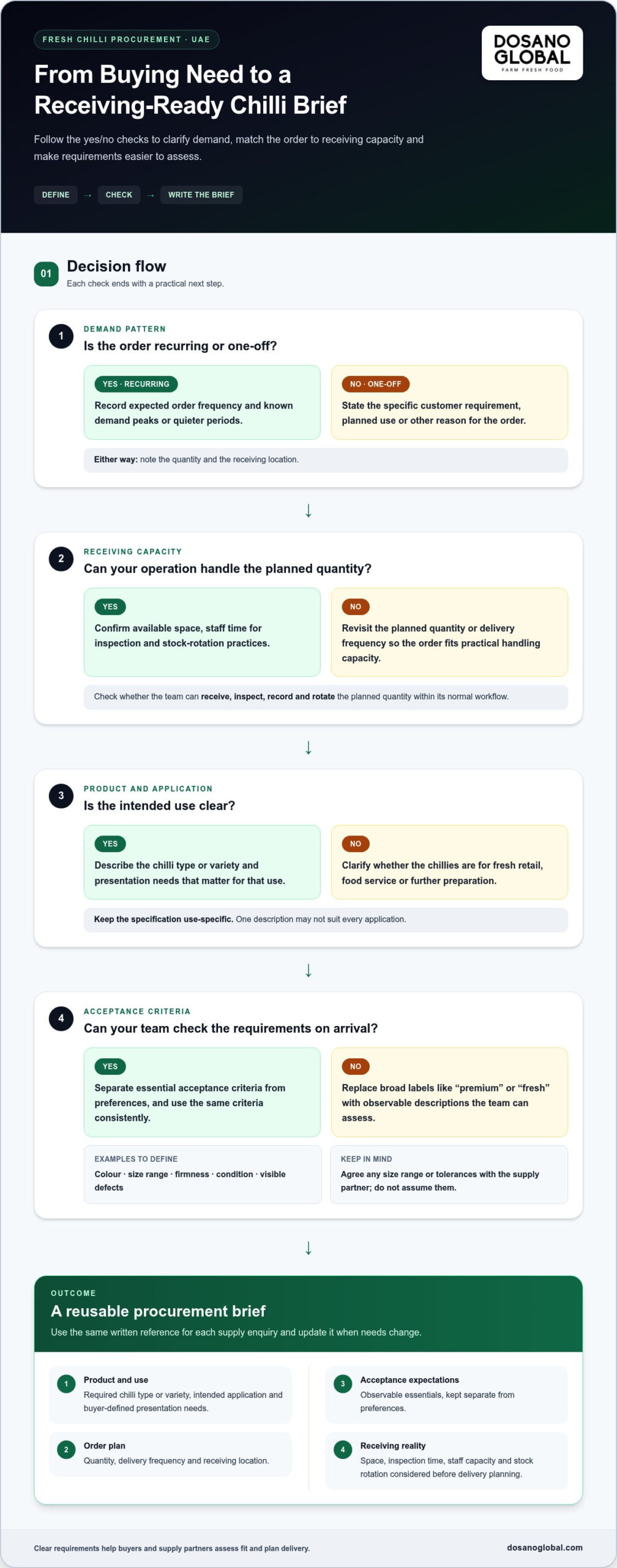
A practical procurement checklist starts with a clear requirement, not a general request for “fresh chillies.” Define what the product is for, how much you expect to use, how often you need replenishment and what your receiving operation can handle. A written brief gives supply partners a shared basis for responding and makes proposals easier to compare.
Separate recurring demand from one-off orders. A food-service buyer planning regular menu use may need a different order rhythm from a distributor preparing for a specific customer requirement. Retail presentation, food-service preparation and further processing can also call for different product descriptions and acceptance criteria. Don’t assume one specification suits every use. The Chili pepper overview provides background on varieties and uses, which can help clarify what you mean when describing the product.
Map demand, use and receiving capacity
Estimate typical usage and note periods when demand may rise, such as for a seasonal menu, promotion or planned customer order. Describe the intended application, whether fresh retail, food service or further preparation, and identify the characteristics that matter for that use. Then assess your receiving operation: available space, staff time for inspection and the stock rotation practices used after delivery.
- Demand pattern: Record whether orders are recurring or one-off, the expected frequency, and any known peaks or quieter periods.
- Application: State who will use the chillies and how, so the product description reflects the actual requirement.
- Receiving capacity: Consider whether the team can receive, inspect, record and rotate the planned quantity within its normal workflow.
This step aligns order planning with practical handling capacity. A quantity that looks suitable on a purchase plan may be difficult to receive if staff, space or inspection time are limited. Include these operational realities in the brief rather than leaving them until delivery planning.
Turn the buying need into a procurement brief
Bring the requirements together in a short document that can be reused for each enquiry. For fresh chilli procurement UAE buyers can use a concise brief to set a shared basis for supply discussions. Include enough detail to distinguish essential acceptance criteria from preferences, and use plain, observable descriptions that the receiving team can apply.
- Product and use: Describe the required chilli type or variety, intended application and any buyer-defined presentation needs.
- Order plan: State the required quantity, delivery frequency and receiving location.
- Acceptance expectations: Record observable essentials, such as the agreed appearance and condition, separately from preferences.
Use the same brief when reviewing each proposal, and revise it when demand or operating needs change. Clear requirements won’t determine every supply outcome, but they give buyers and supply partners a consistent reference for discussing fit, planning delivery and preparing the receiving team.
Fresh chilli quality checklist: specify the product before ordering
A useful chilli specification turns “good quality” into criteria that buyers and receiving teams can assess. Broad labels such as “premium” or “fresh” can mean different things to different people. Describe the required product in observable terms, then separate must-meet acceptance criteria from preferences. This gives supply partners a clear reference and helps your team judge a delivery consistently.
Describe variety, appearance and intended application
Name the chilli type or variety you require, and state whether substitutions are acceptable. Describe relevant visual features, such as the desired colour, size range, firmness and overall appearance. Tie each description to the intended use: chillies for fresh retail display may have different presentation priorities from those destined for food-service preparation. Avoid relying on a general label. If practical, agree on a sample or visual reference before ordering, so both sides understand the target without treating it as a certification or universal grade.
Write criteria in language that can be checked during receiving. For example, specify the expected colour and firmness, then describe the visible defects your team considers unacceptable. If you use a size range, define it in your purchasing terms and apply it consistently. Don’t add measurements or tolerances that haven’t been agreed with the supply partner.
Set condition, packing and acceptance expectations
Describe the condition you expect on arrival, including freshness, visible damage, decay and foreign matter. State what is acceptable and what counts as a variance instead of relying on phrases such as “in good condition.” Record the requested packing format and any order-specific handling instructions. Keep requirements practical and relevant to your use. Avoid adding technical storage advice unless it has been verified against authoritative guidance.
- Essential criteria: Record the agreed variety, condition, packing format and characteristics required for the planned application.
- Preferences: Note desirable features separately, making clear that they are not automatic grounds for rejecting an otherwise acceptable order.
- Receiving record: Tell staff what to inspect and how to document a variance, such as noting affected packages and taking clear photographs.
When feasible, use a mutually agreed sample or reference image to clarify appearance. A sample helps communicate expectations, but the written specification should still explain which characteristics matter and how the delivery will be assessed. For cross-border orders, keep product-quality criteria distinct from import paperwork and check current requirements through relevant official sources. The U.S. International Trade Administration’s UAE Import Requirements and Documentation guide offers background on UAE import procedures. It doesn’t replace current guidance from the applicable UAE authorities.
A usable chilli specification sets out the agreed variety, condition, packing and intended use, with essential acceptance criteria clearly separated from preferences. Buyers planning fresh chilli procurement UAE can share this brief with supply partners and use it to guide receiving checks. For commercial supply discussions, Dosano Global’s fresh chilli sourcing supports buyers seeking coordinated supply and quality controls.
Compare fresh chilli procurement options with a consistent UAE buyer framework
A fair comparison starts with the same written specification and order conditions for every proposal. If one offer responds to a request for a particular variety, condition and packing format while another gives only a broad description, the offers aren’t directly comparable. Ask each supply partner to address the same requirements, then record gaps rather than filling them with assumptions.
Compare fresh chilli offers against the same written specification and delivery conditions. For fresh chilli procurement UAE buyers can use the framework below to capture what each proposal states, what evidence is provided and what needs clarification. It creates a consistent basis for assessment without presuming that one supplier performs better.
| Comparison area | What to record for each option |
|---|---|
| Specification fit | Whether the proposal matches the requested variety, condition, packing and intended use; note any proposed substitution. |
| Quality process | What checks are described, when they occur, and what shipment evidence is provided. |
| Continuity | The proposed order cadence and how changes to quantity or timing are addressed. |
| Documentation | Which documents the proposal says will accompany the order, and any items requiring clarification against applicable requirements. |
| Delivery coordination | Stated delivery terms, timing arrangements, receiving location and handover expectations. |
Assess specification fit and quality controls
Compare each offer line by line with your requirements. Mark a criterion as matched only when the proposal addresses it clearly, and note alternatives separately rather than treating them as equivalent. For quality controls, record the checks described and any supporting evidence supplied for the shipment. A stated quality process is useful information, but it isn’t the same as formal certification. Don’t infer certification from general claims about inspection or quality standards.
Assess continuity and commercial coordination
Review whether each proposal explains how recurring orders would be arranged, how communication would work and how changes to requirements would be handled. Check delivery terms and receiving expectations on the same basis across offers. If an item is missing, label it “not stated” or “follow-up required.” Don’t interpret silence as agreement, or assume a proposed arrangement will continue unchanged unless the terms say so.
Use one evaluation sheet for every option, with separate columns for the proposal, supporting evidence, exceptions and unresolved points. For example, if the requested packing format is addressed but the delivery window isn’t, record the confirmed fit and the open question separately. This makes discussions more precise and preserves a clear record of what was offered.
- Compare like for like: Use identical product requirements, quantities, order frequency and delivery conditions.
- Separate facts from claims: Record what is documented, what is described and what remains unverified.
- Close gaps before assessment: List substitutions, assumptions and unanswered terms for follow-up before treating proposals as comparable.
Broad descriptions such as “premium” or “best” don’t replace specific terms. A consistent framework helps UAE buyers assess supply proposals on relevant details without inventing performance data or confusing an assurance with evidence.
UAE fresh chilli procurement checklist: prepare shipment, documents and receiving
A clear shipment plan connects the agreed purchase to a controlled receiving check. For cross-border fresh chilli procurement UAE buyers should coordinate product details, document handover and delivery arrangements before dispatch, then compare the arriving goods with the order. Import and food-control requirements can change and may vary with the product and shipment circumstances. Verify current rules with relevant UAE official sources before relying on a specific requirement.
Coordinate shipment details and applicable documents
Confirm the order in writing, including product description, quantity, packing, dispatch details and receiving arrangements. Build a document checklist from current official guidance and the shipment’s origin and circumstances, rather than relying on a generic list. Align the buyer, supply partner and relevant logistics parties on who will provide each document, how it will be handed over and when it is needed. Keep the agreed version accessible to the receiving team.
- Confirm the purchase: Match the written order to the agreed chilli description, quantity, packing and delivery conditions. Record any amendment clearly so all parties work from the same version.
- Check applicable requirements: Consult current official UAE import and food-control sources for the shipment in question. Don’t assume that a document or procedure for one product origin or shipment automatically applies to another.
- Coordinate document handover: List the expected documents, the responsible party for each and the agreed handover timing. Resolve missing or inconsistent details before dispatch where possible.
- Prepare receiving staff: Share the order and specification with the people receiving the delivery. Confirm who will check quantity, packaging and product condition, and where findings will be recorded.
- Inspect and document arrival: Compare delivery identity, quantity, package condition and visible chilli condition with the order. Record any variance promptly, with clear notes and photographs where appropriate.
- File the record: Keep the purchase confirmation, relevant shipment documents, inspection notes and follow-up communications together for traceability and future order planning.
Inspect and record the delivery on arrival
Make the receiving check against the agreed specification, not a general impression of quality. Verify the delivery identity and count, look for packaging damage, and assess visible product condition using the acceptance terms set before ordering. If something differs, describe what you observed, identify affected packages where practical and preserve supporting photographs. Record the date and notify the relevant parties through the agreed communication channel.
After inspection, use your business’s established food-safety and stock-rotation procedures. Don’t add temperature limits, shelf-life expectations or handling claims to a buyer checklist unless they’ve been verified against current authoritative guidance and are relevant to the product and circumstances. This keeps receiving instructions useful without turning assumptions into technical rules.
Dosano Global coordinates cross-border fresh produce supply for commercial clients, with quality controls supporting its fresh chilli supply. Dosano Global’s fresh chilli supply is available to commercial buyers seeking coordinated procurement and delivery.
Build a dependable fresh chilli supply relationship with Dosano Global
A well-defined buyer brief gives commercial supply discussions a practical foundation. It brings product expectations, intended use and delivery needs into one shared reference, helping both sides focus on the details that matter to the order. For fresh chilli procurement UAE businesses can establish that clarity before discussing sourcing and supply arrangements with Dosano Global.
Dosano Global sources and supplies fresh chillies and other fresh agricultural commodities to commercial clients across the UAE and global markets. Its cross-border trade coordination and quality-control focus support a supply process where clear requirements matter. A precise brief connects the buyer’s operational needs with procurement discussions without relying on broad descriptions or assumptions.
Translate the checklist into a clear supply brief
Prepare a concise document that sets out the chilli type or variety, intended application, required quantity, order cadence and delivery requirements. Include essential quality and packing expectations agreed for the order, and distinguish them from preferences. This gives the discussion a commercial focus and makes it easier to address requirements consistently as an order is planned.
Be specific enough to guide a useful conversation, but don’t add unsupported claims or technical conditions. Describe the intended use and visible characteristics that matter to your business, rather than relying only on a label such as “premium.” If your plans change, update the brief so the discussion reflects current quantities, timing and receiving arrangements.
- Product need: Identify the requested chilli type and how your business will use it.
- Order plan: State the quantity and expected order cadence.
- Delivery needs: Record the receiving location, delivery arrangements and relevant handover expectations.
- Quality expectations: Keep essential acceptance criteria distinct from preferences.
A shared brief supports focused procurement discussions, helps identify differences in understanding early and gives the buyer a consistent reference as an order moves from planning to receipt. It doesn’t replace current import checks or a receiving inspection. It makes the commercial requirement clearer.
Start a fresh chilli procurement discussion
Dosano Global serves commercial buyers across the UAE with fresh chilli sourcing and supply, supported by quality controls and cross-border trade coordination. A written brief helps align the product need, order plan and delivery considerations. For wider produce purchasing context, the fresh fruit supply buyer’s guide covers related considerations for commercial procurement.
Clear requirements are the starting point for a focused supply conversation. Dosano Global’s fresh chilli procurement supports commercial buyers planning supply for their business.
Put your next procurement cycle on a stronger footing
Make your specification a living commercial document. After each order, use receiving observations and changes in business demand to refine the next brief. This keeps expectations connected to how your operation uses fresh chillies, rather than letting old assumptions carry forward. That discipline can make fresh chilli procurement UAE more focused and give each supply discussion a clearer purpose.
Dosano Global supports commercial clients with fresh chilli sourcing and supply, backed by a quality-control focus across cross-border fresh produce supply. Bring your priorities and procurement needs into a discussion shaped around your business requirements.
Discuss your fresh chilli procurement requirements with Dosano Global to plan supply around clear expectations and your commercial needs.
Frequently Asked Questions
What should a UAE buyer include in a fresh chilli purchase specification?
Include enough detail for the supply partner and receiving team to interpret the order consistently. Identify the chilli type or variety, intended use, expected quantity, packing format and delivery requirements. Add observable condition criteria, such as acceptable firmness and visible damage, in language your staff can apply. For fresh chilli procurement UAE buyers should also state whether substitutions are acceptable and how any difference from the agreed specification will be recorded.
How can a buyer check fresh chillies when a delivery arrives?
Compare the delivery with the purchase order and agreed product reference before distributing stock internally. Check the product description and quantity, examine packaging for damage, and look for visible condition issues such as decay or bruising. If something appears inconsistent, note which packages are affected and take clear photographs where useful. Keep the delivery record with the order documents, then follow your business’s established food-safety and escalation procedures.
Which documents may be required for fresh chilli imports into the UAE?
Depending on the shipment and applicable requirements, import paperwork may include a commercial invoice, packing list, certificate of origin and a health certificate from the exporting country. Other permits or records may apply in particular circumstances. Don’t treat a general checklist as definitive: requirements can depend on origin, product and current UAE rules. Verify the shipment’s document needs through the relevant official UAE authorities before dispatch.
How should fresh chillies be stored after receiving a shipment?
Follow current food-safety guidance and the handling instructions applicable to the product rather than relying on a generic temperature or shelf-life rule. After inspection, identify the received lot and keep it within your business’s approved storage process. Rotate stock using your established date-based system, and separate any packages flagged during receiving so their status is clear. Verify technical storage advice against current authoritative guidance before setting internal limits.
Can fresh chilli varieties be substituted during procurement?
Yes, but treat a substitution as a change to the agreed order, not an automatic equivalent. Varieties can differ in appearance, heat and suitability for a recipe, display or other use. State in advance whether alternatives are acceptable, and require the proposed replacement to be described before the order is finalized. Record the approved change in writing so purchasing, receiving and kitchen or sales teams share the same expectation.
How can a business plan fresh chilli orders when demand changes?
Use recent internal sales, menu usage or customer orders to review the quantity and cadence needed for the next purchasing period. Separate predictable recurring use from short-term peaks, such as a planned promotion or event, and account for the stock your team can receive and rotate. Share updated requirements early in the procurement discussion, then revise the order plan when actual demand differs from the forecast.