
 English
Fresh Produce Quality Checks for Buyers: A Practical Checklist
A produce lot can look sound on top and still hide uneven ripeness, bruising, or decay below. That’s why fresh produce quality checks for buyers need...

A produce lot can look sound on top and still hide uneven ripeness, bruising, or decay below. That’s why fresh produce quality checks for buyers need more than a quick visual scan. Consistent decisions start with agreed criteria and a sample that reflects the lot. For commercial buyers in the UAE, a repeatable process helps teams make dependable procurement decisions.
Natural variation can be mistaken for a defect, while a sample taken from only a small part of the lot can miss a problem. This checklist explains how to assess observable condition, select representative samples, document findings, and decide whether to accept a lot, inspect it more closely, or place it on hold. It also shows how to compare observations with purchase expectations and use clear records to align standards with suppliers. Dosano Global supplies fresh fruits, vegetables, and chillis to commercial clients, supported by stringent quality controls. Clear buyer criteria connect those controls with the standard expected at delivery and make decisions more consistent from lot to lot.
Key Takeaways
- Set product-specific acceptance criteria before inspection, and assess quality, condition, and food safety as distinct questions.
- Assess appearance, maturity, and handling condition separately, using indicators relevant to the produce and its intended use.
- Use fresh produce quality checks for buyers to guide a consistent process from lot identification and sampling to assessment and decision.
- Record observations against agreed criteria so acceptance, closer inspection, or a hold has a clear basis.
- Share requirements with suppliers before ordering and review recurring findings to refine specifications and reduce avoidable disagreements.
Fresh produce quality checks for buyers: what a good inspection establishes
A reliable inspection answers a practical question: does the lot meet the acceptance criteria agreed for that commodity and its intended commercial use? Fresh produce quality checks for buyers work best when criteria are set before delivery, not improvised after someone spots a blemish. This gives buyers, suppliers, and receiving teams a shared basis for assessing the same lot.
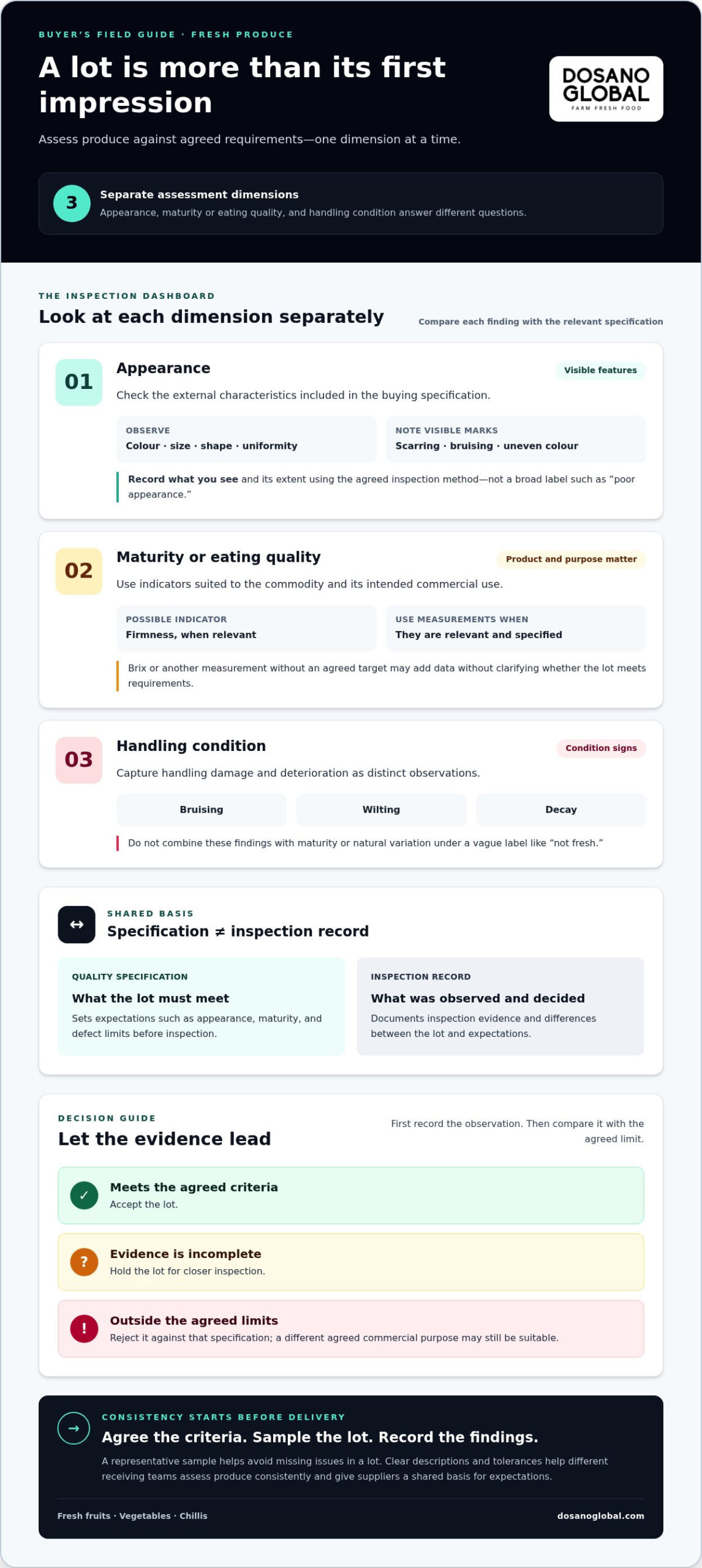
A quality specification defines what a lot must meet; an inspection record documents what was observed and the decision made. A specification sets expectations for attributes such as appearance, maturity, and defect limits. The record captures inspection evidence and any differences between the lot and those expectations.
What does a fresh produce quality check assess?
Keep three assessment dimensions distinct. Appearance covers visible features such as colour, shape, and surface marks. Maturity or eating quality considers indicators relevant to the product and its intended use. Handling condition focuses on signs such as bruising, wilting, or decay. These measures are not interchangeable: an item may look presentable but be too mature for its planned use, or have a superficial mark without being unsuitable.
The right indicators depend on the commodity, buyer specification, and purpose. A minor surface blemish may be acceptable for one use but not another. General food grading also involves inspection, assessment, and sorting by factors such as quality and freshness, as outlined in this overview of food grading. For buyers, the practical question is whether an observed feature exceeds the agreed limit, not simply whether the feature exists.
Why buyers need criteria before inspecting a lot
Without shared criteria, the same produce can receive different judgments from different people. One receiver may treat a colour variation as natural; another may view it as a sign that maturity falls outside the required range. Clear descriptions and tolerances reduce subjectivity and help teams assess lots consistently, even when different people handle receiving.
Criteria also make the decision more precise. A lot may be accepted when it meets requirements, held for closer inspection when evidence is incomplete, or rejected when it falls outside agreed limits. A lot that falls short of one commercial grade may also be suitable for another agreed purpose. Keep the observed defect separate from the decision: record what was found first, then compare it with the relevant limit.
Set expectations before ordering, including which attributes matter most and how exceptions will be handled. A fresh fruit sourcing buyer’s guide offers broader context for aligning sourcing decisions with commercial requirements. For fruits, vegetables, and chillis, consistent criteria help buyers communicate expectations and support dependable supply relationships.
Fresh produce quality checks: assess appearance, maturity, and condition separately
A practical inspection separates what the buyer can see from indicators of maturity and signs of handling damage. These dimensions can affect one another, but combining them into a single impression makes findings harder to interpret. For fresh produce quality checks for buyers, assess each dimension against the product specification and intended commercial use. A mark, colour variation, or firmness level matters in relation to the agreed requirement.
Check visible characteristics against the agreed specification
Start with the external features covered by the specification, which may include colour, size, shape, uniformity, scarring, or bruising. Compare the lot with stated grades, tolerances, or shared reference examples, not with a personal preference for a particular appearance. The USDA Agricultural Marketing Service explains that its vegetable grade standards provide a voluntary common language for describing quality and condition in the U.S. marketplace. They can offer useful terminology, while the buyer’s agreed requirements remain the basis for the purchasing decision.
Make notes specific. Instead of writing “poor appearance,” describe what you observed, such as uneven colour, visible scarring, or bruising, and record its extent using the agreed inspection method. Then compare the evidence with the applicable limit. Natural variation may be acceptable; a defect becomes an acceptance issue when it exceeds agreed criteria. This keeps the observation factual and prevents a buyer’s preference from being mistaken for a purchase requirement.
Assess maturity and condition without assuming one measure fits all
Maturity and eating-quality indicators vary by commodity and purpose. Firmness may matter for produce intended to withstand handling, while another order may call for a different maturity stage. Use internal checks or measurements such as Brix only when they are relevant to the product and included in the buying specification. A measurement without an agreed target can add data without clarifying whether the lot meets requirements.
Keep handling condition separate from maturity and natural variation. Record wilting, decay, or handling damage as distinct observations rather than grouping them under a broad label such as “not fresh.” For example, record a maturity concern separately from visible bruising, then assess each against its own criterion. This makes it easier to decide whether the lot meets its intended use, needs closer review, or falls outside agreed limits.
A simple working sequence helps teams stay consistent:
- Appearance: Compare relevant colour, size, shape, and surface features with the specification.
- Maturity: Assess only the maturity or internal indicators that affect the order.
- Condition: Record wilting, decay, and handling damage separately from natural variation.
Buyers can use the same product-specific approach when reviewing produce supply. Dosano Global sources fruits, vegetables, and chillis for commercial clients, with supply supported by stringent quality controls. Dosano Global’s produce supply is one option for commercial orders with clearly defined requirements.
Fresh produce sampling: decide whether the sample represents the lot
A sample helps buyers assess a lot without inspecting every item, but its findings are useful only if the selection reflects the lot. Fresh produce quality checks for buyers should follow an agreed sampling plan, not an improvised handful chosen from the most accessible package. Sampling can reveal concerns, but it can’t prove that every unexamined item is identical.
Define the lot before sampling. Identify which delivery, product, or group of packages the decision will cover, then follow the sampling method agreed for that lot. No single sample quantity suits every commodity, package format, or transaction. Use the applicable specification and inspection procedure, and verify any sampling threshold or regulatory rule for the commodity and transaction rather than applying a generic number.
Select samples consistently across the lot
Use the agreed plan to select produce from multiple packages or positions in the lot. Don’t rely only on packages that are easiest to reach or items that look best from the outside. If defects are concentrated in one area, a sample drawn elsewhere may miss them. Selecting only from a visibly affected area can also overstate how widespread the issue is.
Make the selection repeatable. The receiving team should be able to understand where the sample came from and how it was chosen. Record the lot identity, sample source, inspection time, and the person conducting the check. These details help link findings to a particular delivery and distinguish documented results from impressions based on an incomplete sample.
Respond when results are mixed or uncertain
Mixed findings don’t automatically mean the whole lot passes or fails. Compare observations with agreed tolerances and the sampling procedure before deciding whether the evidence supports acceptance. If the sample shows a few defects alongside sound produce, record the type and extent of each finding. Don’t assume the observed proportion describes every package unless the agreed method supports that conclusion.
When results are unclear or close to an agreed limit, follow the established procedure for repeating or expanding the inspection. Don’t add an arbitrary number of packages or change the selection method midway, since that makes the result difficult to interpret. If an applicable rule sets a specific sampling approach or threshold, verify that it applies to the commodity and transaction.
Keep uncertainty visible in the record. State what was examined, what was observed, and what remains unknown about the unsampled portion. Then record the decision separately, such as accepting under the agreed criteria, holding the lot for review, or following the specified escalation process. This prevents a sample result from being presented as certainty about produce that wasn’t checked and gives buyers and suppliers a clear basis for follow-up.
A buyer’s fresh produce quality checklist for receiving and recording findings
A repeatable receiving sequence keeps inspections clear, from identifying the delivery to making a decision. Use the same agreed steps for each lot, while tailoring the attribute list and sampling method to the product specification. Fresh produce quality checks for buyers are most useful when another team member can understand what was checked, what the findings mean, and why the lot was accepted or held.
Receiving checklist: from lot identification to inspection
Follow the sequence below and record findings as you go. Match the product identity, lot details, packaging, and labels against the purchase specification. Then use the agreed sampling procedure and attribute list. Commercial quality criteria assess whether produce meets the order; food safety and regulatory checks are separate matters, and applicable requirements should be verified for the commodity and transaction.
- Identify the lot: Record product identity and available lot details, then compare packaging and labels with the purchase specification.
- Confirm requirements: Refer to the agreed attributes, tolerances, and sampling procedure for that order.
- Select the sample: Follow the agreed method and note where the sample came from.
- Assess and record: Capture relevant observations and measurements, plus the inspection date and responsible person.
- Decide: Apply the agreed outcome category and record any follow-up needed.
A useful inspection record identifies the lot, method, findings, and decision. Include enough detail to connect each observation to the relevant criterion. For example, record the defect type and extent rather than writing only “off specification.” If an attribute requires a measurement, include the result and the agreed criterion used to interpret it.
Record decisions and manage exceptions consistently
Use decision categories that match the buyer-supplier agreement, such as accept, hold for review, or reject. A hold is useful when a finding needs review or the available evidence doesn’t support a clear decision. Keep that status distinct from a final rejection, and note who is responsible for the next step under the agreed process.
A compact log can make the reasoning easy to review:
| Check | Observation | Agreed criterion | Evidence | Decision |
|---|---|---|---|---|
| Product identity | Recorded product and lot details | Purchase specification | Label or lot record | Pass or follow up |
| Sampled attribute | Specific finding and extent | Relevant tolerance | Notes, measurement, or photo | Accept, hold, or reject |
Photographs can clarify a visible finding when they show the affected produce and relate clearly to the lot record. Use them as supporting evidence, not as a substitute for written observations or agreed criteria. Escalate material differences through the established buyer-supplier process, and retain the inspection record so recurring issues can be reviewed against the same standard.
For commercial buyers aligning produce requirements with supply, Dosano Global’s fresh produce supply includes fruits, vegetables, and chillis.
Turn produce quality checks into clearer supplier partnerships
Consistent inspection is more than a receiving task. It gives buyers and suppliers a shared basis for discussing whether a lot meets commercial requirements and makes follow-up more constructive when findings differ. Set acceptance criteria before placing an order, then apply those same criteria at receipt. This reduces the risk of judging a delivery against expectations that were never clearly communicated.
Align specifications, samples, and records with suppliers
Agree on the attributes that matter for each commodity, the applicable tolerances, how samples will be selected, and which decision categories will be used. Describe findings in practical, observable terms so both teams understand the same issue. For example, identify the type and extent of a defect rather than relying on a broad label such as “poor quality.” This shared language makes inspection records easier to interpret and compare.
When an exception occurs, use the documented finding as the starting point for a supplier discussion. Compare it with the agreed criterion, clarify any difference in interpretation, and follow the agreed process for review. If requirements change, update the specification and sampling approach before the next order. Make revised expectations explicit rather than assuming they carry over from a previous delivery or informal conversation.
Use a repeatable framework across different produce categories
A consistent inspection structure can work across fruits, vegetables, and chillis, but acceptance criteria must remain commodity-specific. Teams can follow the same overall process while changing the relevant attributes and limits to suit the order. Don’t transfer one commodity’s size, maturity, or defect thresholds to another. A familiar checklist supports consistency; it doesn’t make different products interchangeable.
Review records periodically to identify recurring findings. Look for repeated disagreement over an attribute, unclear wording in a specification, or an inspection method that doesn’t answer the buyer’s practical question. Then decide whether the criteria need clearer definitions, better reference examples, or a different agreed approach. This turns isolated exceptions into useful information for improving future orders and reducing avoidable disputes.
For commercial buyers, fresh produce quality checks for buyers work best as part of an ongoing sourcing relationship: requirements are clear before ordering, observations are recorded at receipt, and both sides use the evidence to resolve exceptions. Dosano Global sources and supplies fresh fruits, vegetables, and chillis to commercial clients across the UAE and global markets, with produce supply supported by stringent quality controls.
Find out more about Dosano Global’s fresh produce supply for commercial requirements.
Make Your Next Produce Order Easier to Align
Turn quality expectations into a practical buying reference. Before placing an order, identify which attributes matter most for its intended use and make sure the people assessing delivery can apply those expectations consistently. When commercial requirements change, update the reference so future decisions reflect what your business needs.
Fresh produce quality checks for buyers are most useful when they inform the next order, not just the decision on the current lot. Use documented observations to clarify specifications, improve supplier communication, and make acceptance decisions easier to explain across your team. A shared standard gives each delivery a clearer commercial basis.
Dosano Global supplies fresh fruits, vegetables, and chillis to commercial clients across the UAE and global markets, supported by stringent quality controls. Explore Dosano Global’s fresh produce supply for your next commercial order and make your requirements clear from the outset.
Frequently Asked Questions
What should buyers check first when inspecting fresh produce?
Start by confirming that the delivery matches the product and lot described in the purchase documents. Check whether the packaging is intact and whether the product’s visible condition raises an immediate concern that needs attention before routine assessment. If the identity or lot details don’t match, pause the quality decision and resolve the discrepancy first. This ensures inspection findings are recorded against the correct order.
How many pieces of produce should a buyer sample from a lot?
There’s no single sample quantity that suits every lot. Follow the sampling plan agreed for the commodity and transaction, along with any applicable inspection procedure. The appropriate approach can depend on lot size, packaging, product variability, and the purpose of the check. Avoid choosing an arbitrary count or treating a sample as proof that every unsampled package has identical condition.
Can buyers accept produce with cosmetic defects?
Yes, if the defect falls within the agreed tolerance and the produce still meets the order’s intended use. A superficial mark might be acceptable for one commercial application but not for a specification that requires a particular appearance. Record the defect clearly and compare it with the agreed limit. Cosmetic appearance alone doesn’t establish whether a lot is acceptable or unsuitable.
What happens if a sample shows mixed quality?
Mixed results call for a decision based on the agreed procedure, not an assumption that the entire lot is either sound or defective. Note which findings meet the criteria and which need review, and consider whether the pattern is isolated or appears across sampled packages. If evidence is inconclusive, use the agreed process for further inspection or escalation, and keep the lot’s status clear while a decision is pending.
Should fresh produce quality checks include Brix measurements?
Include Brix only when it’s relevant to the commodity, intended use, and buyer specification. A reading can support an assessment where soluble-solids content is an agreed indicator, but it shouldn’t be treated as a universal measure of freshness or overall quality. If the specification sets a Brix requirement, use its stated method and acceptance range. Otherwise, the reading may not answer the commercial question the inspection needs to resolve.
What records should buyers keep after a produce inspection?
Keep the lot and order references, inspection date, responsible person, sampling method, observations, relevant measurements, and final decision together. Add photographs or follow-up notes when they clarify an exception, and record who reviewed or resolved it. These details make fresh produce quality checks for buyers easier to compare across deliveries and help teams identify whether a recurring issue calls for a clearer specification or supplier discussion.
How often should a produce quality specification be reviewed?
Review a specification whenever commercial requirements change, a product’s intended use shifts, or recurring inspection findings reveal unclear limits. Repeated disagreement about acceptable scarring, for instance, may show that the wording or reference examples need refinement. Buyers can also schedule periodic reviews as part of supplier discussions, rather than waiting for a serious exception. Update the agreed version so receiving teams apply current criteria to future orders.