
 English
Fruit Exporter UAE: A Commercial Buyer’s Guide to Reliable Supply
A dependable fruit supply is built before a shipment is booked. For UAE commercial buyers, choosing a fruit exporter UAE businesses can rely on means...

A dependable fruit supply is built before a shipment is booked. For UAE commercial buyers, choosing a fruit exporter UAE businesses can rely on means aligning product requirements, quality expectations, seasonal availability and delivery planning with day-to-day operations. If those details aren’t clear, even a promising supply relationship can be difficult to plan around.
Consistent quality and availability matter, but supplier claims are useful only when they connect to your procurement needs. Buyers also need clear communication about sourcing, quality controls and shipment planning. Dosano Global supplies fresh fruits and seasonal produce to commercial clients, with cross-border sourcing and stringent quality controls supporting its supply approach.
This guide offers a practical framework for assessing a fruit supply partner and shaping a dependable procurement relationship. You’ll learn how to align product needs and purchasing plans, account for seasonality, and clarify expectations around quality and delivery. The result is a more focused basis for commercial discussions and a supply plan designed around your business.
Key Takeaways
- Understand how exporters, importers, wholesalers and retailers fit into a commercial fruit supply relationship.
- Assess fruit quality through distinct factors such as visual condition, ripeness, freshness and consistency.
- Use a practical framework to compare a fruit exporter UAE businesses may work with against your product and supply requirements.
- Shape a procurement brief around product specifications, demand patterns, timing and clear communication.
- Explore how Dosano Global’s cross-border sourcing and quality controls support commercial fruit supply for UAE buyers.
Fruit exporter UAE: what commercial buyers should expect
A fruit exporter connects supply sources with business buyers, helping move fresh fruit across commercial markets. The role is practical: understand the buyer’s needs, coordinate sourcing and supply, and communicate clearly about the arrangement. When assessing a fruit exporter UAE businesses may work with, focus on how its supply approach fits your operation, not simply on the breadth of its catalogue.
Fruit export supply serves a business procurement need; a consumer grocery purchase is an individual retail transaction. That distinction affects how buyers discuss assortment, order planning, quality expectations and ongoing supply. These factors work together. A suitable fruit range has limited value if quality expectations are unclear or supply planning does not reflect how the buyer operates.
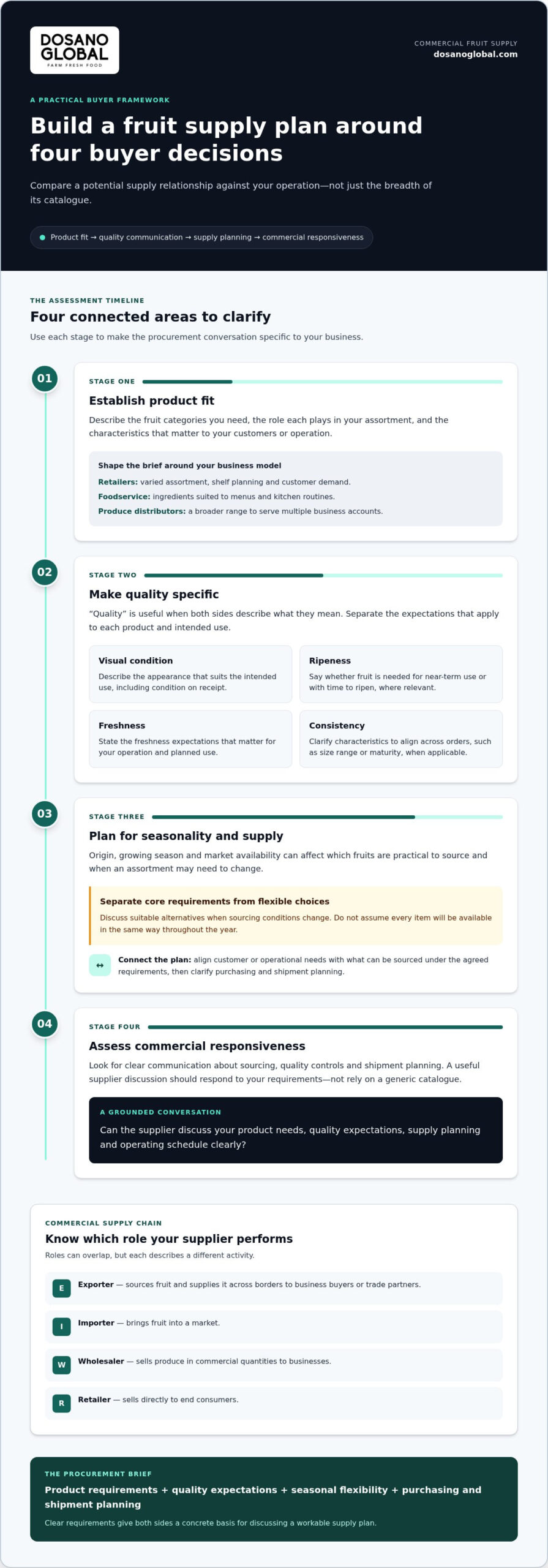
Roles in the commercial chain can overlap, but they describe different activities. An exporter sources fruit and supplies it across borders to business buyers or other trade partners. An importer brings fruit into a market. A wholesaler sells produce in commercial quantities to businesses, while a retailer sells directly to end consumers. Knowing which role a supplier performs helps buyers understand where sourcing, market entry and onward distribution sit in the relationship.
The UAE’s climate and agricultural conditions form part of the wider context for fruit sourcing. The Agriculture in the United Arab Emirates overview provides background on local production and factors shaping the market. The practical takeaway for buyers is to consider sourcing and seasonality when planning an assortment, rather than assuming every fruit will follow the same supply pattern throughout the year.
How a fruit exporter supports commercial procurement
Commercial sourcing starts with a clear buyer brief. Describe the fruit categories you need, the role each plays in your assortment, the quality characteristics that matter to your customers, and how your business plans purchases. This gives the supplier a concrete basis for discussing sourcing and cross-border supply without assuming a particular origin or route. Clear requirements at the outset help both sides discuss a workable plan.
Which UAE businesses may source fruit commercially?
Retailers may need a varied assortment that supports shelf planning and customer demand. Foodservice operators, including restaurants and catering businesses, may focus on ingredients suited to menus and kitchen routines. Produce distributors may prioritize a broader range to serve multiple business accounts. Because buying volumes, assortment needs and operating schedules differ, a useful supplier discussion should reflect the buyer’s business model rather than rely on a generic catalogue.
Compare potential supply relationships across four connected areas: product fit, quality communication, supply planning and commercial responsiveness. Together, they show whether the conversation is grounded in your procurement needs. Dosano Global supplies fresh fruits and seasonal produce to commercial clients, with cross-border sourcing and stringent quality controls as part of its supply approach.
How fruit sourcing, quality control and seasonality shape supply
Fruit supply is shaped by more than the product name. Origin, growing season and market availability can all affect which fruits are practical to source and when an assortment may need to change. For UAE buyers, procurement plans should connect what customers or operations need with what can be sourced under the agreed requirements.
Seasonality should shape a commercial fruit plan, not surprise it. A flexible assortment can help a business respond to changes in availability while keeping purchasing priorities clear. Instead of assuming every item will be available in the same way throughout the year, identify core requirements and discuss suitable alternatives when sourcing conditions change.
Seasonality and product availability for UAE buyers
Availability varies by fruit, season and sourcing conditions. A retailer might plan a core range while allowing for seasonal changes. A foodservice buyer may prioritize fruit for planned menus and adjust purchasing as supply changes. Distinguishing essential items from flexible choices in your procurement brief makes it easier to discuss assortment planning without assuming a year-round supply calendar.
For broader market context, the UAE Fruit Import and Export Data from the Observatory of Economic Complexity provides a reference point for the country’s fruit trade. Trade data can inform market understanding, but it does not establish the availability or timing of a specific commercial supply. Discuss those details in relation to your requirements and current sourcing conditions.
What fruit quality control should mean in a buyer discussion
“Quality” becomes useful when both sides describe what they mean. Separate these points in the discussion:
- Visual condition: Describe the appearance that suits your intended use, including the condition you expect on receipt.
- Ripeness: Explain whether fruit is needed ready for near-term use or with time to ripen, where relevant to the product.
- Freshness: State the freshness expectations that matter for your operation and how they relate to planned use.
- Consistency: Clarify which product characteristics should remain aligned across orders, such as size range or maturity, when those specifications apply.
These are distinct considerations, not interchangeable labels. Attractive appearance alone, for example, doesn’t establish the ripeness required for a kitchen schedule. Setting expectations in plain language gives the buyer and supplier a shared basis for discussing the fruit and can reduce misunderstandings about what an order is meant to deliver.
A fruit exporter UAE buyers engage with should be able to discuss sourcing, quality expectations and seasonal planning as connected parts of supply. Dosano Global supplies fresh fruit and seasonal produce to commercial clients and applies stringent quality controls to fresh produce. Buyers preparing a procurement brief can discuss commercial fruit supply requirements with the team, including product characteristics and the flexibility their operation needs.
Compare fruit exporters in the UAE with a practical buyer framework
A broad fruit catalogue can look impressive, but range alone doesn’t show whether a supplier’s approach fits your procurement needs. Compare the details that affect day-to-day buying: the fruit you need, how quality expectations are communicated, how changing availability is discussed, and how clearly the supplier responds to commercial questions.
Use the framework below to structure a like-for-like discussion. Assess each area against your own product brief instead of treating a general claim as proof of fit.
| Area | What to assess | What a useful discussion covers |
|---|---|---|
| Product fit | Alignment with your fruit categories and stated requirements. | Which items are central to your assortment and what product characteristics matter to your business. |
| Quality communication | Whether quality expectations can be described clearly. | How you define condition, ripeness, freshness and consistency for your intended use. |
| Supply planning | How the supplier discusses availability changes and procurement needs. | Whether planning can account for your demand patterns and flexibility around assortment. |
| Commercial responsiveness | Clarity and relevance in the supplier’s replies. | Whether responses address your questions and help clarify project-specific commercial terms. |
Assess product fit, quality expectations and communication
Start by matching the fruit categories and specifications in your brief to the supplier’s commercial supply approach. A catalogue may show breadth, but a suitable arrangement connects requested items with your intended use and buying priorities. Discuss quality in concrete language so both sides understand the expectations. Clear, relevant replies also help show whether communication can support an ongoing business relationship.
For example, a retailer and a foodservice operator may request the same fruit but have different assortment or ripeness requirements. A useful supplier conversation makes room for those distinctions instead of relying on broad descriptions such as “premium quality.”
Compare supply planning and partnership suitability
Assess how the supplier discusses changing availability and your procurement needs. A practical conversation connects potential assortment adjustments with your replenishment plans rather than implying that conditions remain uniform. Consider whether the communication helps your team plan what is essential, where flexibility is possible, and how updates can support purchasing decisions.
A fruit exporter UAE buyers consider should be evaluated on this fit, not just catalogue size. Dosano Global supplies fresh fruits and seasonal produce to commercial clients, with cross-border sourcing and stringent quality controls for fresh produce. For broader sourcing context, explore the guide to fresh fruit supply essentials for UAE buyers. Use your completed framework to start a focused discussion about product requirements and project-specific commercial terms.
Plan fruit procurement for UAE business requirements
A focused procurement brief turns operational needs into a practical commercial discussion. Before approaching a fruit exporter, UAE buyers should know what their business needs, what can vary and how supply updates should be handled. This preparation connects fruit specifications with demand, planning and cross-border supply considerations.
Build a clear fruit supply brief
Document your requirements in sequence. Include enough detail to make the conversation specific while leaving room to discuss alternatives when your operation can accommodate them.
- Define the products and purpose. List the fruit categories required and explain how each will be used, such as for retail assortment or foodservice operations.
- Describe the specifications. Note relevant expectations for condition, ripeness, freshness, consistency, presentation or other product characteristics that matter to your business.
- Map your demand pattern. Summarize how purchasing needs change over time, including recurring demand, busier periods and items that may be more flexible.
- Set acceptable assortment flexibility. Separate essential requirements from preferences that could change with seasonal availability or sourcing conditions.
- Agree how to communicate. Outline how you prefer to discuss planning, quality expectations, changes and procurement updates, so both sides have a clear basis for ongoing coordination.
This sequence helps distinguish fixed needs from negotiable details. For example, a buyer might require certain fruit categories for regular operations but have flexibility in the wider assortment. The brief should reflect the business’s real priorities, not an idealized list that leaves no room to plan around changing supply conditions.
Prepare for cross-border supply discussions
For cross-border supply, identify questions about the specific product and proposed route, including what shipment planning involves and which documentation considerations may apply. Requirements can depend on the fruit and current rules. Verify applicable UAE import and food requirements through relevant official sources before finalizing arrangements. Don’t rely on a generic checklist or assume the same requirements apply to every product.
Keep the discussion practical. Share the product brief, clarify which specifications are essential, and explain the purchasing pattern the supplier needs to understand. This gives both parties a clearer starting point for discussing sourcing, quality controls and planning without assuming a particular shipment schedule or set of documents.
A well-prepared brief supports a more useful commercial conversation and helps align fruit supply with your business requirements. Review Dosano Global’s commercial fruit supply information as you prepare your procurement brief.
Dosano Global: a commercial fruit supply partner for UAE buyers
Dosano Global supplies fresh fruit and seasonal produce to commercial clients in the UAE and international markets. Its cross-border trade activity connects sourcing with commercial supply, supported by stringent quality controls for fresh produce. For UAE businesses, a supply relationship is most useful when these capabilities align with the operation’s requirements, not when the decision is based on catalogue breadth alone.
A productive discussion begins with the buyer’s priorities: which fruit categories are needed, what product characteristics matter, how demand changes, and where flexibility is possible. Clear communication around these points helps both sides build a shared understanding of the procurement objective and consider a practical supply approach.
A focused approach to commercial fruit supply
Dosano Global sources and supplies fresh fruit for commercial buyers, with cross-border trade supporting supply to UAE and international markets. Quality controls are part of this approach, while the buyer’s product brief helps shape the commercial conversation. This creates a clearer basis for discussing how fruit requirements, seasonal produce and procurement planning fit together.
Businesses use fruit in different ways. A retailer may be planning an assortment for customers, while a foodservice operator may need products aligned with its operational requirements. A distributor may have its own account needs to consider. In each case, sharing the intended use and important specifications gives the supplier useful context for a tailored discussion without assuming identical needs across buyers.
For buyers whose brief includes East African sourcing, the guide to East Africa fruit supply for UAE buyers provides relevant origin context. It can complement a product brief when that region is part of the sourcing conversation.
Move from supplier comparison to a supply conversation
Turn your comparison notes into a concise brief before opening a commercial discussion. Include the fruit categories you’re seeking, specifications that matter to your business, anticipated demand patterns and any flexibility in assortment. Add your expectations for communication about quality and supply planning. This helps keep the conversation focused on your operating needs and makes it easier to explore how a supply relationship could be structured around them.
As a fruit exporter UAE buyers assess, Dosano Global brings together fresh fruit supply, cross-border trade and stringent quality controls for fresh produce. A direct conversation about your requirements lets product needs and procurement priorities guide a practical discussion.
Start a commercial fruit supply discussion with Dosano Global.
Turn your procurement priorities into a clear next step
A dependable supply relationship starts with a useful exchange: your team brings its operating priorities, and the supplier discussion turns them into shared expectations. As you consider a fruit exporter UAE businesses can work with, focus on the questions that will shape your next purchasing decision: which requirements are essential, where can your assortment flex, and what information will help your team plan confidently?
Dosano Global supplies fresh fruits and seasonal produce to commercial clients, supports cross-border trade for UAE and international markets, and applies stringent quality controls for fresh produce. A focused discussion can connect these capabilities with your specific procurement brief, including product needs, specifications and planning priorities.
Bring your requirements forward and put the conversation on a clear footing. Share your commercial fruit supply brief with Dosano Global and take the next step toward a supply approach shaped around your business.
Frequently Asked Questions
What is the difference between a fruit exporter and a fruit wholesaler?
A fruit exporter typically facilitates commercial movement of produce across borders, while a wholesaler supplies fruit to business buyers within a market. These roles can overlap, so clarify what each party handles in your arrangement. For example, establish who coordinates sourcing information, discusses product expectations and communicates supply updates. When speaking with a fruit exporter UAE businesses are considering, explain your intended use and procurement needs.
Can a fruit exporter in the UAE supply seasonal fruit throughout the year?
Not necessarily. Availability can vary with the fruit, its origin and sourcing conditions, so uninterrupted access to one specific item shouldn’t be assumed. Identify acceptable alternatives in advance. For example, a foodservice business planning a changing menu can separate essential ingredients from items that could be substituted, then discuss how availability updates will be shared. Treat forecasts as planning information, not a promise of continuous supply.
How much does it cost to source fruit from an exporter in the UAE?
There isn’t one dependable price that applies to every fruit order. Commercial terms depend on the requested product, its specifications, order requirements and the supply arrangement. To make a discussion useful, provide the same information for each product you’re asking about and request terms specific to your business rather than relying on a general market estimate.
What happens if a fruit shipment does not meet the agreed quality expectations?
The next steps depend on the commercial arrangement between buyer and supplier, so there’s no universal remedy to assume. Before supply begins, make sure the agreed product expectations and the process for raising a concern are clear. If an issue arises, record the relevant order details and describe the concern promptly through the agreed business channel. This gives both parties a specific basis for reviewing the matter and determining next steps.
Do UAE fruit exporters handle import documents and food requirements?
Responsibilities vary by product and commercial arrangement, while applicable UAE requirements can change. Before a shipment proceeds, establish which party is responsible for each relevant task and verify current requirements through appropriate official UAE sources. Avoid relying on a generic document list or assuming that one fruit’s process applies to another. Confirming responsibilities early helps prevent gaps in preparation without treating general guidance as a substitute for current rules.
Can commercial buyers source fruit from more than one origin?
Buyers can explore multiple origins when the product and supply arrangement allow, but origins shouldn’t be treated as interchangeable by default. Differences may affect the agreed product expectations or planning assumptions. If your business is open to alternatives, state which requirements must remain consistent and whether any change in origin needs approval before it affects your assortment. This gives the supplier a clearer basis for discussing options without implying that a particular route is available.
What information should I include when contacting a fruit exporter?
Share the fruit categories you’re considering, their intended commercial use, relevant specifications and your expected ordering pattern. It can also help to distinguish firm needs from early forecasts, identify who will make procurement decisions, and explain how your team prefers to receive updates. A concise brief gives the conversation a clear starting point and helps identify useful next steps. Avoid including sensitive business information unless it’s needed for the discussion.