
 English

Restaurant Food Procurement in the UAE: Manage Suppliers and Costs
A purchase order is only one part of food procurement. For UAE restaurants, effective restaurant food procurement best practices start with defining...

A purchase order is only one part of food procurement. For UAE restaurants, effective restaurant food procurement best practices start with defining needs, sourcing suppliers, and agreeing on terms, then continue with monitoring supplier performance. Treating procurement as a lifecycle connects each buying decision to reliable supply and cost control.
It is easy to focus on the price of an individual order, but a sound process also checks whether products meet the restaurant’s needs and supply remains consistent. A clear approach helps teams plan purchases, assess suppliers, and keep better control of spending and stock.
This guide explains what food procurement means and how its lifecycle works. It also covers practical ways to manage supplier relationships, compliance checks, budgets, negotiations, and waste in the UAE restaurant market.
Key Takeaways
- Build supplier relationships around clear product needs, consistent performance reviews and backup options for key categories.
- Use delivery inspections and accurate records to support quality assurance and spot supplier issues early.
- Start cost control by reviewing spending, contracts and operational gaps, then negotiate terms that fit your purchasing patterns.
- Follow procurement from needs assessment and supplier sourcing through ordering, delivery review and record updates.
- Connect sourcing priorities with stock planning to make purchasing decisions more consistent and reduce avoidable waste.
1. Supplier relationship management and performance evaluation
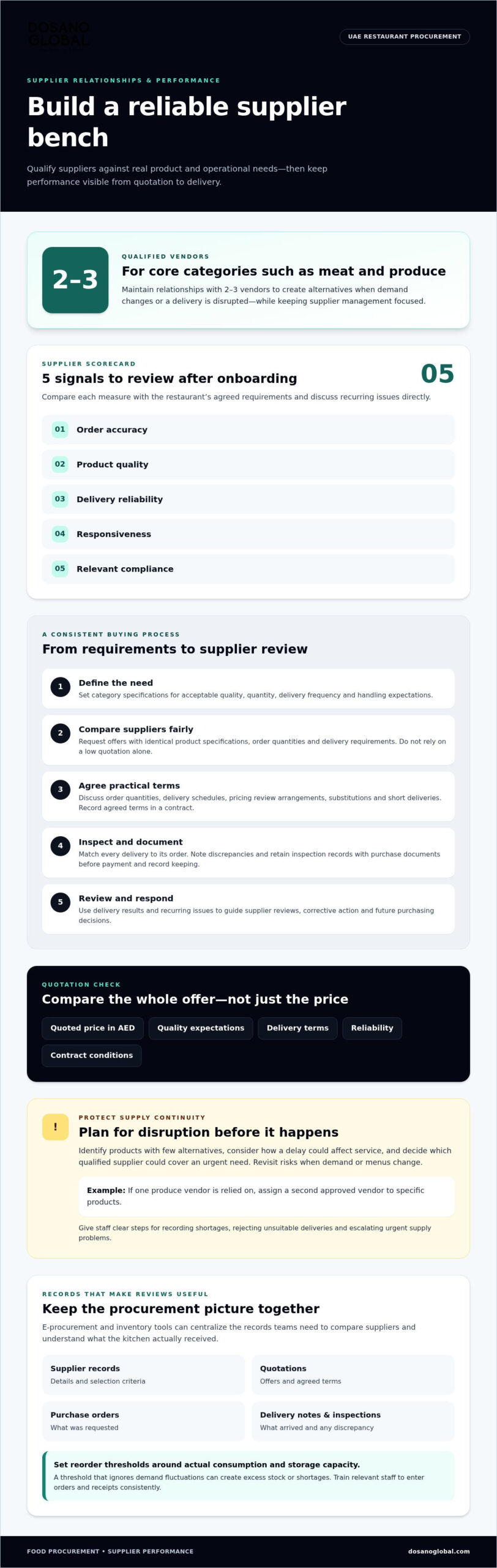
Reliable procurement starts with qualifying suppliers against the restaurant’s actual product and operational needs. Define specifications for each category, including acceptable quality, quantity, delivery frequency, and handling expectations. Then compare prospective suppliers using the same criteria, rather than relying on a low quotation alone. For core categories such as meat and produce, restaurants are advised to maintain relationships with 2-3 vendors. That approach creates alternatives when demand changes or a delivery is disrupted, while keeping supplier management focused.
Use a consistent review process after onboarding. Track order accuracy, product quality, delivery reliability, responsiveness, and relevant compliance, then discuss recurring issues directly with the supplier. A scorecard can compare each measure with the restaurant’s agreed requirements and show whether performance is improving. Consolidating an unwieldy vendor list can strengthen purchasing leverage and simplify communication. Keep enough qualified options to reduce disruption risk, but add suppliers only when there is a clear operational reason.
To compare wholesale food quotations across the UAE, request offers using identical product specifications, order quantities, and delivery requirements. Compare the quoted price in AED alongside delivery terms, quality expectations, reliability, and other contract conditions. Review supplier performance after orders arrive.
Build procurement risk management into regular supplier reviews, not just emergency plans. Identify products with few alternatives, consider how a delay could affect service, and decide which qualified supplier could cover an urgent need. For example, a restaurant relying on one produce vendor could assign a second approved vendor to specific products. Revisit these risks when demand or menus change, and give staff clear steps for recording shortages, rejecting unsuitable deliveries, and escalating urgent supply problems.
E-procurement and inventory software can centralize supplier records, quotations, purchase orders, and delivery notes. Inventory tools can track stock in real time, forecast needs from historical usage, and automatically reorder items when they fall below set thresholds. Set thresholds around actual consumption and storage capacity; a reorder point that ignores demand fluctuations can create excess stock or shortages. Train relevant staff to enter orders and receipts consistently, so the system reflects what the kitchen has actually received.
Use a documented quotation process to compare offers fairly. Send suppliers the same specifications and delivery requirements, then assess each response for quality, reliability, and operational fit. Negotiate practical contract terms, including order quantities, delivery schedules, pricing review arrangements, and procedures for substitutions or short deliveries. Record agreed terms in a contract and match every delivery to its order before completing payment and record keeping. These steps give managers a clear basis for reviewing supplier performance over time.
2. Automated compliance and supplier performance tracking
Start procurement with a needs assessment for each menu category. Record the product specification, expected demand, delivery frequency, storage constraints, and acceptable alternatives. Use these requirements to assess suppliers consistently instead of choosing on quoted price alone. For fresh produce, for example, compare suppliers on how well products match specifications, delivery reliability, and clarity of product details. Keep the selection criteria with the supplier record so the same standards guide onboarding and later reviews.
What UAE food safety and procurement regulations must restaurants follow? Restaurants must follow the food-safety and procurement requirements applicable to their operations and products. Put practical controls in place by documenting supplier details, inspecting deliveries, maintaining traceable records, and recording corrective action when a delivery fails an agreed quality check.
What are the requirements for importing food into the UAE, including permits and documentation? Import requirements depend on the product and shipment route, so identify applicable approvals and supporting documents before placing an order. Keep product and shipment records together, and clearly assign responsibility for collecting and retaining them between purchasing and receiving teams.
Supplier audits test whether documented expectations match actual practice. Use a consistent audit record to capture product quality, delivery performance, traceability information, and corrective actions. Inspect each food and beverage delivery on arrival before completing payment and record keeping. Compare the goods with the order, note discrepancies, and retain the inspection record with the purchase documents. This creates a useful history for supplier reviews instead of relying on staff memory after a problem.
Automated tracking can bring supplier records, purchase orders, audit findings, and delivery notes into one procurement view. Set reminders for scheduled reviews and flag incomplete records for follow-up. Track order accuracy, quality issues, and delivery failures, then review trends with the supplier. Assess the full supply chain from sourcing through receipt, including how the restaurant would respond to disruption. Staff also need training to record rejected deliveries, report shortages, and follow the agreed escalation process.
If a delivery fails, record the order details, the shortage or quality concern, and the immediate operational impact. Apply the agreed response, such as using an approved alternative or adjusting the purchasing plan, and document the supplier’s corrective action. Sustainable and ethical supply chains also depend on clear purchasing criteria. Record sourcing priorities, request relevant product information, and review whether supplier practices align with those priorities. These steps make supplier performance easier to assess and provide a traceable basis for decisions across the supply chain.
3. Budgeting, price negotiation, and cost control
Begin a procurement review by examining current spending, existing contracts, and operational gaps. Group purchasing records by category, such as meat, produce, and poultry, then compare planned purchases with actual usage. This highlights where demand forecasts, order quantities, or contract terms need adjustment. In 2026, global food and beverage essentials could rise in cost by up to 20%, making regular budget reviews important for UAE restaurants. Use that outlook to test purchasing plans, not as a forecast for any single ingredient.
How can restaurants in the UAE manage procurement budgets, inventory, and food waste? Set category budgets based on sales plans and past usage, then track purchases against them. Review stock regularly, adjust order quantities to demand, and record discarded ingredients to identify avoidable waste.
Use cost of goods sold (COGS) as a measure of food spending against revenue, while assessing the restaurant format and menu. Quick-service restaurants typically target COGS of 25–35% of revenue; full-service restaurants, 28–35%; and fine-dining restaurants, 30–38%. Treat these ranges as reference points, then examine portion sizes, menu mix, purchasing patterns, and waste. A rising ratio can signal higher ingredient costs, excess ordering, or inconsistent portion control.
Negotiating works best when the restaurant understands its own order pattern. Compare supplier quotations against the same product specifications, quantities, and delivery terms. Discuss pricing review arrangements, order frequency, bulk-order discounts, and payment timing. Restaurant food-service suppliers typically offer payment terms of 30–60 days, while procurement negotiations may include net-30 terms. Choose terms that fit cash flow and ordering needs, and record the final agreement in the contract.
How should restaurants handle cold-chain, storage, and delivery standards? Set receiving and storage procedures according to product requirements, and train staff to move temperature-sensitive deliveries promptly into appropriate storage. Record delivery condition and any issue against the order, then follow the restaurant’s food-safety procedures before accepting products for use.
Cost control continues after an order is placed. Match each delivery to its purchase order, inspect product condition and quantity, and document discrepancies before completing payment and records. If a supplier sends an unsuitable ingredient or a short quantity, record the issue and apply the agreed contract response. Review these records alongside purchasing and waste data, then adjust order quantities, supplier terms, or menu planning. Consolidating vendors, negotiating suitable contracts, and reducing avoidable waste can help UAE restaurants control procurement spending while maintaining product standards.
4. What Is Food Procurement?
Food procurement is the system a restaurant uses to plan and manage food purchases. Procurement consulting designs that system, while purchasing means buying a specific item. Setting produce specifications, selecting suppliers, and planning order schedules are procurement tasks. Placing an order for tomatoes is purchasing. This distinction helps restaurant teams connect individual orders with menu needs, stock levels, supplier performance, and waste reduction.
In the UAE, sourcing choices must account for a market where 90% of food is imported. Restaurants can set category priorities, then consider local sourcing where products and supply arrangements fit their needs. For each item, record the required quality, expected demand, origin information, and delivery requirements. A produce platform or shared purchasing record can help teams compare sourcing options and capture insights without treating every product as interchangeable.
Sustainable sourcing also means planning purchases around likely use. Review menus, sales patterns, and current stock before ordering, then adjust quantities when demand shifts. For example, if a planned menu change reduces use of a vegetable, update the next order instead of carrying the previous quantity forward. This connects sustainability to everyday decisions and helps purchasing teams reduce surplus before it becomes food waste.
Food waste is relevant across the UAE hospitality industry. Restaurants can help address it by recording discarded ingredients, identifying why each item was wasted, and changing purchasing or preparation decisions accordingly. Spoilage, over-ordering, and low menu demand call for different fixes, so useful records should capture the reason, not just the quantity.
Local and sustainable sourcing requires clear criteria, not just a broad label. Assess whether a supplier’s products meet quality requirements, whether delivery timing suits service, and whether sourcing information supports the restaurant’s priorities. Apply the same criteria during supplier reviews and note changes in product origin or availability. This creates a record for comparing options over time and aligning sourcing decisions with menu and operational needs.
Make the process workable for kitchen, purchasing, and finance teams. Assign responsibility for updating demand forecasts, recording deliveries, and reviewing waste data. A shared platform can bring those records together, while regular reviews turn them into practical insights. Recurring surplus in one category, for example, may call for smaller orders, a revised menu plan, or a different purchasing schedule. Food procurement then becomes a connected system for sourcing, purchasing, and reducing waste, rather than a series of isolated transactions.
5. Food procurement lifecycle
A food procurement lifecycle connects a restaurant’s needs with purchasing decisions and later performance reviews. It moves through linked stages rather than ending with an order. Each stage informs the next: menu plans shape demand, supplier offers guide selection, and delivery records inform future orders. A clear sequence helps managers see how delays, quality issues, or surplus can affect service and profitability.
Start with planning. Review the menu, sales patterns, stock on hand, storage capacity, and upcoming service needs. Turn those needs into product specifications and order quantities. For example, if a menu change reduces demand for an ingredient, update the forecast before purchasing begins. This step limits avoidable surplus and gives suppliers a consistent description of what the restaurant needs.
Next, request offers that match those requirements. A request for proposals can gather supplier offers in a consistent format. Include product specifications, expected quantities, delivery arrangements, and required records. Compare responses against the same criteria, then document why a supplier fits the restaurant’s needs. This record gives the team a reference point if demand changes or a supplier cannot fulfil an order.
After selecting a supplier, agree on terms and create an order that matches the planned requirement. Record the product, quantity, delivery details, and applicable contract terms. When goods arrive, compare them with the order and inspect their condition before recording receipt. If an item is missing or unsuitable, document the discrepancy and its operational impact. Accurate records help staff resolve the immediate issue and inform later supplier reviews.
The lifecycle continues after delivery. Update inventory records to reflect accepted goods, then compare actual use with the forecast. If a restaurant regularly carries excess stock, review order quantities, menu demand, and purchasing frequency. If shortages recur, examine whether the forecast or delivery plan needs revision. These insights help improve preparation for the next purchasing cycle.
Keep procurement records accurate and up to date. Maintain connected files for needs assessments, proposals, supplier decisions, contracts, orders, receipts, and corrective actions. A shared platform can make these records easier for purchasing, kitchen, and finance teams to use. Assign responsibility for each update, such as asking receiving staff to record delivery results and managers to review recurring exceptions. Menus and demand change, so clear ownership helps keep decisions grounded in current information.
For restaurant food procurement best practices in the UAE, treat each completed cycle as an opportunity to adjust the next plan. Review where expected demand differed from actual use, whether deliveries matched orders, and which records need attention. Align your food purchasing plans with the products and quantities your operation requires.
Dosano Global: Meat
Dosano Global supplies fresh fruits, vegetables, and chillis for commercial food operations. Turn to Dosano Global when these categories fit your procurement needs and you want to align sourcing with your menu, demand, and supplier planning. Clear requirements, including product specifications and expected order quantities, connect purchasing decisions with kitchen needs and inventory plans.
For restaurants managing several ingredient categories, a steady sourcing relationship can simplify ordering and supplier coordination. Dosano Global also supplies meat, so buyers can source relevant food categories through one commercial relationship. Match each requirement to your menu and procurement process, then discuss the products that fit your operation.
Contact Dosano Global to discuss your restaurant’s food procurement needs.
Make Your Next Procurement Decision Count
Restaurant food procurement best practices in the UAE are most valuable when they guide decisions beyond the next order. Choose an upcoming purchasing cycle and assess whether your specifications, approvals, and records support the way your kitchen operates. A focused review can reveal where clearer requirements or better coordination would make the process easier to manage.
Turn those observations into a practical procurement priority. You might refine how a category is planned, improve the information shared with suppliers, or make purchasing records more useful to the people who rely on them. Define the next step, assign responsibility, and revisit the result in a future cycle. This steady approach helps your team build a procurement process that adapts as menus and demand evolve.
For a commercial food sourcing discussion shaped around your restaurant’s needs, contact Dosano Global to discuss procurement. Set a clear priority, bring your purchasing plans into focus, and move forward with confidence.
Frequently Asked Questions
What Is Food Procurement?
Food procurement is the coordinated work of planning, selecting, obtaining, and reviewing food purchases. It connects kitchen requirements with supplier decisions and internal controls. For example, when a restaurant introduces a dish, it needs to define ingredient requirements, estimate expected use, and decide who approves orders. Clear responsibilities across kitchen, purchasing, and finance teams help prevent duplicated orders and keep purchasing aligned with operational needs.
What is restaurant procurement?
Restaurant procurement applies food purchasing controls to the demands of a food-service operation. It matches ingredient orders to menu plans, service volume, storage capacity, and preparation needs. A café adding a seasonal salad, for instance, can coordinate produce requirements with menu planning before changing regular orders. This helps the team avoid treating procurement as an isolated task and assess purchases against actual kitchen use.
What are best practices for sourcing food suppliers for restaurants in the UAE?
Best practices for restaurant food procurement in the UAE start with clear, comparable requirements. Specify product characteristics, packaging expectations, order quantities, and delivery windows before assessing offers. Consider a trial order for a new ingredient, then evaluate how well it suits the menu and preparation method. Compare suppliers on product consistency, communication, and fit with the restaurant’s operating schedule, not just the quotation.
How should UAE restaurants verify supplier licenses, certifications, and food traceability?
Restaurants should keep supplier credentials and product traceability records together, then review them during onboarding and routine supplier checks. Confirm that business documents are current and relevant to the supplier’s role, and review the scope and validity dates of any certification presented. For traceability, retain product descriptions, batch or lot identifiers when provided, delivery records, and supplier details. This creates a clear record for investigating a specific ingredient or delivery.
What are the benefits and risks of buying local versus imported food in the UAE?
Local sourcing can offer closer coordination and may suit products available in the required quality and quantity. Imported food can broaden product choice and provide access to ingredients unavailable from local sources. Each option has different considerations: assess product consistency, delivery timing, sourcing information, and the impact of disruption on menus. Compare sourcing options by ingredient category rather than applying one approach to every item.
How should UAE restaurants negotiate supplier contracts, payment terms, and delivery schedules?
Negotiate contracts around the restaurant’s operating pattern, not just the headline price. Define how orders are placed, what happens when quantities change, how substitutions are approved, and how delivery issues are recorded. Align payment timing with invoice review and receiving procedures. Specify delivery days and time windows the kitchen can manage, then review the arrangement when menu demand or service hours change.
What procurement risks affect UAE restaurants, including shortages, price volatility, and food fraud?
Shortages can interrupt menu availability, price volatility can disrupt category budgets, and food fraud can compromise product integrity. Reduce exposure by identifying ingredients with few alternatives, tracking changes in supplier terms, and comparing delivered goods with their descriptions and records. For example, a mismatch between ordered and received product details should be documented and followed up before the ingredient enters kitchen use. Give staff clear steps for escalating suspected discrepancies.