
 English
Seasonal Fruit Sourcing in the UAE: A Guide for Buyers
Seasonal fruit sourcing UAE buyers can rely on works best as a rolling plan, not a fixed calendar. Harvest windows shift by origin and crop...

Seasonal fruit sourcing UAE buyers can rely on works best as a rolling plan, not a fixed calendar. Harvest windows shift by origin and crop conditions, so a fruit that is plentiful one month may be harder to secure, or vary in quality, the next. For commercial kitchens, retailers, and distributors, those changes can affect purchasing plans, menus, and daily operations.
Clear dates and dependable deliveries matter, but seasonal procurement is more reliable when buyers track current crop timing, define quality expectations, and plan for changes in availability. Instead of relying on a static calendar, coordinate demand forecasts, specifications, and order timing, then review them as conditions change.
This guide explains how to build a practical seasonal fruit sourcing plan for businesses in the UAE. You’ll learn how to assess availability by origin, align orders with changing harvest windows, set clear specifications, and plan logistics to protect freshness and continuity. Dosano Global sources seasonal fruits for commercial clients across the UAE, with quality controls that support fresh-produce supply.
Key Takeaways
- Build a practical seasonal fruit sourcing UAE plan by mapping each fruit to its origin, expected supply window, and planned order timing.
- Use a demand forecast and regular calendar reviews to adjust purchasing as crop windows and availability change.
- Set fruit specifications around intended use, maturity, and handling needs to support consistent quality across orders.
- Coordinate order timing, delivery requirements, and supply reviews to help maintain continuity through seasonal changes.
- Dosano Global supports commercial fruit supply across the UAE through cross-border sourcing and quality controls for fresh produce.
Seasonal Fruit Sourcing in the UAE: Why Timing Matters
Seasonal fruit sourcing UAE businesses can plan with confidence means aligning purchases with current harvest and supply information, rather than treating every fruit as equally available throughout the year. A year-round assortment aims to keep the same range on offer. Seasonal sourcing adjusts fruit choices, order timing, and specifications as crop conditions and supply change. This distinction helps buyers make realistic plans for freshness and continuity.
A seasonal calendar is a planning tool, not a promise that a fruit will be available on a particular day or at a consistent volume. Harvest periods can shift with growing conditions, and supply also depends on the source country and crop stage. The general idea of eating and buying produce in season is explained in Understanding Seasonal Food. For commercial buyers, use current crop information to guide decisions, then review the plan as conditions evolve.
What seasonal availability means for UAE fruit buyers
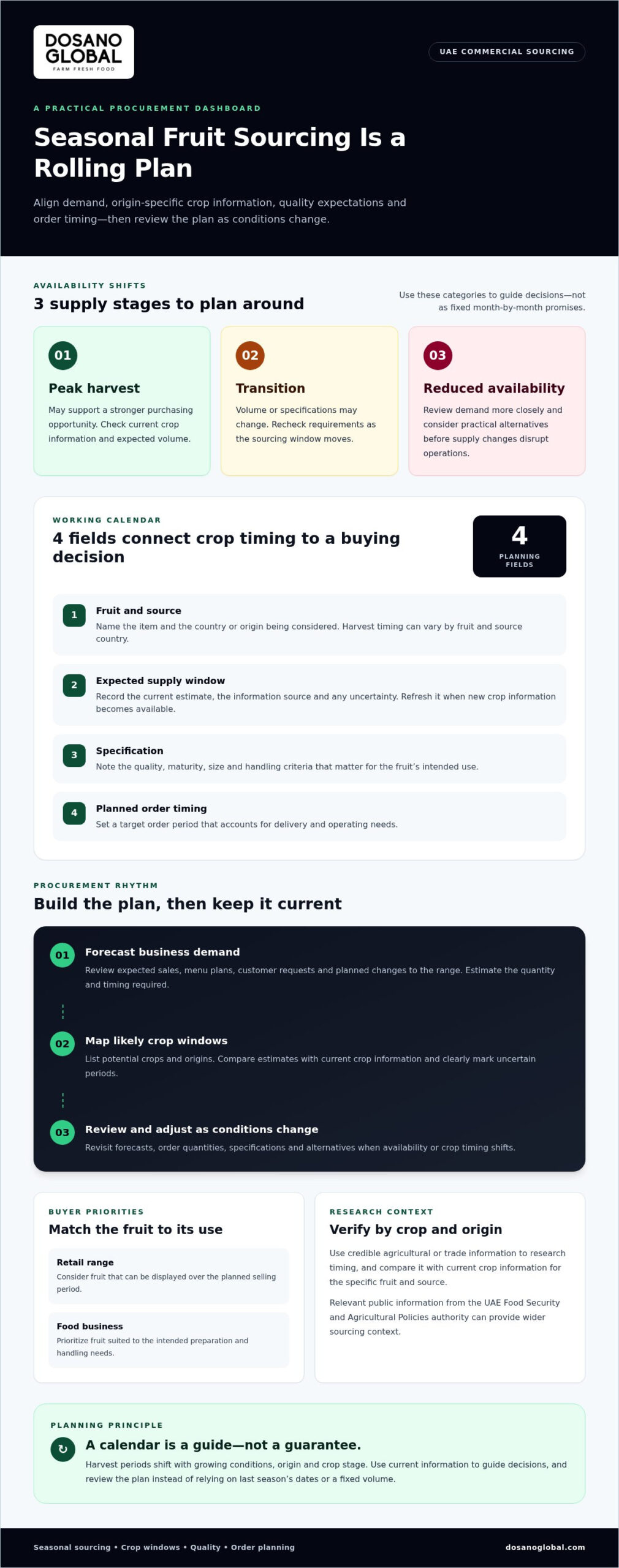
Harvest timing varies by fruit and source country, so a calendar built for one origin may not describe supply from another. Buyers can classify availability as peak harvest, a transition period, or reduced availability. Peak harvest may support a stronger purchasing opportunity, while transition periods can bring changes in volume or specifications. Reduced availability calls for a closer review of demand and alternatives. These categories support planning, but they are not fixed month-by-month claims.
For each fruit, record the expected window, its source, and the information used to verify it. Refresh those details as new crop information becomes available. This gives your team a clearer basis for comparing options and avoids treating last season’s timing as a guarantee for the next one.
How seasonality affects commercial purchasing
Timing shapes more than the order date. It affects planned quantity, the required maturity and appearance, and how fruit will be handled before use or sale. A retailer, for example, may need fruit that can be displayed over a planned selling period, while a food business may prioritize fruit suited to a particular preparation. Set specifications according to intended use, and review them when the sourcing window changes.
Consider a buyer who expects a steady volume of one fruit for a regular menu or retail range. If the crop window shifts or supply tightens, the buyer can review the forecast, adjust order quantities, and consider a suitable alternative before the change disrupts operations. The decision should account for customer demand, quality requirements, and whether the replacement fruit is practical to handle.
- Track the crop: Record the source, expected supply window, and latest crop information.
- Plan for variation: Avoid relying on one fixed date or volume across the full season.
- Review requirements: Match maturity, quality, and handling expectations to the fruit’s intended use.
This coordinated approach turns seasonality into a procurement advantage. Buyers can anticipate change, make informed adjustments, and maintain a dependable fruit offer as availability moves through peak, transition, and reduced-supply periods.
How to Build a Seasonal Fruit Sourcing Calendar
A useful sourcing calendar turns business demand and current crop information into a buying schedule. For seasonal fruit sourcing UAE businesses, it should show which fruit is needed, where it may come from, when supply is expected, and what requirements each order must meet. Treat the calendar as a working document that changes with the season and the business’s needs.
Map fruit demand to verified crop windows
Start with demand your business can identify: menu plans, sales patterns, customer requests, and planned changes to the range. Then map likely supply windows by fruit and origin. Use credible agricultural or trade information to research crop timing, and compare estimates with current crop information before using them to set purchase plans. Mark uncertain periods clearly rather than presenting estimates as confirmed dates.
UAE buyers can also follow relevant public information from the UAE Food Security and Agricultural Policies authority as part of wider sourcing research. A government resource can provide useful context, while fruit-specific harvest timing still needs to be assessed using current information for the particular crop and origin.
Turn the calendar into a buying schedule
Keep the calendar practical enough for procurement and operations teams to use. Give each fruit its own entry, with fields that connect expected availability to a clear purchasing decision:
- Fruit and source: Identify the item and the country or origin being considered.
- Expected supply window: Record the current estimate, the information source, and any uncertainty.
- Specification: Note the quality, maturity, size, or other criteria relevant to the intended use.
- Planned order timing: Set a target order period that accounts for delivery and operating needs.
Use a simple workflow to build and maintain the plan:
- 1. Forecast demand. Review expected sales, menu requirements, and customer needs to estimate the quantity and timing required.
- 2. Map fruit windows. List potential crops and origins, then record likely supply periods without assuming every source follows the same calendar.
- 3. Verify sources. Check current crop and market information, note when it was reviewed, and flag gaps for follow-up.
- 4. Schedule reviews. Set review points ahead of expected seasonal transitions, and revisit the plan when new information or a change in demand emerges.
A seasonal calendar stays useful only when buyers update it against current crop information and changing business demand. During each review, compare the latest supply outlook with planned volumes and delivery needs. If a window shifts, revise order timing, adjust the quantity, or document an alternative specification or sourcing window that still meets the operation’s requirements.
For commercial buyers coordinating cross-border supply, this calendar supports clearer procurement conversations and more deliberate planning. Dosano Global supplies seasonal fruit to commercial clients across the UAE. Its commercial seasonal fruit supply can support a buying plan built around current supply information and defined requirements.
How to Compare Seasonal Fruit Options for Quality and Consistency
Fruit options are easier to compare when buyers assess them against the same commercial requirements. In seasonal fruit sourcing UAE procurement teams should distinguish a crop’s current supply window from the quality and handling criteria their operation requires. A calendar shows when to investigate supply; a specification helps determine whether an option is suitable to order.
Set fruit specifications before ordering
Agree on the variety, size or size range, maturity, condition, and intended use before comparing options. Separate measurable requirements, such as size range or acceptable condition, from subjective descriptions such as “attractive” or “ripe.” Define those terms in practical language so receiving teams and suppliers share the same expectations. A clear fruit specification names the variety, size, maturity stage, acceptable condition, intended use, and handling needs, giving each order and seasonal alternative a consistent basis for evaluation.
The table below is a comparison template, not a harvest calendar. Verify the expected window for each fruit and origin against current crop information before scheduling purchases. The right maturity and handling criteria depend on whether the fruit is intended for immediate sale, storage, or preparation.
| Fruit | Verified sourcing window | Intended use | Maturity to specify | Handling needs |
|---|---|---|---|---|
| Mango | Verify by origin and current crop information | Fresh sale or preparation | Stage suited to planned use and turnover | Set receiving, storage, and transit expectations |
| Avocado | Verify by origin and current crop information | Fresh sale or preparation | Stage suited to planned use and turnover | Agree handling to protect fruit condition |
| Citrus | Verify by origin and current crop information | Fresh sale, storage, or preparation | Define acceptable condition for the use | Specify storage and delivery requirements |
| Berries | Verify by origin and current crop information | Fresh sale or preparation | Set clear maturity and condition criteria | Plan careful handling and suitable temperature management |
Assess freshness and handling requirements
Assess visible condition against the agreed specification, rather than relying on a broad impression of freshness. Consider whether the fruit is intact and suitable for its intended use, and whether its maturity fits the time between receipt and sale or preparation. Storage and transit conditions matter too. Suitable temperature management helps protect produce quality, but handling needs vary by fruit and source.
Don’t apply one shelf-life or temperature figure across different fruits or origins. Use product- and source-specific guidance, and verify figures before adding them to purchasing documents. This keeps requirements accurate instead of turning a general assumption into an unsuitable rule.
Compare alternatives by asking whether each option meets the essential specification, fits the buyer’s handling capacity, and aligns with a verified sourcing window. If an alternative has a different size or maturity profile, record the difference and assess it against the actual use rather than treating it as interchangeable by default. For broader context on UAE agriculture and food priorities, consult the FAO’s perspective on agriculture in the UAE.
How to Plan Seasonal Fruit Orders and Protect Supply Continuity
Reliable seasonal orders start with business demand, clear product requirements, and regular communication. Connect expected usage to suitable sourcing windows and delivery needs, while allowing for adjustments if crop conditions or availability change. Seasonal fruit sourcing UAE businesses can manage effectively requires an early response to change without lowering the quality or suitability standards the operation depends on.
Prepare an order plan around business demand
Estimate usage from the factors that shape your operation: menu requirements, sales patterns, planned promotions, and customer demand. Compare the forecast with current stock and the fruit’s intended use, then decide what order timing and delivery pattern best support operations. Revisit the estimate as demand changes rather than treating a past order volume as a fixed requirement.
Share specifications and delivery needs in a consistent format for every order. This helps procurement, receiving, and operations teams work from the same information and identify changes before they affect the next step.
- Demand: Record the expected quantity and the business need it supports.
- Product requirements: State the fruit, origin where relevant, maturity, acceptable condition, and intended use.
- Delivery needs: Document requested delivery timing and practical receiving or handling requirements.
- Review point: Schedule a plan review ahead of expected sourcing-window changes and whenever demand shifts.
For example, if a food business expects increased use of a fruit during a planned menu period, it can adjust its forecast and align order timing with the expected supply window. If the crop outlook changes, the team can reassess the quantity and discuss workable options before the change affects service or sales planning.
Manage seasonal transitions without compromising requirements
When availability shifts, first identify what has changed: volume, timing, origin, maturity, or condition. Then compare possible alternatives against the intended use. A different fruit is not automatically a suitable substitute. Add it to the plan only if it meets the operational need and the buyer accepts the relevant differences. If no suitable alternative meets the specification, revise the plan rather than weakening essential requirements by default.
Clear communication helps coordinate procurement and distribution through this review. Share updated forecasts, revised specifications, and delivery needs with the relevant teams so purchasing decisions and receiving plans stay aligned. Confirm which requirements are essential and which can be adjusted, such as quantity or timing, without compromising the product’s intended use.
Use each transition to compare the current supply outlook with planned orders, document decisions, and record revised expectations. This creates a practical response process instead of relying on last-minute changes. Dosano Global sources seasonal fruit for commercial clients across the UAE, supporting cross-border procurement with quality controls for fresh produce. The company’s seasonal fruit supply service supports commercial procurement planning.
How Dosano Global Supports Seasonal Fruit Sourcing Across the UAE
Seasonal procurement works best when crop timing, product requirements, and business demand are considered together. Dosano Global sources fresh seasonal fruits through cross-border procurement and supplies commercial clients across the UAE. The company provides a commercial sourcing partner for planning around changing availability, with quality controls for fresh produce.
A commercial approach to changing fruit availability
Start with the fruit a business needs and how it will be used. The expected sourcing window, agreed specification, and operational needs then provide a practical basis for procurement planning. Because crop availability can change, buyers benefit from keeping requirements clear and reviewing plans as supply conditions evolve, rather than treating a seasonal calendar as a fixed order schedule.
Cross-border procurement connects commercial buyers in the UAE with seasonal fruit supply from different origins. Distribution planning brings that supply to business clients across the country. Both steps matter: sourcing choices must fit the required fruit and specification, while distribution planning must reflect the buyer’s delivery and receiving needs. Quality controls for fresh produce support attention to condition across the supply process.
For buyers, the value is a coordinated commercial discussion rather than a simple product selection. A retailer planning a changing fruit range, for example, can outline what the business needs and the role each fruit plays. That context helps frame sourcing around intended use and supply windows while keeping operational requirements in view. Seasonal fruit sourcing UAE businesses can rely on depends on active coordination between crop timing, specifications, and distribution needs.
Plan your next seasonal fruit requirement
Prepare a concise brief to make sourcing discussions more useful. Include the fruit required, its intended use, quality and maturity specifications, and delivery needs. Add expected demand or planned changes to the range, along with any requirements that are essential rather than flexible. This gives procurement planning a clear commercial starting point.
- Fruit: Identify the item and preferred origin, where relevant.
- Use: Explain whether it is intended for fresh sale, storage, or preparation.
- Specification: State the required maturity, condition, and other relevant criteria.
- Delivery: Describe timing and receiving needs for the operation.
- Planning context: Share expected demand and when the requirement may change.
Keep the plan under review as seasonal windows and business needs shift. Reassess the sourcing requirement when availability changes, and distinguish essential specifications from points that may be adjusted without affecting the fruit’s intended use. This helps buyers make deliberate decisions and supports clearer coordination between procurement and distribution.
For commercial buyers planning upcoming seasonal requirements, review Dosano Global’s seasonal fruit sourcing services.
Make Your Next Seasonal Plan More Resilient
Use your next purchasing cycle to turn seasonal fruit sourcing UAE into an active business plan. Start with the fruit your customers or operation need, then review sourcing choices as crop information and demand evolve. Regular reviews can help your team spot changes early and make considered decisions without compromising essential requirements.
For commercial buyers, the next step is to bring those requirements into one clear sourcing discussion. Dosano Global supplies fresh seasonal fruits to businesses across the UAE, coordinating cross-border procurement and distribution with quality controls for fresh produce. Share the intended fruit, use, specifications, and delivery needs to start planning upcoming requirements.
Discuss your seasonal fruit sourcing needs with Dosano Global to plan your next procurement cycle.
Frequently Asked Questions
How do UAE businesses plan seasonal fruit sourcing?
UAE businesses can plan seasonal fruit sourcing by matching expected usage with current crop information and practical delivery requirements. Seasonal fruit sourcing UAE buyers should distinguish essential requirements from flexible ones, such as whether a specific origin is necessary or an equivalent source may work. A hospitality business, for example, can flag menu-critical fruit separately from items that can change with the season, making purchasing decisions easier to prioritize.
What information should a seasonal fruit sourcing calendar include?
A useful calendar records each fruit, its source, expected supply window, required specification, planned order timing, and intended use. Add the date the information was reviewed and its source, so teams can see whether an entry needs refreshing. Assigning an internal owner to review updates also helps prevent an old estimate from quietly becoming the basis for a new order.
Can seasonal fruit be sourced consistently throughout the year?
Consistent supply may be possible when suitable sources have different verified crop windows, but it should not be assumed for every fruit or origin. Buyers need to assess each option against quality requirements, business demand, and delivery needs. If a fruit is essential to operations, plan for possible gaps and consider alternatives only when they suit the intended use. A sourcing plan should reflect current conditions, not promise uninterrupted availability.
How can buyers verify when a fruit is in season?
Check current crop and market information for the specific fruit and source country, rather than relying on a general seasonal chart. Compare dated information from credible agricultural or trade sources, and note whether it describes harvest timing or market availability. These can differ. If information is broad or sources conflict, mark the window as uncertain and avoid using it as a firm order date until it is updated.
What quality specifications should commercial fruit buyers provide?
Provide the fruit variety, intended use, required maturity, size or size range, acceptable condition, and relevant handling needs. Define measurable requirements clearly and explain subjective terms such as “ripe” in relation to when the fruit will be used. A business serving fruit fresh may need different maturity criteria from one that stores it before sale. Agreeing on these details makes incoming orders easier to assess consistently.
How does cold-chain handling support fresh fruit supply?
Appropriate temperature management during transit and storage helps protect fruit condition and freshness. Handling requirements differ by fruit, so use product-specific guidance rather than applying one temperature or shelf-life assumption to every item. At receipt, teams can check the shipment’s visible condition and note concerns against the agreed specification. Clear handling instructions also help align transport, storage, and receiving practices.
What should a business do when a fruit’s seasonal availability changes?
Reassess expected demand, order timing, and current options as soon as the supply window changes. Identify which requirements are essential, then evaluate whether another source or fruit is suitable for the planned use. A different fruit is not automatically interchangeable. Update the purchasing plan and share the change with relevant operational teams so menus, sales plans, and receiving arrangements can adapt without relying on outdated assumptions.