
 Arabic

Vegetable Exporter UAE for Fresh Produce Cold Chain and Shipping
Export value depends on more than the vegetable itself: freshness through transit, dependable cold-chain handling, and a shipping plan suited to the...

Export value depends on more than the vegetable itself: freshness through transit, dependable cold-chain handling, and a shipping plan suited to the destination all matter. For a vegetable exporter serving the UAE, fresh produce is typically pre-cooled, stored under appropriate cold conditions, and transported in temperature-controlled vehicles. Sea freight from India to the UAE typically takes 3-5 days.
When choosing vegetables for export to the UAE, product selection is only one part of the plan. A commercially workable order also depends on sourcing, the buyer’s specifications, handling requirements, and the route. Confirm these details together before committing to an assortment.
This article explains how the cold chain works for UAE-bound fresh produce, what affects shipping and product quality, and which considerations shape a commercially sound export plan. It also looks at vegetables with potential for UAE-bound trade and how Dosano Global’s fresh produce supply fits wholesale buyers’ needs.
Key Takeaways
- Understand how UAE produce imports and export trade shape the market, including the role of VAT in commercial planning.
- Learn which cold-chain stages help protect fresh vegetables on India-to-UAE routes, from pre-cooling through temperature-controlled transport.
- Assess Indian vegetables for Dubai trade by weighing buyer demand, product suitability and the practical needs of a shipment.
- Compare air and sea shipping considerations to match the route with the produce and delivery requirements.
- Get a clearer picture of the UAE’s vegetable exports and the destinations they serve.
UAE fruit and vegetable importers and exporters
The UAE’s produce trade connects overseas suppliers with importers, distributors, retailers, and food-service buyers. Demand, shipment origin, and the emirate of entry shape commercial planning and customs clearance.
UAE Produce Demand and Import Dependence
The UAE imports approximately 90% of its food, making international supply central to the market. For fruit and vegetable buyers, that dependence makes reliable sourcing and suitable product planning important. Importers assess the produce mix, order requirements, and continuity of supply before arranging purchases.
Distributors supply onward channels, while hospitality buyers serve hotels, restaurants, and catering businesses. Their requirements can differ: a distributor may need a varied assortment, while a restaurant group may prioritize consistent product specifications. Suppliers can shape product discussions around the buyer’s channel and requested purchasing details.
UAE Vegetable Exports and Destinations
Import data and export data describe different trade flows. In 2023, the UAE’s top partner countries for vegetable imports were India, Australia, the United States, Canada, and South Africa. These countries identify import sources, not UAE export destinations. Buyers should distinguish goods arriving for local markets from goods leaving the country.
For export analysis, records should identify the vegetable, its origin, and its destination. This makes it possible to distinguish locally produced vegetables from imported goods traded onward. A vegetable’s presence in the UAE market does not, by itself, show where it was grown or whether it was exported from the country.
Customs Clearance and Export Procedures
For UAE-bound produce, importers and exporters coordinate shipment information, customs declarations, any required checks, and the handover for delivery. The destination and shipment details determine the relevant clearance steps. Fruit and vegetable shipments may be tested before being allowed into the market.
Clearance planning starts with accurate product, origin, and destination details, supported by consistent records. Importers and exporters coordinate the information with the relevant customs process and delivery handover. Matching product descriptions across documents helps avoid confusion about what is being shipped and where it is going.
Tax is another element of commercial planning. The UAE VAT rate is 5% and is reclaimable, according to the Federal Tax Authority. Importers should account for VAT treatment alongside transaction records and other accounting steps.
Market scale also informs sourcing and distribution plans. The page estimates that Dubai consumes over 1.2 million tons of fresh produce yearly, while consumer-oriented food imports in the UAE reached USD 13.6 billion in 2023. Dubai’s fruit and vegetable trade grew by 19 per cent in value in the first half of 2013 compared with the first half of 2012.
The UAE fruits and vegetables market is projected to reach USD 6.81 billion in 2025 and USD 9.82 billion by 2030. Mordor Intelligence projects the UAE fruits and vegetables market to grow at 7.6% annually. These figures offer context for importers and exporters weighing demand, assortment, and supply continuity.
How is cold-chain handled for fresh produce to the UAE?
Fresh produce shipments to the UAE require a plan that accounts for handling, export documentation, customs coordination, and the route. Aligning these details from dispatch through arrival helps the parties manage the shipment and its product information.
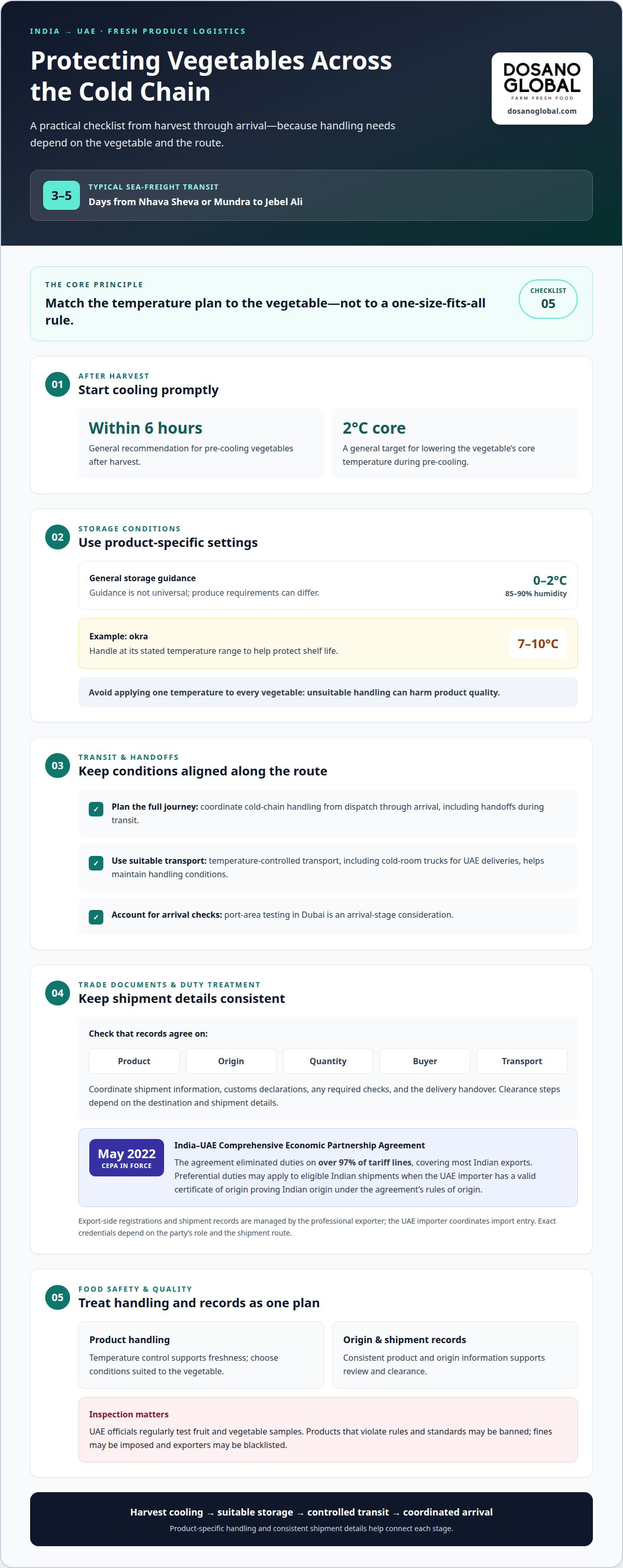
Professional exporters arrange pre-cooling soon after harvest, then select storage conditions suited to the vegetable. A general recommendation is to pre-cool vegetables within 6 hours of harvest and lower their core temperature to 2°C. Storage guidance gives 0-2°C and 85-90% humidity, but produce needs can differ.
Okra, for example, is handled at 7 to 10°C to protect its shelf life. Applying one temperature to every vegetable can harm quality, so product type guides handling. Exporters coordinate suitable storage and temperature-controlled transport, including cold-room trucks for UAE deliveries.
Transit planning matters too. Sea freight from Nhava Sheva or Mundra to Jebel Ali typically takes 3-5 days. Exporters plan the cold chain across the route, including handoffs in the middle of transit, so the container remains suited to the produce. Port-area testing in Dubai is another arrival-stage consideration.
The India-UAE Comprehensive Economic Partnership Agreement (CEPA) has been in force since May 2022. It eliminated duties on over 97% of tariff lines covering most Indian exports. Vegetable exporters should distinguish general tariff treatment from preferential treatment: UAE importers may claim preferential CEPA duties on eligible Indian shipments with a valid certificate of origin proving Indian origin under the agreement’s rules of origin.
For an India-to-UAE shipment, the professional exporter manages relevant export-side registrations and shipment records, while the UAE importer coordinates import entry. The exact credentials depend on the party’s role and the shipment’s route; one exporter’s registrations do not establish a universal UAE licence requirement.
Food safety and quality planning links product handling, origin records, and destination requirements. UAE officials regularly test fruit and vegetable samples; products that violate rules and standards may be banned, with fines imposed and exporters blacklisted. Temperature control supports freshness, while consistent shipment information supports review.
Keep the product description, origin, quantity, buyer, and transport details consistent across commercial and shipping records. For a preferential CEPA claim, a valid certificate of origin is central. Together, these records connect export dispatch with UAE import clearance.
Key risks include temperature changes, delays, damaged produce, testing outcomes, and incorrect origin evidence for a CEPA claim. Exporters manage them through product-specific temperature control, a planned route, and coordinated documentation. Buyers benefit when shipment planning treats quality, transit, and tariff eligibility as connected decisions.
Profitable Indian vegetables for Dubai export
A vegetable exporter should match buyer demand with the products and supply details relevant to the order. For UAE buyers, that means discussing the requested assortment, product specifications, quantity, and handling requirements. A popular crop is not automatically the right choice if its available volume or condition does not fit the buyer’s needs.
Onions are a major example. India exports approximately 403,000 metric tonnes of onions to the UAE annually, making them a substantial part of this trade flow. A supplier assessing onions for Dubai considers buyer demand, consistency of the available lot, and the shipment’s ability to reach its destination in saleable condition. Volume alone does not determine commercial suitability.
Potatoes also feature strongly: they account for approximately 25% of Indian vegetable exports to the UAE. For a wholesale buyer, their place in the export mix provides useful context when planning a product range. Suppliers can compare the requested quantity and intended sales channel with available supply, then assess whether the order fits the buyer’s requirements.
Okra offers another selection consideration. India accounts for 62.12% of global fresh okra production, giving suppliers a significant production base to source from. A professional assessment considers consistency across the offered volume and the buyer’s product expectations. The relevant question is not simply whether the crop is available, but whether the offered supply matches the commercial order.
Producer organisation can shape sourcing, too. Farmer Producer Organisations in Odisha exporting vegetables to Dubai have reported 30 to 40% higher price realisation than domestic sales. This example highlights how export channels may create different commercial opportunities for producers. Suppliers still need to assess the specific crop, buyer requirements, and supply coordination rather than assume every shipment delivers the same result.
Buyer type helps refine the selection. A distributor supplying several accounts may need a broader mix, while a retail buyer may focus on products suited to its customer demand. Consumer interest influences those orders, but professional suppliers make decisions from the buyer’s requested assortment and the dependable volume available. Clear specifications help align sourcing with the intended wholesale or retail channel.
A sound selection process weighs the whole transaction, not an isolated crop statistic. Suppliers compare sourcing consistency, product condition, buyer demand, and transport suitability. They also account for handling and shipping requirements, since a vegetable’s commercial value depends on reaching the buyer in acceptable condition. This approach helps distinguish a promising product opportunity from a shipment that does not fit the order.
For Dubai-bound trade, onions, potatoes, and okra illustrate three distinct selection signals: established export volume, a substantial share of trade, and a strong production base. Professional suppliers use these signals to guide product discussions, then match the final assortment to buyer demand, supply continuity, and shipment planning.
Air and sea shipments
Choosing air or sea freight starts with the vegetable, required arrival timing, order volume, and buyer’s delivery plan. Air freight suits shipments where speed is the priority, while sea freight can accommodate larger consignments. Neither mode suits every order. The exporter matches varieties and shipment size to the route, then coordinates handling and customs documentation around the selected method.
For air shipments, professional planning focuses on the time-sensitive handoffs between dispatch, airport handling, arrival, and final delivery. Each transfer affects how long fresh produce spends outside its intended storage conditions. Exporters align packing, dispatch timing, and receiving arrangements so the shipment can move efficiently through the route. This can make air a practical option for a buyer with a short replenishment window.
Sea freight is suited to planned orders where volume and route timing can be coordinated in advance. India-to-UAE produce shipments can move from Nhava Sheva or Mundra to Jebel Ali. For containerized consignments, exporters coordinate the cargo plan with the buyer’s required assortment and arrival arrangements. A larger load only makes sense when the buyer can receive and distribute the volume effectively.
Product choice shapes the freight decision. A supplier may assess onions, potatoes, or okra against the buyer’s quantity, delivery schedule, and handling needs. Different varieties can have different temperature requirements, so the load plan needs to account for the actual produce rather than treating mixed vegetables as identical cargo. Clear product information also helps align shipping and import records.
Customs preparation forms part of both options. Exporters coordinate commercial and transport details so descriptions, quantities, origin, and consignee information remain consistent across shipment documents. For eligible Indian-origin goods, a CEPA preferential-duty claim depends on a valid certificate of origin and the agreement’s rules of origin. Freight selection and tariff eligibility are separate decisions, but both shape the import plan.
Before dispatch, the exporter aligns four practical elements: confirmed assortment, order volume, shipping mode, and receiving arrangements. For example, a buyer seeking a broad wholesale assortment may need a different load plan from one replenishing a single vegetable. Coordinating those details early helps avoid sending cargo that does not match the buyer’s capacity or sales schedule.
Sea freight offers a structured option for planned container shipments, while air freight prioritizes speed for suitable orders. The right choice depends on the vegetable, buyer’s timing, shipment volume, route, and ability to receive the produce. A professional exporter brings these factors together, then prepares the shipment and its documentation for the chosen transport method.
Which vegetables does the UAE export, and to which countries?
When reviewing UAE vegetable trade, separate locally grown products from imported produce later shipped onward. An import origin does not establish an export destination, and a product’s presence in local markets does not prove UAE origin. Trade records need to identify the vegetable and destination for the reporting period being reviewed.
For trade analysis, begin with the export flow, then group records by vegetable and partner country. This shows which products moved out of the UAE and where they went. Keep re-exports distinct from locally produced vegetables: the route may pass through the UAE even when the crop originated elsewhere. That distinction matters to buyers assessing origin, supply routes, and product availability.
Destination lists depend on the period and product classification being reviewed. A country may appear as a trading partner in one period but not another, and records may group vegetables differently. Comparisons are most useful when they use the same reporting period and product categories.
For commercial analysis, separate three details in each record: vegetable identity, declared origin, and destination. Then compare equivalent trade flows. Locally grown vegetables sent abroad should be analysed separately from imported vegetables redistributed through the UAE. This distinction helps buyers understand whether a pattern reflects local production or onward trade.
The direction of movement matters in fresh-produce trade. A shipment arriving for local sale is an import, while goods leaving the country are exports or re-exports, depending on their origin. Keep these categories separate when describing which vegetables the UAE exports and where they go.
For a buyer assessing an order, the practical next step is to specify the vegetable, quantity, destination, and product requirements. These details shape the sourcing discussion and help determine whether the proposed assortment fits the buyer’s needs. A destination list alone cannot establish whether a particular product suits an order.
Accurate trade reporting should name a vegetable and its destination together, rather than infer exports from the UAE’s import activity. That approach gives buyers, distributors, and suppliers a clearer basis for assessing cross-border trade. For businesses sourcing vegetables for wholesale supply, discuss vegetable sourcing as a separate commercial requirement.
Dosano Global: Vegetables
Dosano Global is a vegetable exporter serving buyers in the UAE, supplying fresh vegetables for commercial purchasing and international trade. Businesses looking for a vegetable exporter in the UAE can discuss their product needs and destination requirements directly.
Fresh vegetables sit alongside fruits and chillis in Dosano Global’s agricultural product range. Buyers can specify the products and quantities they are seeking to make the supply discussion more focused.
اتصل بـ Dosano Global to discuss your vegetable requirements and begin a conversation about supply for your business.
Move from market planning to a supply conversation
To prepare a clear sourcing enquiry, identify the vegetables you need, the quantity, and the destination. Include the requested variety, packing, grading, and any certification requirements relevant to the order. These details give Dosano Global a practical basis for discussing your commercial requirements.
Dosano Global supports wholesale buyers with vegetables and also offers fruits, chillis, and meat. These categories can help businesses plan broader fresh-produce purchasing through one trade conversation. Share the product categories and destination relevant to your business, then discuss how the supply relationship can fit your purchasing plans.
Build your next sourcing discussion around the products your customers value and the supply priorities your business must meet. Contact Dosano Global about UAE exports to begin that conversation and move forward with confidence.
Frequently Asked Questions
What products do you export to the UAE?
Dosano Global supplies fresh vegetables, fruits, chillis, meat, and poultry to buyers in the UAE. Its named vegetable examples include tomatoes, broccoli, and sweet peas; fruit examples include avocados, mangoes, pineapples, and passion fruit. Chilli varieties are also part of the product range. For an enquiry, specify the product and variety, quantity, destination, and any packing or grading requirements.
Which UAE ports do you ship into?
Dosano Global supplies UAE buyers, but its supply focus is not tied to a single named port. Port arrangements depend on the particular shipment and destination requirements. For a focused enquiry, include the destination alongside the product, variety, and quantity. This gives the proposed supply discussion a clear commercial context without assuming one standard port for every vegetable order.
Who are the leading vegetable exporters and suppliers in the UAE?
Dosano Global is a UAE supplier of fresh agricultural products for commercial buyers. Its vegetable range includes tomatoes, broccoli, and sweet peas, with grading, packing, and delivery requirements discussed for the order. The company also supplies fruits, chillis, meat, and poultry. Rather than relying on an unsupported “leading” ranking, buyers can assess whether a supplier’s products and commercial focus fit their purchasing needs.
What packaging, cold-chain, and transport options are used for UAE vegetable exports?
Dosano Global discusses grading, packing, and delivery requirements for fresh vegetables as part of the order. State the product, variety, quantity, destination, and requested packing and grading details in your enquiry. Include any certification requirements relevant to the order, too. The arrangement should be based on the product and buyer’s requirements, rather than assuming one packaging format, cold-chain setup, or transport mode applies to every vegetable.
What UAE food safety, quality, and phytosanitary rules apply to vegetable exports?
UAE officials regularly test fruit and vegetable samples. Products that violate rules and standards may be banned, with fines imposed and exporters blacklisted.
What documents are needed to export vegetables from the UAE?
Keep the product description, origin, quantity, buyer, and transport details consistent across shipment records. Exporters and importers coordinate shipment documents, customs declarations, and any required checks. For a preferential CEPA claim, a valid certificate of origin is central.