
 English
East Africa Fruit Supplier in the UAE: A Commercial Buyer’s Guide
What makes an East African sourcing option a good fit: not broad claims, but fruit quality, supply planning, and handling that align with your...

What makes an East African sourcing option a good fit: not broad claims, but fruit quality, supply planning, and handling that align with your requirements. Finding an East Africa fruit supplier UAE buyers can rely on takes more than comparing origin statements. It means assessing the product and supply details that support confident procurement decisions.
For UAE buyers, seasonal availability and the journey to market can affect supply continuity and fruit condition on arrival. This guide explains how to assess supplier information, compare quality and supply plans, and account for handling and transit when planning procurement cycles.
Dosano Global supplies fresh fruits to commercial clients in the UAE and international markets. Its B2B supply discussions are shaped around buyer requirements and quality expectations. Read on to see how to assess sourcing fit and prepare for a commercial supply discussion.
Key Takeaways
- Assess East African sourcing by how well origin, fruit quality, supply continuity, and handling align with your procurement needs.
- Map the process from product specification through quality checks and shipment planning to delivery expectations.
- Compare an East Africa fruit supplier UAE businesses are considering using practical details, not broad claims about premium quality or reliability.
- Prepare a clear procurement brief that separates essential fruit requirements and projected demand from flexible preferences.
- Dosano Global supplies fresh fruit to commercial buyers across the UAE, with supply discussions shaped around buyer requirements and quality expectations.
Why UAE Buyers Consider East African Fruit Supply
For UAE commercial buyers, East African fruit sourcing means procuring fresh fruit from origins in the region for supply to businesses in the UAE. It can provide another sourcing option, but “East Africa” is not a single farm, crop, or specification. Each purchasing decision should connect a particular origin and product with the buyer’s quality expectations, required volumes, timing, handling needs, and delivery plan.
A regional sourcing corridor describes a route for commercial procurement, not a promise that every fruit is available throughout the year or will arrive to one uniform specification. Harvest cycles, order requirements, and the journey to the UAE all matter. Evaluate the product and supply plan rather than treating origin as a stand-alone quality signal. For broader context on the region’s agricultural role, see the overview of the Economy of East Africa.
Corridor fit is the match between a fruit’s origin, its handling and transit requirements, and the buyer’s commercial needs. A good fit can support procurement planning, but it does not remove the need to define quality, timing, and delivery expectations.
What does East Africa fruit sourcing mean for UAE buyers?
It means coordinating a supply relationship across borders, from a specific regional origin to a UAE commercial destination. A buyer’s brief clarifies what the purchase must achieve: the fruit required, its intended use, expected order pattern, acceptable condition on arrival, and preferred delivery timing. These details give both parties a practical basis for discussing supply.
Availability and product characteristics can differ by origin and season. Don’t assume that every country in East Africa supplies every variety, or that one sourcing route can cover every procurement cycle. A corridor can be valuable while still requiring a plan for seasonal changes, variation between shipments, and the handling needed to protect fruit condition in transit. The useful question is not simply whether fruit comes from East Africa, but whether the proposed supply plan suits the order.
Which businesses may evaluate this supply option?
Retailers, hospitality businesses, and food-service operators may assess regional sourcing when they need fresh fruit for resale, menus, or ongoing operations. Their requirements differ. A retailer may prioritize consistent presentation across units, while a hospitality buyer may focus on intended use, order frequency, and fit with menu planning. Food-service teams may need to coordinate purchasing with expected demand and delivery schedules.
Purchase scale, product specifications, and delivery preferences determine whether an arrangement fits the business. A clear brief separates essential requirements, such as acceptable quality and delivery timing, from preferences that allow flexibility. This is B2B procurement, not household grocery shopping: the focus is a planned commercial relationship and the needs of an operating business. Dosano Global supplies fresh fruit to commercial clients across the UAE, with supply discussions shaped around buyer requirements and quality expectations.
How East Africa-to-UAE Fruit Sourcing Works
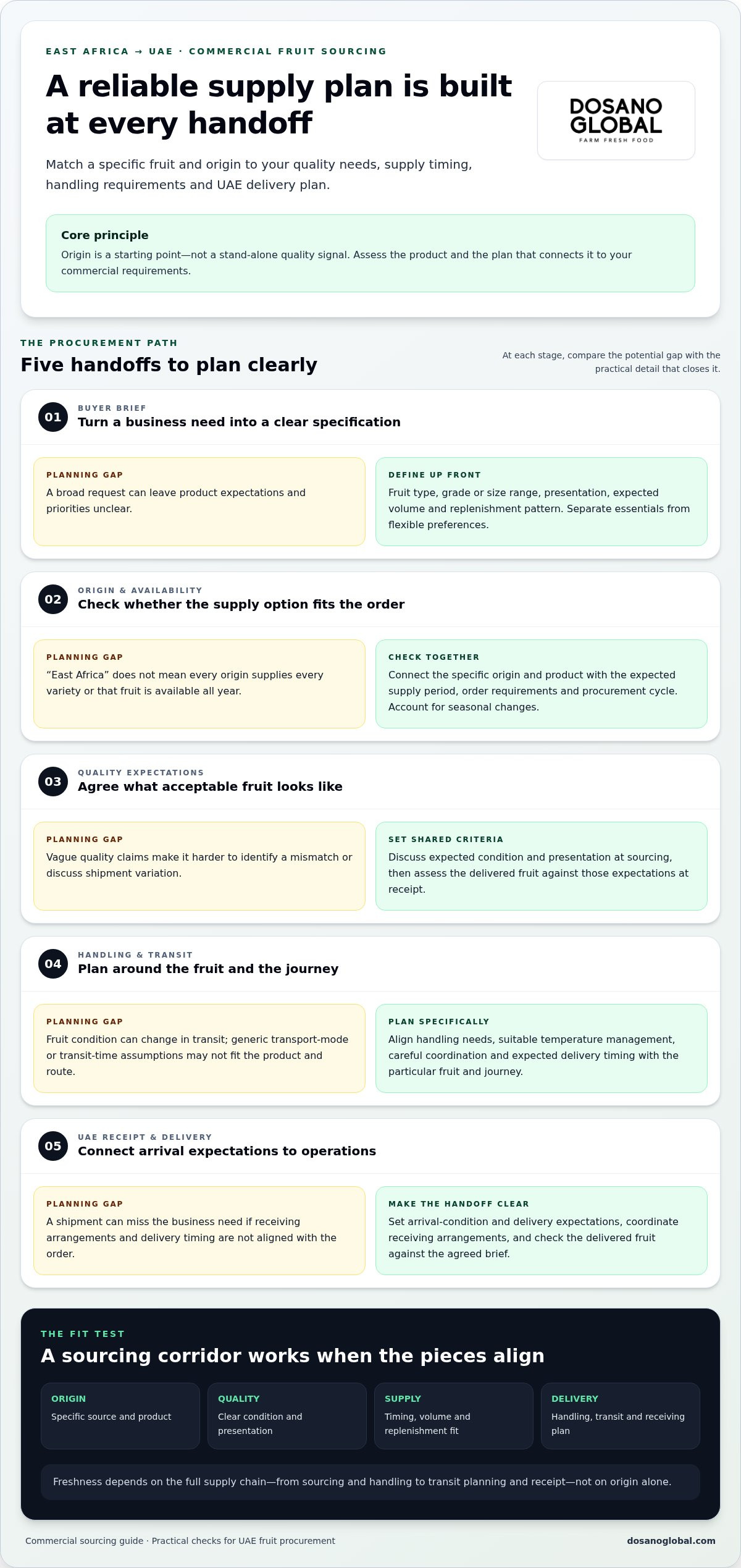
A well-planned fruit shipment starts with a clear commercial brief, then moves through sourcing, quality assessment, shipment planning, and receipt in the UAE. Each stage affects whether the order meets the buyer’s needs. An East Africa fruit supplier UAE buyers work with should be able to discuss how product requirements connect to sourcing and supply planning. Origin alone is not a substitute for clear specifications.
From buyer requirements to procurement planning
Begin by defining the fruit type, required grade or size range, presentation, expected volume, and replenishment pattern. Mark which details are essential and where reasonable flexibility is possible. For example, a buyer might need fruit suited to a particular retail display or food-service use, with delivery planned around expected demand. A clear brief keeps sourcing discussions focused on commercial priorities without assuming that every variety, quantity, or schedule is available.
Once requirements are clear, consider how the sourcing option fits the order: whether the product and expected supply period align, what quality expectations apply, and how delivery timing supports the buyer’s operations. The UAE National Food Security Strategy 2051 provides broader context for the UAE’s approach to food sourcing and diversification. It is not a substitute for checking current import requirements for a particular shipment.
Where quality and handling fit into the supply chain
Quality matters at more than one point. At sourcing, buyers and suppliers can agree on expected condition and presentation. At receipt, the buyer can assess whether the delivered fruit meets those expectations. Shared criteria make differences easier to identify and discuss, and help distinguish normal variation from a mismatch with the procurement brief.
Freshness depends on the full supply chain, from sourcing and handling to transit planning and receipt, not on origin alone. Fruit condition can change during transit, so shipment planning should account for the product’s handling needs and the time involved in moving it to the UAE. Suitable temperature management, careful handling, and clear coordination can help protect condition, but no single measure replaces a plan suited to the particular fruit and journey.
Keep transport-mode and transit-time assumptions specific to the product and route. Avoid basing purchasing decisions on a generic estimate when those details are not established. Instead, align expected delivery timing and receiving arrangements with the commercial requirement, then review the fruit on arrival against the agreed expectations.
Import documentation and food requirements can depend on the product and shipment circumstances. UAE buyers should check current requirements with the relevant official authorities before finalizing procurement, rather than relying on general guidance alone. For commercial buyers shaping an order, a focused discussion of fruit requirements and supply expectations with Dosano Global’s commercial fruit team provides a practical starting point for procurement planning.
How to Compare East African Fruit Suppliers for UAE Business
A fair comparison looks beyond origin labels and broad promises. For UAE buyers, the practical question is how closely a proposed supply arrangement matches the fruit specification, quality expectations, replenishment needs, communication standards, and delivery coordination the business requires. Compare an East Africa fruit supplier UAE buyers are assessing using information that can be described clearly and evaluated against consistent criteria.
Use the table below for a side-by-side review. Record what each proposal states, then score its fit against your procurement priorities. A simple scale from 1 to 5 works: 1 means a major gap, 3 means an acceptable fit, and 5 means a strong fit supported by clear details. Mark missing information as “not assessed” rather than guessing.
| Criterion | What to compare | Useful evidence to record |
|---|---|---|
| Product fit | Fruit type, grade expectations, presentation, and packaging requirements | Specific details that match the buyer’s product brief |
| Quality checks | How quality expectations are described across sourcing and receipt | Clear criteria, checks, and a shared understanding of acceptable condition |
| Continuity | How the proposed supply plan aligns with projected demand and replenishment | Seasonal considerations and an explanation of how changes are communicated |
| Communication | Clarity and usefulness of updates about sourcing, order planning, and changes | Defined points of communication and information relevant to procurement decisions |
| Delivery coordination | Whether the delivery plan fits the buyer’s timing and receiving arrangements | Aligned expectations for timing, coordination, and condition on arrival |
Which supplier details support a fair comparison?
Compare like with like. Use the same fruit requirements, grade expectations, packaging preferences, projected order pattern, and delivery needs when reviewing each supply proposal. Separate specific operational information from phrases such as “premium quality” or “reliable service.” Those descriptions may express intent, but they don’t define quality for your order or explain how the arrangement fits your replenishment pattern.
How can buyers assess continuity and product fit?
Compare the proposed supply plan with expected demand and seasonal needs. Look for a clear explanation of how sourcing or availability changes would be communicated, and whether your team would have useful time to adjust purchasing plans. An East African origin is one comparison factor, not evidence of year-round availability or identical specifications across orders.
Weight the scores according to business priorities. A retailer may place greater emphasis on presentation, while a food-service buyer may prioritize fit with planned use and delivery coordination. Product fit and quality expectations may be essential for either; communication and continuity can carry different importance depending on replenishment frequency. The scorecard is a decision aid, not a substitute for a detailed commercial brief.
Dosano Global supplies fresh fruit to commercial clients across the UAE and international markets. Its procurement discussions connect buyer requirements with quality-conscious sourcing and commercial supply partnerships, giving buyers a practical basis for aligning product needs and supply expectations.
Plan an East African Fruit Procurement Brief for the UAE
A focused procurement brief turns general interest in East African fruit into a practical B2B discussion. It gives the supplier a clear view of what your business needs, how you assess quality, and how orders fit into your purchasing cycle. Separate essential requirements from flexible preferences so the discussion can focus on priorities without assuming supply capacity or availability.
What should a commercial fruit brief include?
Set out the product, expected demand, quality expectations, packaging needs, order pattern, and receiving arrangements. If exact specifications are still being developed, describe the intended use and identify what your team can adjust. When evaluating an East Africa fruit supplier UAE buyers can use these details to discuss sourcing in relation to the actual commercial requirement.
- Product: Name the fruit and describe the grade, size, ripeness, or presentation requirements that matter to your business.
- Demand: Share projected order quantities and how often you expect to replenish. Label estimates as forecasts, not confirmed orders.
- Packaging: Note preferred packaging and any practical requirements for storage, display, or handling at your receiving point.
- Quality: Explain the condition you expect on arrival and which quality points are essential versus negotiable.
- Delivery and receiving: State preferred delivery windows, receiving procedures, and any coordination needs at the destination.
- Contacts: Identify the people responsible for procurement, receiving, and quality feedback, including who should receive updates about order changes.
This format distinguishes firm requirements from preferences. For example, a particular presentation may be essential for a retail order, while order frequency could remain flexible as demand becomes clearer. A supplier can then respond to the brief in context, rather than treating a demand estimate as a promise or assuming every preference is mandatory.
How should buyers prepare for supply discussions?
Share enough context to explain the business need: intended use, expected demand pattern, quality priorities, and receiving constraints. Discuss sourcing, quality expectations, supply planning, and delivery coordination together, since a change in one area can affect the others. Dosano Global supplies fresh fruit to commercial clients across the UAE and uses buyer requirements to shape focused procurement discussions.
Before shipment planning, verify current UAE import documentation requirements for the specific product and shipment with the relevant official authorities. Requirements can depend on the goods and circumstances, so general guidance should not replace current, product-specific information.
Prepare your requirements for a B2B supply discussion with Dosano Global’s commercial fruit team. A clear brief gives the conversation a practical starting point for aligning sourcing, quality expectations, and delivery planning.
Work with Dosano Global on UAE Fruit Supply
Commercial fruit procurement works best when buyer requirements guide the discussion from the start. Dosano Global supplies fresh produce to commercial clients across the UAE and international markets, including fresh fruits, vegetables, and chillis. For buyers assessing an East Africa fruit supplier UAE businesses could work with, the next step is to define the required product and supply expectations, then discuss how those needs can shape procurement.
How Dosano Global supports commercial produce buyers
Dosano Global focuses on B2B fresh-produce supply. Quality-conscious procurement and dependable business relationships help frame discussions around buyer needs, from product expectations to how supply should fit purchasing plans. The buyer’s brief provides a basis for discussing sourcing considerations and relevant quality expectations without relying on broad claims alone.
This practical focus matters for businesses whose fruit requirements are tied to retail, hospitality, or food-service operations. A clear understanding of intended use, expected demand, and receiving preferences makes supply discussions more relevant. Buyers can also use the broader resource, Fresh Fruit Supplier UAE: A Commercial Buyer’s Guide, to review the commercial considerations involved in fruit procurement.
What to share when starting a supply discussion
Bring a concise brief that explains what your business needs and which requirements are essential. Include the fruit requirements, projected demand, quality standards, preferred packaging or presentation, and delivery preferences. If some details remain flexible, say so. This helps Dosano Global shape sourcing discussions around the project rather than treating preferences as fixed specifications or demand estimates as confirmed orders.
Keep the connected parts of the requirement in view. Product expectations influence quality discussions, expected demand informs supply planning, and delivery preferences need to work with receiving arrangements. Sharing who handles procurement, receiving, and quality feedback can also support clear communication as the discussion develops.
- Product needs: Describe the fruit and any relevant grade, size, ripeness, or presentation expectations.
- Demand outlook: Provide estimated quantities and replenishment patterns, noting where forecasts may change.
- Quality priorities: State the condition you expect and which criteria are non-negotiable.
- Delivery preferences: Outline timing and receiving considerations that affect your operation.
A tailored conversation gives both sides a practical starting point for aligning buyer needs with sourcing, quality expectations, and supply planning. It can also help identify which details need to be resolved before procurement planning advances.
Discuss your commercial fruit supply requirements with Dosano Global and share the brief that will guide your UAE procurement conversation.
Make Your Next Procurement Move with Confidence
Turn your procurement brief into a working plan your team can use across upcoming buying cycles. Keep priorities clear, note where demand or preferences may shift, and use each supply discussion to refine the requirements that matter most to your operation. Choosing an East Africa fruit supplier UAE businesses can work with starts with a focused conversation about those needs, not assumptions about origin alone.
Dosano Global sources and supplies fresh agricultural commodities for commercial buyers, with fresh produce supply serving clients across the UAE. A direct discussion can connect your requirements with sourcing considerations and quality expectations, keeping the next step grounded in your business needs.
Start a commercial fruit supply discussion with Dosano Global and share your procurement priorities. A clear brief is a strong foundation for a dependable B2B relationship and more confident planning.
Frequently Asked Questions
Which fruits are commonly sourced from East Africa for UAE buyers?
There isn’t one fruit list that applies to every East African origin or season. For UAE buyers, a useful shortlist depends on the specific crop, producing area, harvest window, and commercial specification. Treat origin as a starting point, not proof of availability. Build a product-by-product procurement plan and assess each fruit against your quality needs, projected demand, and intended use.
How does East African fruit reach commercial buyers in the UAE?
Fruit typically moves through a commercial supply chain from sourcing and preparation to international transport, UAE import procedures, and delivery to the buyer. The transport plan depends on the fruit, route, and order requirements, so generic transit assumptions may not fit a particular shipment. UAE buyers can plan receiving arrangements in advance and align delivery expectations with how their business will store and use the fruit.
What should UAE businesses check when comparing East Africa fruit suppliers?
Compare each supplier against the same product brief. Look for clear specifications, quality expectations, packaging details, supply planning, communication practices, and delivery coordination. Assess an East Africa fruit supplier UAE buyers are considering by how well its proposed arrangement fits the business, not only by origin or broad claims such as “premium” and “reliable.” Record missing details separately instead of treating them as proven strengths.
How can buyers assess fruit quality before accepting a commercial shipment?
Agree on practical acceptance criteria before the order, including the expected presentation and condition for the fruit’s intended use. At receipt, inspect the packaging and a representative portion of the shipment for visible damage, inconsistent presentation, or other departures from the agreed criteria. Document concerns promptly with clear notes and photographs, and share them through the agreed quality-feedback process. This creates a useful record for resolving discrepancies and refining future orders.
Does East African fruit supply remain consistent throughout the year?
Not necessarily. Availability can shift with harvest cycles, origin, and growing conditions, so a stated East African origin should not be treated as evidence of continuous supply. Buyers can plan by mapping forecast demand against expected sourcing periods and identifying which requirements allow flexibility. Keep a clear communication process for changes to expected availability, so purchasing teams can review their plans before a supply gap affects operations.
What import requirements apply to fresh fruit entering the UAE?
Requirements can depend on the product and shipment, so confirm current UAE import requirements with the relevant official authorities before arranging a shipment. Check which approvals, registrations, documents, and label details apply to the specific goods and destination. Build responsibility for preparing and reviewing the relevant paperwork into the procurement plan, and allow time to resolve documentation questions before shipment planning is finalized.
Can a UAE business source fruit through a wholesale supplier rather than directly from farms?
Yes. A UAE business can work with a wholesale supplier as its commercial sourcing partner instead of managing procurement directly with farms. This gives the buyer a single supply discussion for explaining product requirements, projected demand, and quality expectations. Dosano Global sources and supplies fresh agricultural commodities to commercial clients across the UAE, supporting B2B fruit procurement rather than household grocery purchases.
[…] fruit types your business relies on and any acceptable alternatives. Sourcing options can vary by fruit, origin and season. Early planning gives both sides a basis for discussing suitable procurement arrangements without […]