
 English

Poultry Supplier Comparison: A Commercial Buyer’s Guide to Reliable UAE Supply
For businesses searching for a reliable commercial partner, a broad catalogue alone is not enough to identify a supply source that fits the...

For businesses searching for a reliable commercial partner, a broad catalogue alone is not enough to identify a supply source that fits the operation. Compare product requirements, commercial standards and delivery arrangements against your day-to-day needs.
Supplier descriptions often leave out details that matter during procurement and receiving. To make a useful comparison, define what you need, set clear specifications and consider supply coordination alongside the product itself. The right fit is not simply the supplier with the longest list. It is the one whose sourcing and supply approach aligns with your operation.
This guide gives commercial buyers a practical framework for comparing poultry suppliers and defining requirements before procurement discussions. You’ll learn how to assess product fit, clarify specifications and compare supply and delivery arrangements. Dosano Global sources and supplies fresh poultry for commercial clients, tailoring supply to commercial standards and delivery requirements.
Key Takeaways
- Choose supply that fits your operation, not simply the supplier with the broadest catalogue.
- Set clear product specifications and quality expectations to make comparisons consistent and receiving requirements easier to manage.
- Compare sourcing approaches by product range, coordination needs and fit with your procurement workflow.
- Use a five-step framework to define needs, compare supplier responses and shortlist a suitable poultry supplier.
- Align fresh poultry supply with your business standards and delivery needs through a tailored commercial arrangement.
Poultry supplier comparison: what commercial buyers need to decide first
The right supplier is the one whose products and supply arrangements match your operation, not necessarily the one with the largest catalogue. A food-service buyer may prioritize formats and specifications suited to menu preparation, while a retailer may focus on product presentation and receiving routines. Wholesale procurement teams may need to coordinate supply across several business requirements. Start with a clear basis for comparison before reviewing offers.
Define four areas: product requirements, quality expectations, order patterns and delivery needs. Describe each in practical terms your team can apply consistently. Specify the poultry format your operation needs, the criteria staff use when receiving an order, how demand changes over time and which delivery arrangements suit your operating schedule. The overview of poultry farming practices and global production offers broader industry context, but your own requirements should guide the comparison.
Use the same brief for every supplier under review. A like-for-like comparison makes differences and gaps easier to spot. Changing criteria between discussions can make a polished catalogue seem more suitable than it is. Treat the search as a procurement decision, not a catalogue-only choice.
Which commercial requirements should shape the comparison?
Separate essentials from preferences before assessing responses. Essentials are requirements your business needs to receive, store or use poultry as planned. Preferences may be useful, but they do not determine whether supply works. Document your receiving process, expected demand pattern and operating schedule, then state the quality expectations and product documentation your team relies on. This gives procurement and receiving staff a shared reference.
- Product: Record the poultry type, format and other specifications your operation requires.
- Quality and documentation: Set the expectations your team uses to assess products and review accompanying information.
- Ordering and delivery: Describe your usual ordering pattern, receiving capacity and scheduling needs.
Keep the criteria practical. If your receiving team needs particular information to identify and check an order, include it in the comparison brief rather than leaving it implicit. The goal is to make each response easy to assess against your workflow.
Why a catalogue alone cannot establish supplier fit
A broad catalogue shows product range, but it does not explain whether a supplier’s sourcing and distribution arrangements match your specifications, order pattern or delivery requirements. Consumer-facing presentation helps shoppers browse; commercial procurement requires clear requirements and coordinated supply. Look beyond product descriptions to how the offer fits your purchasing and receiving process.
Supplier fit is the alignment between a buyer’s product, quality and operational requirements and the supplier’s sourcing and delivery arrangements. Use that definition to keep discussions focused. Dosano Global sources and distributes fresh poultry for commercial clients, tailoring supply to commercial standards and delivery requirements. Apply the same principle when comparing options: assess the supply relationship against your needs, not catalogue size alone.
Compare poultry suppliers by product fit, standards, and supply coordination
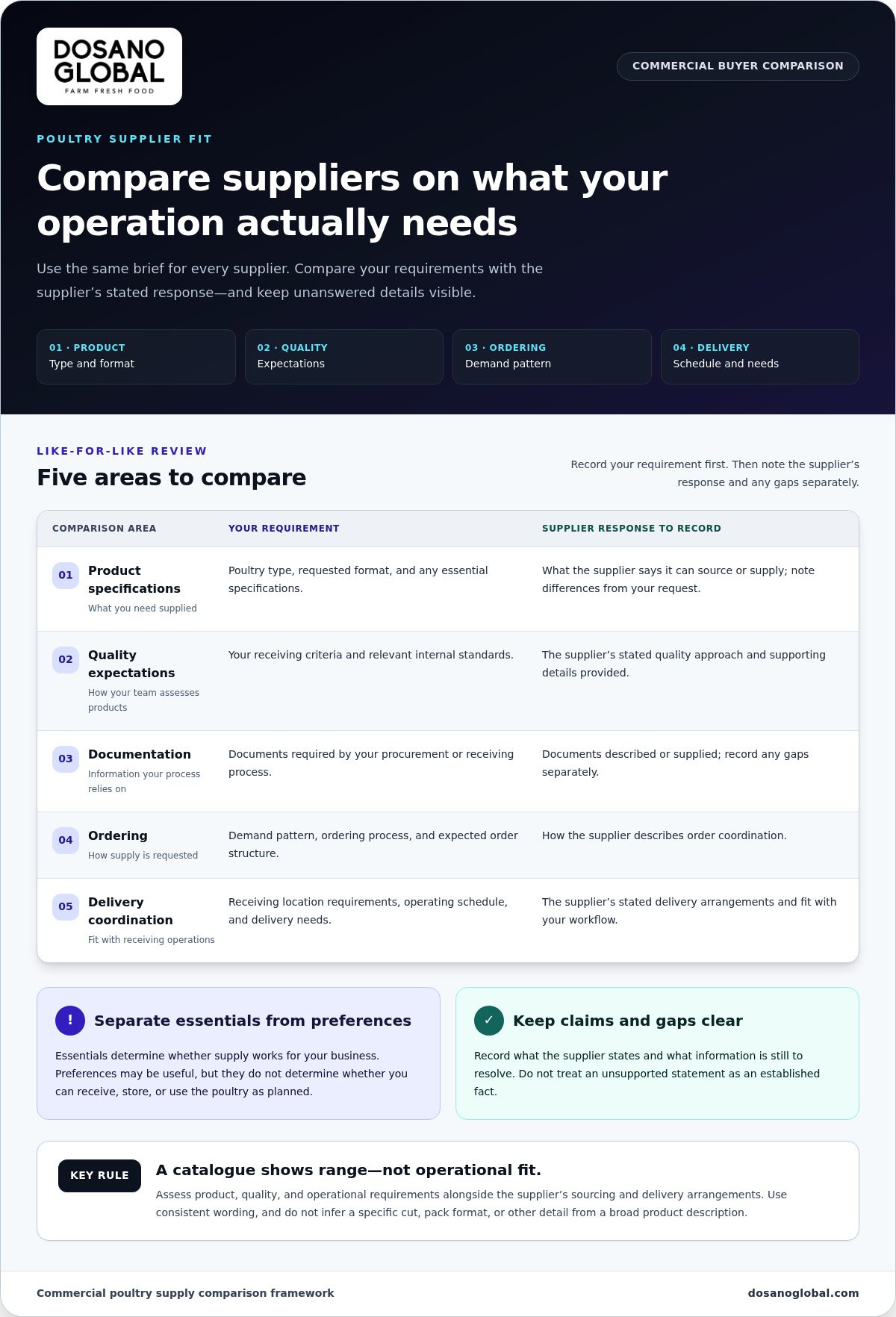
A useful comparison records more than whether a supplier lists poultry. It shows how the response matches your requested product, quality expectations, documentation needs, ordering pattern and delivery coordination. Keep your requirements distinct from supplier claims. A clear record helps procurement teams compare equivalent offers instead of relying on broad descriptions.
Use the same comparison fields for every supplier you consider, including when searching for a poultry supplier Sharjah. Record your requirement first, then enter each supplier’s response separately. Track the information provided and any details still to resolve, so an unsupported statement is not mistaken for an established fact.
| Comparison area | Buyer requirement to record | Supplier response and evidence |
|---|---|---|
| Product specifications | Poultry type, requested format and any essential specifications | What the supplier states it can source or supply; note differences from the request |
| Quality expectations | Your receiving criteria and relevant internal standards | Supplier’s stated quality approach and supporting details provided |
| Documentation | Documents your procurement or receiving process requires | Documents described or supplied; record any gaps separately |
| Ordering | Demand pattern, ordering process and expected order structure | How the supplier describes order coordination |
| Delivery coordination | Receiving location requirements, operating schedule and delivery needs | Supplier’s stated delivery arrangements and fit with your workflow |
How product specifications affect supplier suitability
Broad labels such as “chicken” or “fresh poultry” may not describe equivalent offers. State the poultry category and format your business needs, then add specifications that matter to its use and receiving process. Separate must-haves from preferences, and do not infer a particular cut, pack format or other detail from a general category description. Consistent wording helps procurement teams compare responses accurately.
For example, if your operation needs a defined format, include it in every comparison request instead of treating a general category match as sufficient. Record where a response aligns, differs or needs clarification. Keep the comparison at commercial category level unless specific product details have been stated.
How standards and documentation fit into the decision
Set standards based on your procurement policy and operating needs, then assess each response against them. HACCP or Halal certification may be relevant criteria for a buyer, but listing them as criteria does not establish that a supplier holds either credential. Keep requested documentation, supplier statements and documents reviewed in separate fields.
Regulatory and certification requirements can depend on the product and transaction. Before treating a particular requirement or statement as evidence of compliance, check it against current authoritative guidance. This keeps buyer expectations clear without attributing unsupported credentials or handling methods to a supplier.
Dosano Global sources and supplies fresh poultry for commercial clients, tailoring supply to commercial standards and delivery requirements. Use these comparison dimensions to frame a discussion about commercial poultry supply around your business needs.
Compare poultry supply approaches without losing sight of business needs
Commercial poultry supply can be arranged in different ways. Some buyers begin with a catalogue, others build a direct sourcing relationship, and some prefer a broader wholesale arrangement that brings purchasing and supply coordination together. Each approach has trade-offs. The useful question is how well it fits your product needs, procurement workflow and receiving operation, not which model sounds best in general.
Catalogue-led purchasing
A catalogue-led approach helps buyers scan categories and identify potential product matches. It can suit teams with defined requirements that can be compared against listed items. A catalogue alone, however, may not explain how closely an item matches a requested format or how supply will align with ordering and delivery needs. Use it as a starting point, then compare details consistently.
Direct sourcing relationships
A direct sourcing relationship gives buyers a focused way to discuss a defined poultry requirement and the supply arrangement around it. This can work well when procurement teams know what they need and value clear communication about specifications. Its fit depends on how well the relationship supports the buyer’s coordination process. Use a consistent product description across discussions so responses remain comparable.
Broader wholesale supply arrangements
A broader wholesale arrangement may suit businesses looking for a commercial sourcing relationship shaped around their standards and delivery requirements. Assess how well the buyer’s procurement workflow matches the supplier’s stated approach to sourcing and supply. Do not assume that a broader arrangement automatically means greater range, simpler ordering or a particular delivery capability. Compare the described offer with your operation’s needs.
To assess the models side by side, consider:
- Range: Does the approach support the poultry category and specification your business needs?
- Coordination: Can your team align ordering and receiving processes with the arrangement described?
- Clarity: Are product details specific enough to compare against your request?
- Workflow fit: Does the approach suit the way your procurement team plans and manages supply?
A buyer with one clearly defined requirement may prefer a direct discussion focused on that need. A team managing broader commercial procurement may place more weight on how sourcing and delivery arrangements can be tailored to its operating standards. Neither model is a universal winner. The right fit depends on your setup, requirements and the coordination your team can manage.
For buyers comparing a poultry supplier Sharjah search, sourcing fit and supply coordination are useful points to assess. For a wider view of commercial procurement considerations, see the UAE poultry supplier buyer’s guide.
Use a practical decision framework to shortlist a poultry supplier
A consistent process turns supplier information into a decision your procurement and receiving teams can use. Apply the same sequence to every option and record supporting information alongside responses. Shortlist against your operation’s priorities rather than an assumed market benchmark. This keeps the decision grounded in your requirements, whether you are assessing a search result for a poultry supplier or comparing other commercial supply options.
- Define your needs. List the poultry categories, quality expectations, documentation, order patterns and delivery requirements that matter to your business. Separate essentials from preferences.
- Standardize specifications. Write each requirement in clear, consistent terms so every supplier receives the same brief and can respond to the same points.
- Compare responses. Record what each supplier states against your requirements. Keep documented information separate from assumptions and unanswered questions.
- Assess operational fit. Consider how the stated ordering and delivery arrangements align with your procurement workflow, receiving process and operating schedule.
- Build your shortlist. Retain the options that best match your priorities and note any outstanding details that could affect the decision. There is no universal winner; the strongest fit depends on your business.
Use a simple comparison record to keep the assessment clear:
| Criteria | Buyer priority | Supplier response | Follow-up status |
|---|---|---|---|
| Product requirements | Essential or preferred; specify the need | Record the supplier’s stated response | Documented, open or resolved |
| Standards and documentation | List relevant business expectations | Note details or documents provided | Documented, open or resolved |
| Ordering needs | Describe your ordering pattern | Record the stated ordering approach | Documented, open or resolved |
| Delivery requirements | Describe receiving and schedule needs | Record the stated delivery arrangement | Documented, open or resolved |
Turn the comparison into a workable procurement discussion
Prepare a concise brief that brings together your product requirements, standards, ordering needs and delivery expectations. A structured brief keeps the discussion focused and makes it easier to distinguish a direct response from an assumption. Use your brief to discuss how your needs align with commercial supply.
Use this bulk poultry procurement checklist to organize your planning. To discuss your commercial poultry supply requirements, share your requirements with Dosano Global.
How Dosano Global supports commercial poultry supply
A useful supplier comparison should lead to a clear commercial conversation. Once your team has defined the poultry requirements, standards and delivery needs that matter, discuss how they align with a sourcing relationship. Dosano Global sources and distributes fresh poultry for commercial clients, with supply tailored to commercial standards and delivery requirements. The company facilitates trade partnerships for clients in the UAE and international markets.
A commercial sourcing relationship shaped around buyer requirements
Start with the essentials: your business type, the poultry category and specifications you require, the standards your operation follows, and the delivery arrangements your receiving process needs. Clear information frames a relevant sourcing discussion and gives both sides a shared understanding of the commercial requirements. It also keeps the conversation focused on your business rather than general catalogue descriptions.
For example, a food-service buyer may describe the poultry requirements that suit its menu and receiving workflow, while a procurement team may outline the standards and delivery coordination needed for its purchasing process. Details differ by operation, so a useful brief reflects your priorities rather than assumptions about what a supplier typically provides.
Dosano Global’s role is commercial sourcing and supply. Its approach is to tailor supply to buyer requirements, commercial standards and delivery needs. This provides a practical basis for discussing how fresh poultry sourcing and distribution can align with your operation, without presuming a particular product specification, origin, certification, order volume, schedule or handling system. When assessing a poultry supplier Sharjah search, use the same principle: judge fit against clearly stated business requirements.
Before opening a supply discussion, bring together the details that will shape it:
- Business context: Explain your operation and how poultry fits your procurement needs.
- Product requirements: Describe the poultry category and any specifications essential to your use.
- Standards: State the quality expectations and documentation relevant to your business.
- Delivery needs: Outline the receiving requirements and coordination your operation requires.
Start a poultry supply conversation with Dosano Global
A concise, well-prepared brief keeps attention on the requirements that matter and helps shape a suitable commercial supply discussion. Share your business type, poultry needs, applicable standards and delivery requirements. Dosano Global works with commercial clients across the UAE and international markets, connecting sourcing and supply with business requirements.
Discuss poultry supply with Dosano Global and outline your commercial requirements.
Set your next poultry procurement discussion up for success
Turn your comparison into a concise purchasing brief. Bring together the requirements that will shape a workable supply relationship, including the poultry you need, your commercial standards and delivery requirements. This gives procurement discussions a practical starting point and keeps decisions grounded in the needs of your operation.
For businesses evaluating a poultry supplier Sharjah search has identified, a suitable partnership should support clear commercial requirements. Dosano Global provides fresh poultry sourcing and distribution for commercial clients, tailoring supply to commercial standards and delivery requirements. Its trade partnerships serve UAE and international markets, connecting buyer needs with commercial supply.
Share a clear brief outlining your business requirements and take the next step toward a supply discussion. Discuss poultry supply with Dosano Global and move forward with a practical procurement plan.
Frequently Asked Questions
How should a business compare poultry suppliers?
Compare suppliers using one consistent brief and assess each response against your operation’s priorities. For example, a food-service team can separate requirements tied to menu use from preferences that can change, then record how each response addresses them. Keep written details distinct from assumptions. This makes trade-offs visible and helps procurement, receiving and operational teams decide using the same information.
What information should I prepare before requesting a poultry supply discussion?
Prepare a concise outline of your business type, intended poultry use, required product details and the internal standards your team follows. Add your ordering pattern, delivery needs and any documentation relevant to your process. If several people will review the arrangement, gather their requirements first so the brief reflects procurement and receiving needs. Treat preferences as fixed requirements only when they affect product use or operations.
Is fresh poultry different from frozen poultry for commercial buyers?
Yes. Fresh and frozen poultry are distinct product requirements, and the format you need can affect inventory planning and use. Consider how the requested format aligns with storage capacity, stock rotation and intended menu or retail use. State the required format clearly in your purchasing brief. Neither option is universally preferable, and a general product description should not be taken to mean both are offered.
How can a buyer assess poultry quality consistently?
Define what quality means for your operation before reviewing supplier information. Your receiving team may need clear criteria for checking that a delivery matches the agreed product description, while kitchen or retail teams may have separate use-related expectations. Apply the same criteria across supplier comparisons and record the basis for each assessment. Broad claims alone do not establish a match, so distinguish specific product information from general descriptions.
What does poultry traceability mean for a commercial buyer?
Traceability means being able to connect a product with relevant information about its sourcing or movement through documented records. The details that matter depend on your business’s procurement, internal record-keeping and receiving needs. Define the information you want to retain, then compare supplier responses against that requirement rather than assuming a particular system or credential. If a regulatory requirement is involved, check current guidance from an authoritative source.
How do delivery requirements affect a poultry supplier comparison?
Delivery fit depends on how an arrangement works with your receiving operation, not simply on whether delivery is mentioned. Consider access arrangements, who receives the order and how your team handles deliveries that fall outside its usual workflow. State your requirements clearly and record the arrangements described in response. Keep assumptions about timing or coordination separate from details that have been agreed.
Can one poultry supplier support different commercial buyer types?
The fit should be assessed against each buyer’s actual needs, not inferred from a broad customer category. A retailer and a food-service business, for instance, may use different product descriptions, receiving processes and stock routines. Set out the intended use and operating requirements for the purchasing team. This gives both sides a clear basis for discussing whether a tailored commercial supply arrangement suits that business.
[…] your requirements are written down, use the same scorecard for every proposal. A confident headline or broad quality claim won’t show whether an offer matches your product […]
[…] this meat supplier buyer’s guide alongside your poultry assessment. For a practical framework to compare poultry suppliers and assess commercial fit, see this […]