
 English

Poultry Supplier UAE: A Commercial Buyer’s Guide to Reliable Supply
A poultry supplier UAE businesses can rely on needs to align product requirements, handling expectations, and delivery arrangements with the way each...

A poultry supplier UAE businesses can rely on needs to align product requirements, handling expectations, and delivery arrangements with the way each operation works. Before comparing suppliers, define what your business needs, how often it expects to order, and what its receiving team can manage. A clear brief makes it easier to assess whether a supply arrangement fits.
Farms, product retailers, and wholesale sourcing partners serve different commercial needs. The right model depends on your product requirements, buying pattern, and need for coordination. This guide explains how to set out those requirements, compare supply approaches, and plan around delivery and receiving operations.
You’ll learn how to build a practical product brief, include handling and delivery in your purchasing plan, and compare sourcing models against your operational needs. Dosano Global sources and supplies meat and poultry for commercial clients in the UAE and international markets, tailoring sourcing to client standards and delivery requirements. Use the steps below to prepare for a focused supply discussion.
Key Takeaways
- Match your poultry brief to how your business buys, uses, and plans supply.
- Set out product requirements, handling expectations, and delivery needs together to reduce ambiguity.
- Compare a poultry supplier UAE by operational fit, commercial tailoring, delivery coordination, and communication.
- Record forecast volumes and ordering patterns to build a supply plan around expected demand.
- Dosano Global tailors commercial poultry sourcing to client standards and delivery requirements.
What UAE businesses need from a poultry supplier
The key question is whether the poultry supply arrangement fits your operation. Product suitability is only one part of the decision. A commercial relationship also depends on a clear product description, agreed handling expectations, and delivery coordination that works with your receiving process. When comparing a poultry supplier UAE, look beyond a catalogue and consider how supply can align with your day-to-day requirements.
Those requirements vary by business. A restaurant may base its brief on menu use and a regular ordering pattern. A retailer may focus on consistency across its range, while a distributor may need to coordinate incoming supply with customer commitments. An institutional buyer may plan around structured demand and internal handling procedures. Each needs a distinct brief, even when sourcing in the same market.
Availability alone doesn’t establish whether a supplier can support an ongoing commercial relationship. Discuss what is being supplied, how the product’s handling requirements will be communicated, and how delivery fits your receiving and storage processes. Background on poultry farming practices can help frame general sourcing questions, but your own product brief should guide the supply discussion.
Which poultry supply model fits your business?
A producer-led model centers on a producer’s own product range and sourcing structure. A sourcing and distribution partnership connects a buyer’s requirements with supply and coordinates commercial delivery needs. Neither model suits every operation. Consider your buying volume, product range, and ordering rhythm: a focused brief with predictable demand may call for a different arrangement from one with varied requirements or changing forecasts.
Compare each model with the way your business actually buys. How much choice do you need? Is demand relatively stable, or does it change? How closely does supply planning need to connect with your operations? Dosano Global sources and supplies meat and poultry for commercial clients, tailoring sourcing to client commercial standards and delivery requirements.
Turn business needs into a clear supply brief
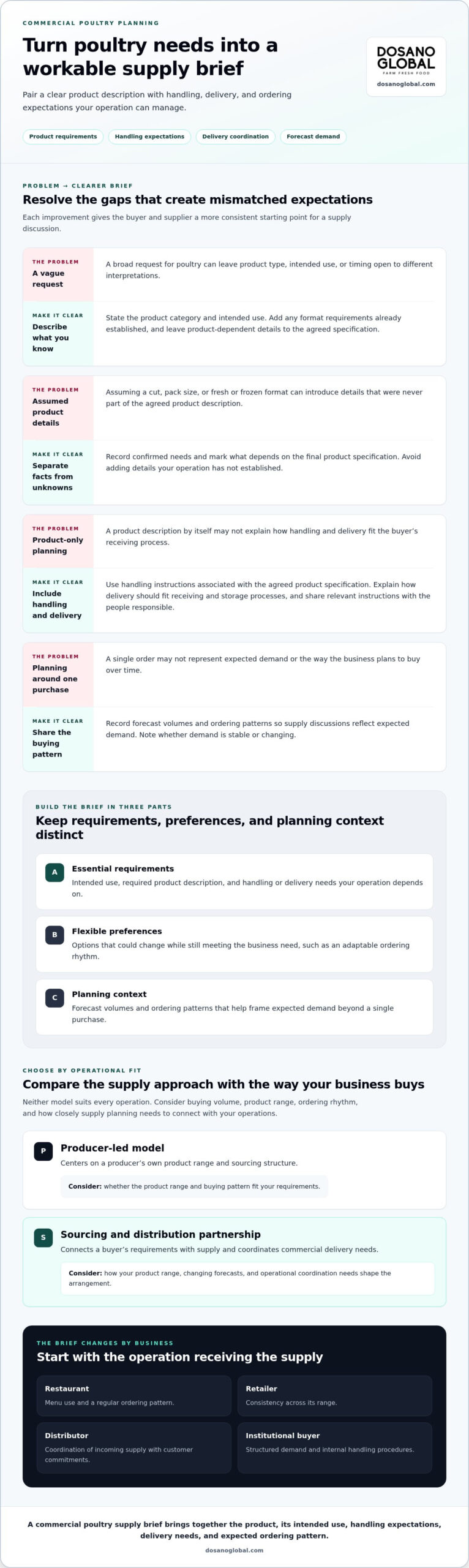
A concise brief gives everyone a shared starting point. State the intended use, the product description your business needs, and the expected ordering pattern. Add relevant handling requirements and explain how delivery should fit your receiving process. Be precise, but avoid adding technical details that don’t affect your use of the product.
- Essential requirements: intended use, required product description, and handling or delivery needs your operation depends on.
- Flexible preferences: options that could change while still meeting the business need, such as an adaptable ordering rhythm.
- Planning context: forecast volumes and ordering patterns, so supply discussions reflect expected demand rather than a single purchase.
A commercial poultry supply brief describes the product a business needs, its intended use, and the handling and delivery expectations for the supply arrangement. Separating essential requirements from preferences helps a sourcing partner shape a practical arrangement while keeping the standards your business relies on in view.
How poultry specifications, handling, and delivery shape supply
A useful specification turns a broad request for poultry into a shared description of what the buyer needs. It reduces the risk of differing assumptions about product type, intended use, or timing, and gives sourcing discussions a clear starting point. For a poultry supplier UAE businesses work with, a precise buyer’s brief also helps connect ordering, delivery, and receiving requirements.
A poultry supply specification is a written description of the product a business requires, its intended use, and the handling and delivery expectations that shape supply. Make it detailed enough to guide sourcing, while leaving product-dependent details to the final agreed specification. This allows buyers to communicate requirements without guessing at product features or storage conditions.
Describe the poultry product your operation needs
Start with the product category and intended use. Explain how the poultry fits your business, whether for food service, a retail range, or distribution. Then record any format requirements your operation has already established. Clear wording matters: a vague request can be interpreted in different ways, while an agreed description gives both parties a consistent reference.
Separate confirmed needs from details that depend on the final product specification. You may know the intended use and ordering pattern but still need product-specific information for internal planning. Don’t assume a particular cut, pack size, or fresh or frozen format unless it is part of the agreed product description. This keeps the brief accurate and lets a sourcing partner tailor supply to commercial standards.
- State the purpose: explain how the product will be used or supplied within your business.
- Describe what is established: include the category and any confirmed format requirements.
- Mark product-dependent details: leave specifics to the agreed product description instead of relying on assumptions.
Align handling expectations with delivery cadence
Product description is only one part of the brief. Storage and handling instructions vary by product, so don’t apply general shelf-life or storage assumptions to all poultry. Use the instructions associated with the agreed product specification and share them with the people responsible for receiving and storing supply. That keeps operational planning grounded in the product’s actual requirements.
Discuss delivery cadence at the same time. The receiving team needs to plan for arrivals, and the buyer needs to align ordering frequency with demand, storage capacity, and the business schedule. A delivery pattern that doesn’t fit receiving operations can create avoidable pressure, even when the product meets the brief. Describe your preferred frequency, receiving windows, and practical constraints as part of the commercial requirements.
Bring the product description, handling instructions, and delivery expectations together in one record before finalizing a supply plan. Dosano Global tailors poultry sourcing to client commercial standards and delivery requirements, connecting a buyer’s brief with a suitable supply arrangement. Businesses can outline their requirements through Dosano Global’s poultry supply partnership.
How to compare poultry suppliers in the UAE by operational fit
Start with your operating needs, not a league table. One business may need a defined catalogue, while another may need sourcing tailored to its commercial standards and delivery requirements. The right poultry supplier UAE businesses choose depends on this fit: how product requirements are handled, how deliveries are coordinated, and how clearly supply discussions are managed.
Compare supply models against your operating needs
Producer-led supply connects purchasing to a producer’s own range. A catalogue-led model can suit buyers whose needs match listed products and established ordering choices. A sourcing and distribution partnership may be more relevant when a buyer needs specific requirements considered as part of a broader commercial supply discussion. Neither model is automatically better. The decision depends on product scope, purchasing pattern, and the level of coordination your business needs.
Use the comparison below to identify what matters most for your operation. It describes typical model differences, not a ranking of individual businesses.
| Comparison area | Producer-led or catalogue-led purchasing | Sourcing and distribution partnership |
|---|---|---|
| Product fit | Works well when listed products align with the buyer’s defined requirements. | Focuses discussion on matching sourcing to the buyer’s commercial brief. |
| Commercial tailoring | Purchasing follows the available range and its established descriptions. | Supply discussions can be shaped around client standards and business requirements. |
| Delivery coordination | Buyers plan around the purchasing and delivery arrangements attached to the offer. | Delivery requirements form part of the wider supply conversation. |
| Communication | Often centers on selecting and ordering listed items. | Supports ongoing discussion about sourcing needs and supply coordination. |
Use a practical supplier-fit scorecard
Assess each model against the same criteria. Record each result as “strong fit,” “partial fit,” or “not aligned,” and add a note explaining the rating. A scorecard helps teams compare options, but it doesn’t prove product quality or regulatory compliance.
- Product alignment: Does the supply model match the product requirements your operation has defined?
- Requirement flexibility: Can the commercial discussion reflect your standards and purchasing needs?
- Delivery coordination: Do the arrangements fit your receiving capacity and operating schedule?
- Trade communication: Are requirements, changes, and next steps discussed clearly?
Use the results to identify the arrangement that supports your actual purchasing pattern, rather than relying on a generic ranking. Dosano Global is a commercial meat and poultry sourcing and supply partner, tailoring sourcing to client standards and delivery requirements. For planning across meat categories, read this meat supplier buyer’s guide alongside your poultry assessment. For a practical framework to compare poultry suppliers and assess commercial fit, see this guide.
Plan a poultry supply arrangement around your business requirements
A useful supply plan connects expected demand with the product brief and the realities of receiving supply. Before approaching a poultry supplier UAE businesses can work with, document how your operation uses poultry, how demand changes, and what your team can receive and store. This gives the commercial discussion a clear foundation without assuming a particular order size or schedule.
Prepare a concise commercial poultry brief
Focus the brief on what your business needs and how it operates. Distinguish essential requirements from flexible preferences so sourcing can be tailored without losing sight of your standards. Record demand as a forecast, not as an assumed minimum quantity.
- Define the business need. Note your business type and intended use, such as food service, retail, distribution, or institutional supply.
- Describe the product. Write down the poultry category and any product details your operation has established. Keep product-dependent details separate until the final specification is agreed.
- Map expected demand. Document forecast volumes, likely changes in demand, and ordering patterns. Include seasonal or business-cycle shifts if they affect your planning.
- Rank requirements. Mark product and service expectations as essential or flexible. This shows where the brief needs close alignment and where options may be considered.
- Set the ordering rhythm. Describe your preferred frequency and how much notice your team needs to plan purchasing and receiving.
This process turns internal purchasing knowledge into a concise commercial brief. Compare the plan with actual ordering patterns over time, then refine forecasts as demand changes. For a detailed checklist covering order volumes, specifications, supplier terms, and delivery plans, see this guide to bulk poultry procurement in the UAE.
Coordinate delivery expectations and receiving operations
Delivery planning should reflect your team’s capacity, not just a requested arrival time. Consider when staff are available to receive goods, how deliveries fit with other operational demands, and whether storage arrangements are ready when supply arrives. Set out practical receiving windows and constraints so the proposed cadence can work with your schedule.
Base storage and handling plans on the agreed product-specific instructions. Avoid using generalized shelf-life or storage assumptions in forecasts: operational teams need the details for the product they will receive. A practical plan connects expected order frequency with available storage and the time needed to inspect and put away incoming supply.
Dosano Global tailors poultry supply to client commercial standards and delivery requirements. Share your demand forecast, product brief, and receiving expectations to start a focused commercial discussion through Dosano Global’s poultry supply discussion. For wider purchasing planning across meat categories, use this meat procurement requirements guide as a related reference.
UAE import, food-safety, and documentation requirements can depend on the product and transaction. Verify current rules and required documents with relevant official sources before finalizing an import plan. Keep that compliance review distinct from the commercial supply brief.
Work with Dosano Global for tailored poultry supply in the UAE
Commercial poultry sourcing works best when the buyer’s requirements lead the discussion. Dosano Global sources and supplies meat and poultry for commercial clients in the UAE and international markets, aligning sourcing with client commercial standards and delivery requirements. For businesses seeking a poultry supplier UAE partner, the starting point is the operation’s actual needs, not an assumption that one purchasing arrangement suits every buyer.
A clear business brief gives the supply conversation direction. Restaurants, retailers, distributors, and institutional buyers use poultry differently and plan orders in different ways. Sharing the context behind your requirement helps focus discussion on product needs, operating expectations, and delivery coordination.
What a commercial conversation can cover
Start with your business type, intended use, and the poultry requirements your team has defined. Explain which standards matter to your operation and how delivery needs fit your receiving arrangements. These details help Dosano Global tailor sourcing to your commercial requirements rather than treating every buyer’s brief as identical.
Share essential points first, then outline preferences that allow flexibility. This separates core business needs from details that can be shaped as the supply arrangement develops.
- Business context: the type of commercial operation and how poultry supports it.
- Product needs: the product description and commercial standards relevant to your intended use.
- Supply expectations: the ordering pattern, receiving considerations, and delivery requirements that affect your operation.
Start a UAE poultry supply discussion
Dosano Global sources and distributes poultry for commercial clients, connecting buyer requirements with tailored supply discussions. Bring a clear brief that explains what your business needs and which delivery arrangements fit its operations. This gives the discussion a practical focus without assuming product details or supply terms in advance.
The same approach can support wider commercial meat sourcing. Keep product needs and operating requirements together so your business can communicate its expectations clearly from the outset.
To outline your commercial poultry requirements, visit Dosano Global’s poultry supply page.
Set your next poultry supply decision in motion
Your next purchasing cycle is an opportunity to turn a clear brief into a stronger commercial relationship. Start with your business requirements, then shape the discussion around how poultry supply can support your plans as demand changes. For buyers assessing a poultry supplier UAE businesses can work with, direct communication helps establish shared priorities and clarify the commercial standards that matter.
Dosano Global works with commercial clients on meat and poultry sourcing and distribution, tailoring supply to client standards and delivery requirements. Its international trade partnerships support commercial supply discussions serving the UAE. Bring forward your product needs and operating context to discuss an arrangement suited to your business.
Discuss your commercial poultry supply requirements with Dosano Global.
Frequently Asked Questions
How do I choose a poultry supplier in the UAE for my business?
Choose a supplier based on how well its commercial supply approach fits your operation, not only on the products it presents. Consider whether your purchasing process suits a producer’s defined range or a sourcing partner that discusses specific business requirements. For example, a buyer coordinating supply across several outlets may need clear communication and planning alongside product suitability. Compare product fit, ordering patterns, delivery coordination, and communication against your day-to-day and longer-term needs.
What should a commercial poultry supply brief include?
Give the supplier enough context to understand the purpose of the purchase. Include your business type, intended use, required product description, forecast demand, and expected ordering pattern. Note any internal approval or receiving considerations that could affect purchasing. A catering business, for example, can explain how poultry is used across its service operation. Keep preferences separate from essential requirements so the discussion stays focused on what your business needs.
Can a poultry supplier tailor deliveries to business requirements?
Delivery arrangements can be discussed around a business’s requirements, with the agreed plan shaped by the commercial brief and operating needs. Explain how your receiving process works, when staff can accept deliveries, and what storage arrangements are available. These details help frame a practical discussion about delivery coordination. Don’t assume a specific frequency or arrival time until it forms part of the agreed arrangement.
What is the difference between a poultry farm and a poultry sourcing supplier?
A poultry farm is associated with raising birds and may sell products connected to its own production. A sourcing supplier works with commercial buyers to source and distribute poultry, shaping the supply discussion around their requirements. The models suit different purchasing approaches: a buyer whose needs fit a producer’s range may prefer a producer-led relationship, while a business seeking tailored commercial sourcing may choose a supply partner.
How can I compare poultry suppliers without focusing only on price?
Compare how well each supply model supports your operating needs. Assess product alignment, how requirements are handled, whether delivery coordination fits your operation, and how clearly business communication is managed. A simple internal scorecard can include examples behind each rating, such as whether ordering arrangements were explained clearly. This helps reveal operational fit, but it doesn’t certify product quality, food safety, or regulatory compliance.
What food-safety and import requirements apply to poultry supply in the UAE?
Requirements depend on the product and whether it is imported, so confirm current rules with relevant UAE authorities before arranging an import. Imported poultry requires halal certification from a body accredited by the Ministry of Industry and Advanced Technology. Import documentation may also include a veterinary health certificate and origin documents. Requirements can change, so use current official guidance for the specific transaction.
Does Dosano Global supply poultry to commercial buyers in the UAE?
Yes. Dosano Global sources and distributes meat and poultry for commercial clients in the UAE and international markets. Its sourcing discussions are tailored to client commercial standards and delivery requirements. Commercial buyers can share their business context and poultry requirements to start a focused discussion about a suitable supply arrangement.
[…] broader supplier-selection considerations, use the poultry supplier buyer’s guide alongside this order-level checklist. The guide supports supplier evaluation; the checklist turns […]
[…] For buyers comparing a poultry supplier Sharjah search, sourcing fit and supply coordination are useful points to assess. For a wider view of commercial procurement considerations, see the UAE poultry supplier buyer’s guide. […]