
 English
Meat Supplier UAE: A Commercial Buyer’s Guide to Reliable Supply
What makes a meat supplier UAE businesses can depend on more than a source of product? It is the ability to match the meat range and...

What makes a meat supplier UAE businesses can depend on more than a source of product? It is the ability to match the meat range and specifications to your operation, apply quality controls, and coordinate supply around your requirements. A product list alone cannot support continuity if the products or ordering arrangements do not fit the way your business works.
Consistent quality and dependable supply matter when meat is central to your menu or daily operations. Dosano Global sources and supplies fresh meat and poultry to commercial clients, with supply tailored to commercial standards and delivery requirements. Its meat range includes goat, sheep, beef, and offal, supported by international trade partnerships.
This guide explains how to assess product fit, quality practices, supply consistency, and delivery coordination when choosing a meat supplier in the UAE. It also outlines what information to prepare for a clear commercial supply discussion, so your requirements are understood from the outset and the relationship can be organized around your business needs. Businesses sourcing other fresh produce can also review this guide to choosing a fresh fruit supplier UAE commercial buyers can rely on.
Key Takeaways
- Understand what a commercial meat supplier does and how sourcing and supply differ from processing, retail, and freight forwarding.
- Match meat type and product specifications to the intended use, then use consistent descriptions for inquiries and repeat orders.
- Assess a meat supplier UAE businesses can rely on by evaluating product fit, repeatable quality controls, continuity, and communication.
- Set clear order and delivery expectations by sharing receiving requirements and communicating demand changes promptly.
- See how Dosano Global’s fresh meat and poultry supply connects tailored commercial standards, quality controls, and delivery coordination.
What a Meat Supplier in the UAE Does for Commercial Buyers
A commercial meat supplier sources and supplies meat to businesses according to their product, quality, and delivery requirements. The work involves matching suitable supply to an operation’s needs and coordinating the expectations that support ongoing orders. For a business searching for a meat supplier UAE, it helps to distinguish meat sourcing and supply from broader food distribution, which may cover multiple product categories.
Related activities serve different purposes. Food processing changes or prepares ingredients, retail sells products directly to consumers, and freight forwarding arranges transport for goods. A meat supplier’s role is to source and supply the meat and coordinate the commercial requirements around it. Domestic production is also part of the UAE’s wider supply landscape. The overview of Agriculture in the UAE provides context on local agriculture, including meat production.
Which businesses work with a commercial meat supplier?
The common factor is a recurring operational need, not a particular company size. A hospitality or food-service business may need products that suit its menu and purchasing schedule. An institutional kitchen serving people regularly may prioritize predictable specifications and coordinated deliveries. Requirements differ from one operation to another, so clear communication is essential to a useful supply relationship.
What belongs in a meat supply requirement?
Start with four points: product type, specification, expected consistency, and delivery expectations. The relevant details depend on how the meat will be used, what the operation requires, and how it purchases. A menu-led kitchen and an institutional kitchen may order different products or follow different purchasing rhythms, even when both buy meat regularly.
Use the same product descriptions in supply inquiries and repeat orders. This creates a shared reference for the requested product and makes it easier to discuss changes without ambiguity. Dosano Global sources and supplies fresh meat and poultry to commercial clients, tailoring supply to client standards and delivery requirements, with quality controls as part of its fresh commodity approach.
Keep the initial requirement concise but specific. Name the product category, state the specifications that matter to your operation, describe the consistency you expect across orders, and explain how delivery needs to fit your receiving process. This gives a commercial discussion a clear starting point, with more detailed procurement planning to follow as needed. For a practical checklist, see fresh meat procurement requirements, including how to clarify product specifications, quality criteria, documentation, and receiving arrangements.
Match Meat Products and Specifications to Your UAE Business
Begin with what the product needs to do in your operation. Menu use, preparation methods, and purchasing patterns all influence what a business should request. A kitchen planning dishes around fresh meat may need a different specification from an operation purchasing poultry for a broader food-service programme. State the intended use first, then describe the product and the requirements that matter to your business.
How should a business describe the meat it needs?
Use clear, repeatable language instead of a general request for “meat.” Identify the product category, intended use, and essential specifications. Where relevant, state the required presentation or pack format as part of your request. Use consistent units, such as kilograms, and repeat the same terms in inquiries, order discussions, and follow-up requests. A shared description helps everyone understand what the order is intended to meet.
Describe meat and poultry separately because they can have different menu roles and preparation needs. If your requirement includes more than one type, avoid grouping them under a broad description. Dosano Global supplies fresh meat and poultry to commercial clients, tailoring supply to client standards and delivery requirements.
How do supply needs differ across business operations?
A menu-driven operation may plan purchases around the ingredients required for particular dishes. An institutional or broader food-service operation may coordinate purchasing across several parts of its service. In either case, a change in demand can affect order planning and the product specifications the operation needs. Share expected changes early and keep product descriptions stable, so supply discussions have a consistent basis. More detailed volume calculations can be handled as part of procurement planning.
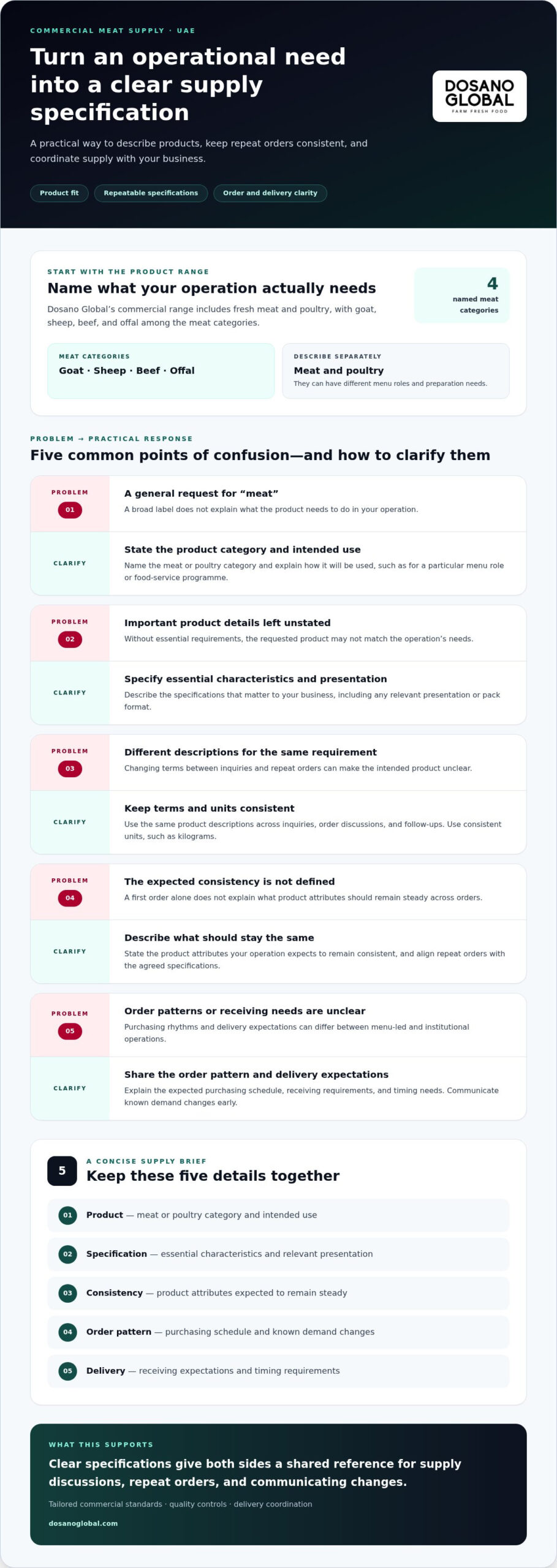
Before discussing supply with a meat supplier UAE businesses should align on a concise set of details:
- Product: Meat or poultry category and intended use.
- Specification: Essential characteristics and any relevant presentation requirements.
- Consistency: Product attributes that should remain steady across orders.
- Order pattern: Expected purchasing schedule and known changes in demand.
- Delivery: Receiving expectations and timing requirements for the operation.
Clear specifications give both sides a practical starting point and make changes easier to communicate. For an overview of Dosano Global’s commercial meat supply, visit Dosano Global’s meat supply.
Assess Meat Quality and Supply Consistency Before You Commit
A promising first order is only one part of a dependable supply relationship. Consistency depends on aligning repeat orders with agreed specifications, communicating changes early, and keeping quality practices clear over time. Look for explanations of how sourcing and quality controls support supply, rather than relying on broad assurances alone.
Supplier-level checks assess the systems and communication behind supply; product-level quality assurance assesses whether the meat received meets the agreed requirements. Both matter. A well-organized supply process supports consistency, while each delivery still needs to match the product specification agreed with your business.
| Assessment area | What to evaluate | Why it matters |
|---|---|---|
| Product fit | Does the supplied meat or poultry match the category and specifications agreed for your operation? | A clear fit helps the product serve its intended menu or operational use. |
| Quality controls | Are quality-control practices explained clearly and applied consistently? | Repeatable processes give quality claims a practical basis. |
| Continuity | Can the supplier discuss ongoing requirements and communicate changes that may affect supply? | Regular coordination helps your team plan without assuming uninterrupted availability. |
| Communication | Are product descriptions, order details, and updates clear and consistent? | Shared information reduces avoidable misunderstandings between orders. |
What does dependable meat supply look like?
Dependable supply means repeat orders are aligned with agreed product requirements and changes are communicated clearly. It does not mean every order will be identical or availability can never change. A commercial buyer and a meat supplier UAE businesses work with both need ongoing coordination: stable specifications, clear order details, and timely notice when demand or requirements shift.
How should buyers think about quality controls and documentation?
Consider how quality controls relate to the product and supply process, and whether relevant records support a clear, traceable discussion. Appropriate documentation can depend on the product and supply circumstances. UAE food-safety, import, and documentation requirements may also vary, so verify current rules with the relevant authorities for your situation. This is a practical assessment framework, not legal advice or a complete compliance checklist.
Dosano Global includes quality controls in its fresh commodity supply approach and tailors meat and poultry supply to commercial standards and delivery requirements. Evaluate these practices alongside product fit, continuity, and communication to form a broader view of the supply relationship, rather than judging it on a single order.
Coordinate Meat Sourcing, Orders, and Delivery Requirements
Clear coordination turns a product requirement into an order your business can plan around. The buyer explains the operational need, and the supplier aligns sourcing and supply with the stated standards and delivery expectations. For a meat supplier UAE businesses can work with effectively, the discussion should establish shared expectations without assuming fixed availability or delivery timing.
What information helps start a supply discussion?
Start with the product category and essential specifications, then explain the standards your business needs the supply to meet. Describe expected demand, receiving arrangements, and any delivery constraints that affect your operation. If demand may change because of menu shifts, service periods, or other known factors, mention them early. A concise overview gives the supplier a practical basis for discussing your requirements.
A simple sequence keeps the conversation organized:
- Share the requirement: Describe the meat or poultry needed, its intended use, and key standards.
- Explain the pattern: Outline expected ordering needs and known changes in demand.
- Align expectations: Discuss order details, receiving requirements, and delivery coordination.
- Keep communication active: Share updates and feedback as the supply relationship develops.
Keep the information concise and consistent. You do not need an exhaustive procurement file to begin a supply discussion. More detailed planning, such as organizing requirements for purchasing decisions, can be developed through a practical meat sourcing and procurement plan for UAE businesses.
How can buyers support dependable repeat orders?
Use the same product descriptions and units each time you place or discuss an order. If expected demand changes, communicate the update promptly so expectations can be realigned. Receiving details matter too: clarify the appropriate delivery window and any site-specific instructions that affect acceptance. These steps support coordination, but they do not guarantee inventory, frequency, or fulfilment outcomes.
Feedback after an order can make future discussions more precise. Note whether the product matched the agreed specifications and whether the order and receiving arrangements worked for your operation. Timely, specific feedback creates a useful reference for repeat supply and helps address misunderstandings before they carry into the next order.
Dosano Global tailors fresh meat and poultry supply to commercial standards and delivery requirements, with quality controls as part of its supply approach. Read about Dosano Global’s meat supply and how it serves commercial requirements.
Work with Dosano Global for Meat Supply Across the UAE
Commercial meat supply works best when product requirements, quality expectations, and delivery coordination are treated as connected parts of the relationship. Dosano Global sources and supplies fresh meat and poultry to commercial clients in the UAE and international markets, tailoring supply to client standards and delivery requirements. Its international trade partnerships support this sourcing and supply role.
How Dosano Global approaches commercial meat supply
Dosano Global connects commercial requirements with meat and poultry sourcing and distribution. The process starts with understanding the products and standards that matter to a client’s operation, then aligning supply and delivery expectations with those requirements. Quality controls form part of the company’s fresh commodity supply approach, giving buyers a practical point to include in a wider assessment of product fit and communication.
For businesses evaluating a meat supplier UAE operations can work with, the important question is how supply connects to the way products will be received and used. Clear requirements frame the discussion, while consistent communication gives both parties a shared reference as needs evolve. Dosano Global focuses on commercial supply, supported by international trade partnerships.
What are the next steps for a supply discussion?
Prepare a concise overview of your business requirements. Include the meat or poultry category, the standards relevant to your operation, your expected demand pattern, and the delivery requirements that shape receiving. If you anticipate changes in purchasing needs, describe them clearly. This gives the discussion a useful starting point without requiring a lengthy procurement plan.
As the conversation develops, keep product descriptions and expectations consistent. Share relevant updates and clarify how your operation receives supply. This helps align sourcing, order discussions, and delivery requirements with the commercial need, without making assumptions about fixed availability or delivery schedules.
Dosano Global brings together fresh meat and poultry sourcing, quality controls, and delivery coordination for commercial supply requirements across the UAE. Explore Dosano Global’s commercial meat supply to understand how its supply approach can align with your business requirements.
Build a More Dependable Meat Supply Partnership
A reliable supply relationship starts with clear product specifications and a shared understanding of your operation’s needs. Match meat and poultry to their intended use, keep requirements consistent across orders, and communicate changes in demand and receiving expectations promptly. These steps help turn a search for a meat supplier UAE businesses can rely on into a focused commercial discussion.
Quality and continuity depend on more than a single order. Consider whether quality-control practices are clear and repeatable, and whether communication keeps requirements aligned over time. Dosano Global sources and distributes fresh meat and poultry to commercial clients, tailoring supply to client standards and delivery requirements. Quality controls form part of its fresh commodity supply approach.
Bring your product requirements, operating standards, expected demand, and delivery needs into the conversation. Discuss your commercial meat supply requirements with Dosano Global to take the next step toward a supply relationship shaped around your business.
Frequently Asked Questions
What does a meat supplier in the UAE provide?
A commercial meat supplier sources and supplies meat according to a business’s requirements. The relationship can involve aligning product specifications, quality expectations, order needs, and delivery requirements. Explain the intended use and operational needs so both sides have a clear understanding. When comparing a meat supplier UAE businesses can work with, focus on this practical fit. The supply arrangement is shaped by the requirements agreed between buyer and supplier.
How can a business assess a meat supplier’s reliability?
Assess whether the supplier understands your product specifications, explains its quality-control approach, and communicates clearly about orders and delivery requirements. Reliability also depends on consistent information and timely updates when your business needs change. Consider the overall relationship rather than relying on a broad claim or a single interaction. If documentation applies to your supply, verify current UAE requirements with authoritative sources for your product and circumstances.
What information should I provide when contacting a meat supplier?
Share the meat or poultry category, intended business use, important product specifications, expected demand pattern, and delivery requirements. Explain the standards your operation must follow, and distinguish essential details from preferences that may be flexible. Clear information helps the supplier understand the request and discuss a suitable supply approach. Avoid broad descriptions when repeat orders need to match closely. Consistent terms and units make the request easier to interpret.
How can a business maintain consistent meat supply?
Use clear, repeatable product specifications and communicate expected demand as accurately as possible. Keep order details consistent, share changes early, and provide feedback when requirements shift. These habits support coordination between your business and supplier, especially across repeat orders. They cannot guarantee product availability or a particular delivery schedule. Agree on expectations for your supply arrangement and keep communication active as business needs evolve.
What documents may be relevant when sourcing meat in the UAE?
Relevant documentation depends on the product, its origin, and the circumstances of the supply. Identify the documents that apply to your transaction and verify current UAE requirements with authoritative sources before placing orders. Do not assume one document list applies to every meat product or arrangement. A supplier’s quality-control information can also help you understand its supply practices, but it is not a substitute for transaction-specific documentation.
Can one supplier support both meat and poultry requirements?
Yes. Dosano Global sources and supplies both meat and poultry to commercial clients. Describe each category separately because product specifications, expected demand, and delivery coordination may differ. Discussing both requirements together can give a clearer picture of your operation’s needs and how supply should align with them. Keep the product details distinct, especially when the categories serve different menus or purchasing schedules.
How much meat should a business order from its supplier?
There is no single order quantity that suits every business. The requirement depends on how the product is used, customer demand, storage capacity, purchasing cycle, and anticipated changes. Review past usage and likely demand to develop a practical estimate, then communicate it clearly to your supplier. Update forecasts as conditions change and agree on order expectations directly. Procurement calculations should reflect your operation rather than rely on a general quantity recommendation.
[…] a broader procurement perspective across food categories, read the meat supply buyer’s guide. You can also discuss commercial fruit requirements with Dosano […]