
 English

Bulk Poultry Procurement in the UAE: A Practical Buyer Checklist
The lowest quote isn’t always the order that best serves your business. For bulk poultry procurement UAE buyers need to align product specifications,...

The lowest quote isn’t always the order that best serves your business. For bulk poultry procurement UAE buyers need to align product specifications, order volumes, supplier terms, and delivery plans rather than compare prices in isolation. If specifications are unclear, offers are difficult to assess. If forecasts miss demand, the result can be excess stock or a shortage. And a delivery plan only works if it fits your receiving schedule and storage capacity.
A clear checklist brings these decisions together. This guide shows you how to prepare a consistent poultry purchasing specification, compare supplier proposals using the same commercial criteria, and plan order volumes and delivery cadence around business demand. It also covers the practical details to organise before placing an order, so your purchasing team can make decisions with greater clarity.
Dosano Global sources and supplies fresh poultry for commercial clients, tailoring supply to commercial standards and delivery requirements, with quality controls as part of its approach. Use the steps ahead to build a more dependable procurement plan for your UAE operation.
Key Takeaways
- Start bulk poultry procurement UAE with a demand forecast shaped by sales, menus, customer needs, and operating schedules.
- Record the product form, cut, pack format, and intended use so supplier proposals can be compared against the same requirements.
- Assess proposals against specification fit, documentation, delivery terms, and communication, not headline claims alone.
- Confirm order details in advance and prepare receiving arrangements that fit your storage capacity.
- Use a completed checklist to align your commercial poultry requirements with Dosano Global’s tailored sourcing and supply approach.
Bulk poultry procurement in the UAE starts with a clear demand plan
Reliable bulk supply starts before you send out a request for proposals. Without a clear picture of what the business will use and when, buyers risk ordering too much, running short, or receiving stock when their teams and storage facilities aren’t ready. A demand plan gives suppliers a consistent basis for discussing specifications, quantities, and delivery arrangements.
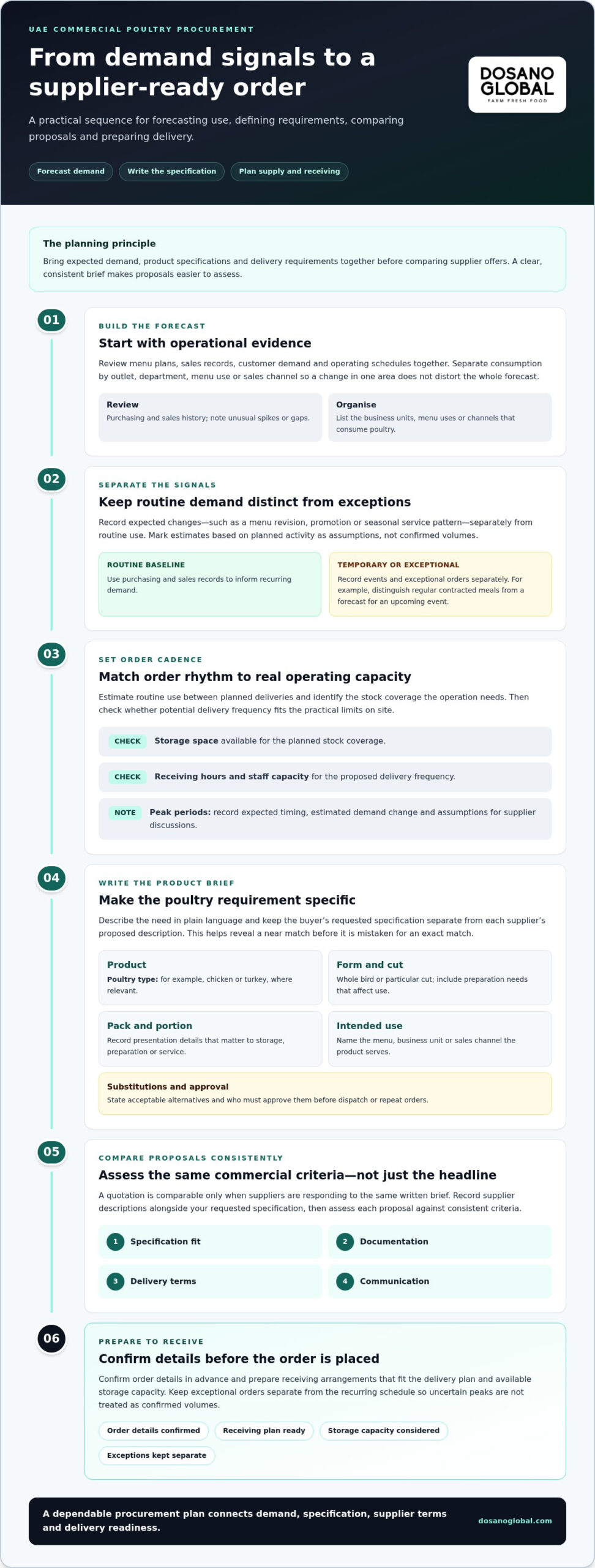
Build the forecast from operational evidence rather than a single headline estimate. Review menu plans, sales records, customer demand, and operating schedules together. A change in service hours or a planned promotion may affect expected use. Record a temporary event or exceptional order separately from routine demand.
A procurement plan combines expected demand, product specifications, and delivery requirements into a practical basis for ordering. This is especially useful in the UAE, where businesses balance their own operating patterns with a supply environment shaped by both local poultry farming and imports. The overview of Agriculture in the United Arab Emirates provides wider context for that food-supply picture.
Build a working poultry demand forecast
Start by identifying where poultry is used across the business. Separate demand by outlet, department, menu use, or sales channel so a change in one area doesn’t distort the whole forecast. Compare planned demand with purchasing and sales records where available. Treat forward estimates as planning assumptions, not guaranteed volumes.
- List the business units, menu uses, or sales channels that consume poultry.
- Review purchasing and sales history over a relevant period, noting unusual spikes or gaps.
- Record expected changes, such as a menu revision, promotion, or seasonal service pattern, separately from routine demand.
- Mark assumptions clearly, including estimates based on planned activity rather than confirmed customer orders.
For example, a catering operation might separate regular contracted meals from a forecast for an upcoming event. That distinction helps the buyer discuss a baseline requirement and a potential increase without presenting both as fixed demand.
Set order cadence around operations
Forecasting a total requirement is only part of the decision. The practical order size and frequency must also fit the business’s storage capacity, preparation workflow, and ability to receive deliveries. Map the stock coverage the operation needs against these limits, then compare that plan with the pace of poultry use.
- Estimate routine use between planned deliveries and identify the stock coverage the operation needs.
- Match potential delivery frequency to available storage space, receiving hours, and staff capacity.
- Identify peak periods early, then record their expected timing, estimated demand change, and assumptions for supplier discussions.
Keep exceptional orders separate from the recurring schedule. This gives suppliers a clearer view of expected demand and helps your team plan receiving and storage without treating uncertain peaks as confirmed volumes.
Specify bulk poultry requirements before comparing UAE suppliers
A quotation is only comparable when each supplier is responding to the same written brief. Descriptions such as “premium chicken” or “bulk pack” may sound clear but leave important details open to interpretation. For bulk poultry procurement UAE businesses should define their needs first, then record supplier descriptions separately. This makes differences visible before a proposal becomes an order.
Use the checklist below to prepare your specification. Include the details that matter to the intended use, especially those that affect preparation, portioning, storage, or receiving. If a requirement can vary, state the acceptable range or approval process rather than assuming every supplier uses the same terms.
Record the product and presentation requirements
Start with the poultry type and how the business will use it. A menu item, catering use, or resale may call for different cuts and handling at the operation level. Describe the requirement in plain language, then ask suppliers to state the corresponding product description. Don’t treat supplier terminology as a substitute for your own specification.
- Poultry type: Name the required type, such as chicken or turkey, where relevant to the operation.
- Product form and cut: State whether you need a whole bird or a particular cut, and describe preparation needs that affect use.
- Pack and portion format: Record pack format, portion size, or other presentation details where they matter to storage, preparation, or service.
- Intended use: Note the menu, business unit, or sales channel the product serves to give the requirement an operational context.
- Acceptable alternatives: Identify any substitutions the business may accept and specify who must approve them before dispatch or repeat orders.
Keep the buyer’s requested specification in one column and the supplier’s proposed description in another. This prevents a near match from being mistaken for an exact match and gives receiving staff a reference for checking the order.
Define quality, documentation, and acceptance criteria
Turn general expectations into clear acceptance criteria. For example, state the required product description, packaging condition, and any buyer-defined limits or checks receiving staff can apply consistently. Avoid relying on terms such as “good quality” alone. Record the evidence or documentation your business needs, and distinguish internal purchasing requirements from documents required under applicable UAE rules.
Import and food requirements can change, so verify current rules for the product and transaction before finalising the specification. The U.S. Department of Commerce’s UAE Import Requirements and Documentation provides a reference point, but buyers should validate current requirements with the relevant UAE authorities. Don’t assume a document or certification applies to every product or supplier.
A consistent brief supports clearer proposals and repeat orders. Dosano Global tailors fresh poultry supply to commercial standards and delivery requirements, with quality controls as part of its approach. Once your requirements are documented, discuss commercial poultry supply against that brief.
Compare bulk poultry proposals using consistent commercial criteria
Once your requirements are written down, use the same scorecard for every proposal. A confident headline or broad quality claim won’t show whether an offer matches your product needs, documentation expectations, or receiving arrangements. Compare the details line by line, and record gaps instead of filling them with assumptions.
Comparable specifications make supplier proposals more meaningful because they show which differences are real, rather than the result of different descriptions. This buyer-led method helps bulk poultry procurement UAE businesses assess offers on a like-for-like basis, without relying on time-sensitive supplier rankings.
| Criterion | What to compare | Record clearly |
|---|---|---|
| Specification match | Product type, form, cut, preparation, pack details, and acceptance criteria against your written brief. | Exact match, difference, or unresolved detail. |
| Documentation | Documents provided against buyer requirements and applicable UAE requirements. | Document name, status, and any outstanding item. |
| Delivery terms | Proposed delivery window, order process, and handling of changes or substitutions. | Confirmed terms and any operational mismatch. |
| Communication | How order updates, exceptions, and approvals are managed. | Named process or point still to resolve. |
Assess product fit and supporting documentation
Check each offer against the requested product form and acceptance criteria, not just its general description. If a proposal offers an alternative cut or pack format, record it as a variation and assess it separately. Then compare the documents supplied with the requirements in your brief. Treat certification, traceability, and quality-control statements as claims to evaluate against relevant evidence, not automatic guarantees.
Compare delivery terms and supply communication
A product match still needs an operationally workable delivery arrangement. Compare proposed delivery windows with your receiving hours, staff capacity, and storage plan. Note how the order is placed, how changes are communicated, and whether substitutions require approval. If a proposal leaves these points open, record them as unresolved rather than accepted terms.
Use three labels in your comparison: confirmed for details stated in the proposal, variation for differences from your brief, and open for items that still need resolution. For example, if the specification matches but the delivery window isn’t stated, mark product fit as confirmed and delivery timing as open. This prevents an assumption in one area from making the entire offer appear complete.
Apply the same rating method to each criterion, such as “matches,” “partly matches,” or “does not match,” and add a short note explaining the result. Keep commercial terms in a separate column so they don’t obscure specification or delivery gaps. The completed comparison gives your team a clear record of trade-offs and a stronger basis for choosing an arrangement that fits the operation.
Use this UAE bulk poultry checklist to prepare orders and deliveries
A completed specification and supplier comparison become useful when they guide each order from approval through receipt. Set up a simple process with three stages: prepare before ordering, confirm the order in writing, and check the delivery against the agreed details. This keeps purchasing, operations, and receiving teams aligned, especially when an order changes or a repeat delivery is due.
Before ordering: prepare the details
Use this checklist as a working template for your commercial operation. Assign an owner to each step and adapt the fields to your purchasing and receiving procedures.
- Demand and stock: Confirm the planned requirement against current stock, expected use, and available storage capacity.
- Product specification: Refer to the agreed poultry type, form, cut, presentation, and acceptance criteria.
- Quantity and timing: Set the requested quantity and suitable delivery window based on the operation’s needs.
- Receiving readiness: Confirm that a responsible team member, receiving space, and required checks are in place.
- Documentation: Identify the order records and any buyer-required documents that should accompany or relate to the delivery.
For broader supplier-selection considerations, use the poultry supplier buyer’s guide alongside this order-level checklist. The guide supports supplier evaluation; the checklist turns your chosen requirements into a practical routine.
Confirm each order against the agreed specification
Before treating an order as final, record the requested product, agreed quantity, and delivery timing in the same order record. Include any approved substitution and who authorised it. If a change arises, communicate it to the relevant parties before dispatch and update the record so purchasing and receiving teams work from the same information.
Use a consistent format for repeat orders. A clear record helps the team identify what was agreed, compare the delivery with the order, and resolve discrepancies through the business’s established process. In bulk poultry procurement UAE operations, this discipline supports continuity without assuming every order will be identical.
Prepare receiving and storage procedures
Assign responsibility for receiving checks before the delivery arrives. Make sure the person receiving the order has access to the order details and knows how to record documents, quantities, and any discrepancy. Follow the applicable handling and storage requirements for the products received, using the business’s established procedures rather than assumptions.
If a delivery differs from the order, record the difference promptly and follow the agreed resolution process. Keep the order record, receiving notes, and related communication together. This creates a useful history for future purchasing decisions and helps teams distinguish a one-off exception from a recurring issue.
To align fresh poultry sourcing with your commercial standards and delivery requirements, discuss your poultry supply requirements with Dosano Global.
Build a dependable UAE poultry supply partnership with Dosano Global
A strong supply relationship starts with a clear understanding of the buyer’s operation. Dosano Global sources and supplies fresh poultry for commercial clients in the UAE, tailoring supply to commercial standards and delivery requirements. Its approach also includes quality controls. Your completed checklist gives the discussion a practical foundation by setting out what the business needs and how those requirements fit its purchasing and receiving processes.
For bulk poultry procurement UAE businesses can use this brief to move from general requirements to a focused commercial conversation. The aim is to align product needs, demand expectations, and delivery planning while keeping assumptions visible.
Turn the checklist into a clear supply brief
Bring the key decisions into one concise document. Summarise the poultry specifications and intended use, expected demand, preferred order cadence, and delivery requirements. Include business-specific acceptance standards and the documentation your team needs to manage purchasing and receipt. Separate fixed requirements from estimates or preferences so the discussion can focus on what matters most to your operation.
A well-organised brief connects the buyer’s requirements with a suitable sourcing and supply approach. It also gives both sides a shared reference for discussing changes, commercial expectations, and supply consistency without treating forecasts as guaranteed volumes.
- Product: State the poultry type, form, cut, presentation, and intended use relevant to the operation.
- Demand: Share expected requirements as estimates, distinguishing routine needs from exceptional peaks.
- Ordering: Outline preferred order cadence and operational considerations that affect timing.
- Delivery and receiving: Describe the receiving arrangements and delivery requirements that shape practical planning.
- Standards and records: Note acceptance criteria, business standards, and required documentation.
Take the next step with a tailored supply discussion
Use the brief to explain how poultry supports your business, which product requirements matter, and how your team plans orders and receives deliveries. Clear context makes the conversation more relevant than a general enquiry and gives both sides a practical starting point for discussing commercial requirements.
Dosano Global sources and supplies fresh poultry for commercial clients, tailoring supply to commercial standards and delivery requirements, with quality controls as part of its approach. If your wider purchasing brief includes other meat categories, the meat supplier buyer’s guide offers broader sourcing context.
Share your commercial poultry requirements with Dosano Global to begin a tailored supply discussion.
Put your next poultry order on a stronger footing
Your next procurement cycle is an opportunity to turn a written plan into a more coordinated working relationship. Use your completed checklist to start a focused discussion about the requirements that matter to your operation, including how purchasing decisions connect with receiving and storage. This helps keep expectations clear as business needs shift.
For bulk poultry procurement UAE, a dependable approach relies on clear communication and practical alignment, not assumptions. Dosano Global works with commercial clients on fresh meat and poultry sourcing and supply, with quality controls included in its approach. Share the standards and delivery requirements your business has set to start a supply discussion shaped around your needs.
Discuss your commercial poultry supply requirements with Dosano Global and move forward with a clearer plan for your business.
Frequently Asked Questions
How do I plan bulk poultry orders for a UAE business?
Plan bulk poultry orders by connecting forecast demand with product needs, order timing, receiving capacity, and documentation. For bulk poultry procurement UAE businesses can start with purchasing and sales records, then note changes such as a revised menu or a planned event. Treat those figures as estimates, not fixed commitments. Record assumptions alongside the forecast, and revisit it when customer demand, operating schedules, or business plans change.
What should a bulk poultry purchase specification include?
A purchase specification should identify the poultry type, product form or cut, presentation, intended use, acceptance criteria, and relevant documentation. Include details that affect how your operation prepares, stores, or serves the product. For example, a portion requirement matters if it changes kitchen preparation. Keep buyer requirements separate from supplier descriptions, then use the same written specification for every proposal so differences are clear.
How can I compare bulk poultry supplier proposals in the UAE?
Compare each proposal against the same product specification, documentation needs, delivery terms, communication process, and substitution arrangements. Mark details as confirmed, different from your brief, or still open. A low headline offer alone doesn’t establish whether a proposal suits your operation; it may leave important product or delivery points unresolved. A short written comparison helps your team see trade-offs and decide what needs resolution before approving an order.
What documents should UAE buyers request when sourcing poultry in bulk?
The documents to request depend on the product, your business requirements, and the UAE rules currently applicable to the transaction. List your documentation needs in the purchasing brief, then verify relevant halal, food-safety, and import requirements through authoritative UAE sources before ordering. Avoid relying on an old checklist or assuming every document applies in the same way to every product. Keep the verified requirements with the order record for reference.
How often should a business order poultry in bulk?
There’s no universal ordering frequency. The right cadence depends on demand, storage capacity, receiving operations, and the agreed delivery arrangement. Use purchasing history to understand how quickly stock is used, then compare that pattern with forecast demand and the space available for incoming orders. Treat the working schedule as a planning tool, not a fixed rule, and review it after changes to menus, sales activity, or business operations.
What should I check when a bulk poultry delivery arrives?
Check the delivery against the order record, including the agreed product description, quantity, packaging, and accompanying documents. For example, compare the delivered presentation with the specification rather than relying only on a general product label. Staff responsible for receiving should follow the business’s applicable handling and storage procedures. Record any discrepancy promptly, note the details, and use the established process to resolve it before closing the order record.
Can a poultry supply arrangement be tailored to a business’s delivery requirements?
Yes. Commercial buyers can outline delivery needs, order cadence, poultry specifications, and operating constraints in a supply brief. Dosano Global sources and supplies fresh meat and poultry for commercial clients, tailoring supply to commercial standards and delivery requirements, with quality controls as part of its approach. Share the details that shape your operation so the supply discussion can focus on relevant requirements without assuming a particular volume, schedule, or outcome.